
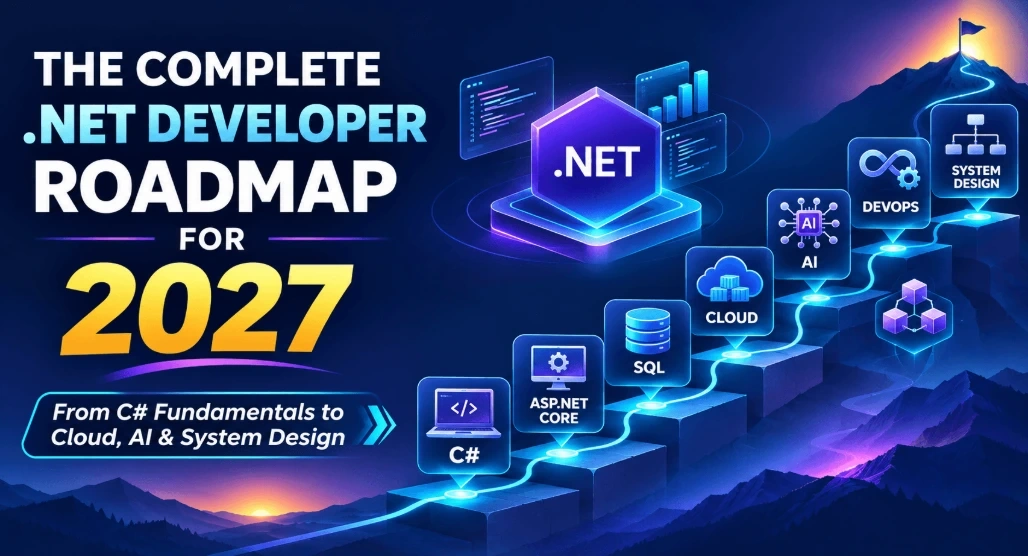
A Practical Guide to Becoming a Modern .NET Developer
The .NET ecosystem continues to evolve, and 2027 is an exciting time to build a career as a .NET developer. With modern C#, ASP.NET Core, cloud-native development, AI integration, and distributed systems becoming increasingly important, developers need more than just knowledge of programming languages and frameworks.
Whether you are a beginner starting your programming journey, an experienced developer looking to upgrade your skills, or someone preparing for senior .NET developer roles, having a structured learning roadmap can make a significant difference.
In 2027, becoming a successful .NET developer is not about learning every available framework or tool. It is about building strong fundamentals, understanding modern development practices, choosing the right specialization, and gaining practical experience by building real-world applications.
This roadmap covers the essential skills, technologies, tools, and learning paths required to become a job-ready .NET developer in 2027.
What Has Changed in the .NET Ecosystem for 2027?
The .NET ecosystem has moved beyond traditional enterprise application development.
Some important areas developers should focus on include:
.NET 11 and C# 15: Modern runtime improvements, language features, and developer productivity.
ASP.NET Core: Building high-performance REST APIs and modern web applications.
Entity Framework Core: Modern data access, database performance, and efficient querying.
AI Integration: Building intelligent applications using LLMs, embeddings, RAG, and AI agents.
Cloud-Native Development: Containers, microservices, orchestration, and cloud deployment.
.NET Aspire: Developing and observing distributed applications.
DevOps and CI/CD: Automating testing, building, and deployment.
System Design: Designing scalable, secure, and maintainable enterprise applications.
.NET Roadmap for 2027
The goal is to become a developer who can design, build, deploy, and maintain production-ready applications.
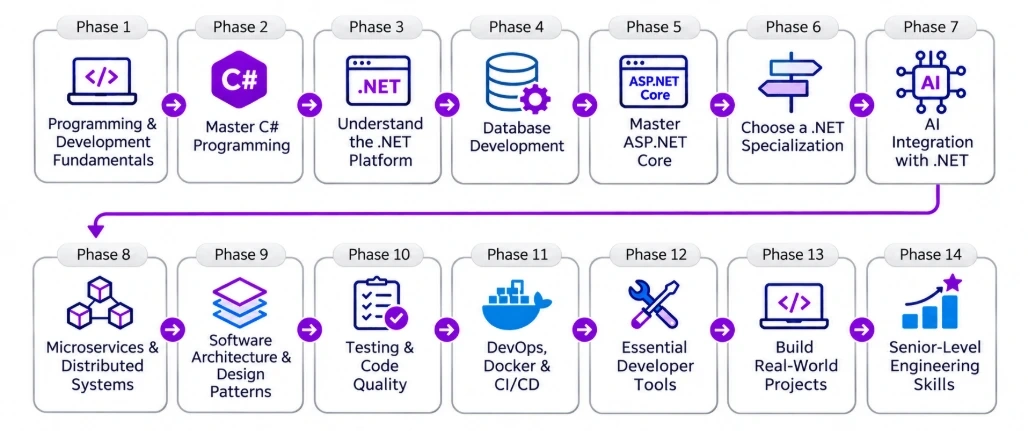
This roadmap is divided into 14 structured learning phases, covering everything from programming fundamentals and C# to advanced .NET development, AI integration, cloud-native architecture, and senior-level engineering skills. Each phase builds on the previous one, helping you follow a clear learning path, understand the technologies involved, and track your progress toward becoming a job-ready .NET developer.
Phase 1: Programming and Development Fundamentals
Before jumping into advanced .NET technologies, every developer should understand the fundamentals of software development.
These concepts remain important regardless of which programming language or framework you use.
1. Understand How the Web Works
Start by understanding the basic concepts behind web applications.
Learn:
Client-server architecture
HTTP and HTTPS
HTTP methods (GET, POST, PUT, PATCH, DELETE)
HTTP status codes
Request and response lifecycle
REST architecture
JSON and XML
Cookies and sessions
DNS and basic networking
Synchronous and asynchronous communication
You should understand what happens when a browser sends a request to a backend application and receives a response.
2. Learn Git and Version Control
Git is an essential skill for professional developers.
Learn:
Git fundamentals
GitHub or Azure DevOps repositories
Branching and merging
Pull requests
Merge conflicts
Commit best practices
Code reviews
Git workflows
You should be comfortable collaborating with other developers using Git.
3. Understand Software Development Principles
Learn the fundamentals of writing maintainable code.
Important concepts include:
Object-Oriented Programming (OOP)
SOLID principles
DRY (Don't Repeat Yourself)
KISS (Keep It Simple, Stupid)
Separation of Concerns
Dependency Injection
Clean Code
Basic design patterns
These concepts will become increasingly important as your applications grow.
Phase 2: Master C# Programming
C# is the foundation of the .NET ecosystem.
A strong understanding of C# will help you work with backend applications, APIs, desktop applications, cloud services, and AI-powered solutions.
1. C# Fundamentals
Start with:
Variables and data types
Operators and expressions
Conditional statements
Loops
Methods and parameters
Arrays and collections
Exception handling
Classes and objects
Constructors
Properties and fields
Interfaces and inheritance
Abstract classes
Access modifiers
Namespaces
Do not simply memorize syntax. Practice solving programming problems and writing small applications.
2. Intermediate and Advanced C#
Once you understand the basics, move toward advanced concepts.
Focus on:
Generics
Delegates
Events
Lambda expressions
LINQ
Extension methods
Nullable reference types
Records
Pattern matching
Asynchronous programming
async and await
Task and Task<T>
CancellationToken
IDisposable and IAsyncDisposable
Reflection
Attributes
Expression trees
Dependency Injection
3. Modern C# Features
Stay updated with modern C# language features.
For 2027, pay particular attention to C# 15, which ships with .NET 11.
Explore:
Union types
Closed hierarchies
Collection expression arguments
Extension indexers
Labeled break and continue
Memory safety improvements
Understand when these features improve readability, maintainability, and application design.
Recommended goal: Build a console-based inventory management application using OOP, LINQ, collections, exception handling, and asynchronous programming.
Phase 3: Understand the .NET Platform
After learning C#, understand how the .NET platform works internally.
1. .NET Fundamentals
Learn:
What is .NET?
.NET SDK and runtime
Common Language Runtime (CLR)
Garbage Collection
Managed and unmanaged code
JIT compilation
Native AOT
NuGet package management
Project and solution structure
Configuration management
Environment-specific settings
Logging and diagnostics
Understand the difference between .NET Framework and modern .NET.
2. Work with .NET CLI
Learn how to create, build, run, test, and publish applications using the command line.
Important commands:
dotnet new
dotnet restore
dotnet build
dotnet run
dotnet test
dotnet publish
dotnet add package
dotnet tool
You should be comfortable working with the CLI even when you primarily use Visual Studio or JetBrains Rider.
3. Understand the Latest .NET Versions
For 2027, understand the supported .NET releases.
.NET 10: Long Term Support (LTS).
.NET 11: Standard Term Support (STS), released in November 2026.
Both are important releases to understand. Choose the appropriate version based on project requirements and support policies.
Always use supported versions and keep applications updated with the latest security patches.
Phase 4: Learn Database Development
Almost every enterprise application requires database interaction.
A professional .NET developer should understand both relational databases and modern data access techniques.
1. SQL Fundamentals
Start with SQL Server or PostgreSQL.
Learn:
Database design
Tables and relationships
Primary and foreign keys
Constraints
SELECT, INSERT, UPDATE, DELETE
Joins
Subqueries
Views
Stored procedures
Functions
Indexes
Transactions
Normalization
Query optimization
Execution plans
SQL is an essential skill even when using an ORM.
2. Entity Framework Core
Entity Framework Core is one of the most important technologies in modern .NET development.
Learn:
DbContext
DbSet
Code First approach
Database First approach
Migrations
Relationships
Navigation properties
LINQ queries
Eager loading
Lazy loading
Explicit loading
Change tracking
No-tracking queries
Transactions
Raw SQL queries
Performance optimization
Explore the latest EF Core capabilities available with your target .NET version.
3. Other Data Access Technologies
Understand when to use different data access approaches.
Explore:
ADO.NET
Dapper
Entity Framework Core
Redis
MongoDB
You do not need to master every database technology. Focus on relational database development first and then expand based on project requirements.
Recommended project: Build an Employee Management System with SQL Server, EF Core, CRUD operations, relationships, pagination, sorting, and filtering.
Phase 5: Master ASP.NET Core
ASP.NET Core is the backbone of modern backend development in the .NET ecosystem.
If you want to become a backend or full-stack .NET developer, this is one of the most important phases.
1. ASP.NET Core Fundamentals
Learn:
ASP.NET Core architecture
Middleware pipeline
Routing
Controllers
Minimal APIs
Dependency Injection
Configuration
Environment management
Built-in logging
Model binding
Model validation
Filters
Exception handling
Static files
Hosting models
Understand how an incoming HTTP request travels through the ASP.NET Core middleware pipeline.
2. Build RESTful Web APIs
Learn how to develop production-ready Web APIs.
Important topics:
REST API principles
Controllers and Minimal APIs
HTTP methods and status codes
Request and response models
DTOs
API versioning
Pagination
Sorting and filtering
Global exception handling
Fluent validation or built-in validation
OpenAPI and Swagger
Rate limiting
CORS
API performance
Understand how to design APIs that are easy to consume and maintain.
3. Authentication and Authorization
Security is a critical part of backend development.
Learn:
Authentication vs. Authorization
ASP.NET Core Identity
JWT authentication
OAuth 2.0
OpenID Connect
Role-based authorization
Claims-based authorization
Policy-based authorization
Refresh tokens
Secure password storage
External identity providers
Microsoft Entra ID
Also understand common security vulnerabilities such as SQL injection, XSS, CSRF, and broken access control.
4. Real-Time Applications
Learn how to build real-time applications using SignalR.
Explore:
Hubs
Clients and server communication
Groups
Connection management
Authentication with SignalR
Real-time notifications
Chat applications
Recommended project: Build an ASP.NET Core Web API with JWT authentication, role-based authorization, EF Core, validation, logging, and centralized exception handling.
Phase 6: Choose Your .NET Development Specialization
Once you have a strong foundation in C#, .NET, databases, and ASP.NET Core, choose a specialization.
You do not need to master every technology in the .NET ecosystem.
Choose the direction that matches your career goals.
1. Backend .NET Developer
<Best suited for developers interested in APIs, databases, business logic, and enterprise systems.>
Focus on:
ASP.NET Core Web API
Entity Framework Core
SQL Server or PostgreSQL
Redis
Authentication and authorization
Background services
Hangfire or Quartz.NET
Message queues
RabbitMQ or Azure Service Bus
Microservices
Docker
Cloud deployment
Performance optimization
Backend developers should focus on application reliability, scalability, security, and maintainability.
2. Full-Stack .NET Developer
Full-stack developers build both backend and frontend applications.
For the frontend, choose one primary technology.
Option A: Angular
TypeScript
Components
Services
Dependency Injection
Routing
Reactive Forms
RxJS
HTTP Client
State management
Option B: React
JavaScript fundamentals
TypeScript
Components
Hooks
Props and state
React Router
API integration
State management
Option C: Blazor
Razor components
Component lifecycle
Data binding
Event handling
Routing
Forms and validation
State management
JavaScript interoperability
Blazor Server and WebAssembly
Static Server-Side Rendering
A full-stack developer should understand how the frontend communicates with backend APIs, handles authentication, and manages application state.
3. Cloud-Native .NET Developer
Cloud-native development is an important skill for modern enterprise applications.
Focus on:
Docker
Kubernetes fundamentals
Microservices
Distributed systems
Azure App Service
Azure Functions
Azure Container Apps
Azure SQL Database
Azure Storage
Azure Key Vault
Azure Service Bus
Application Insights
Infrastructure as Code
Join the conversation! Your thoughts help the community grow.