

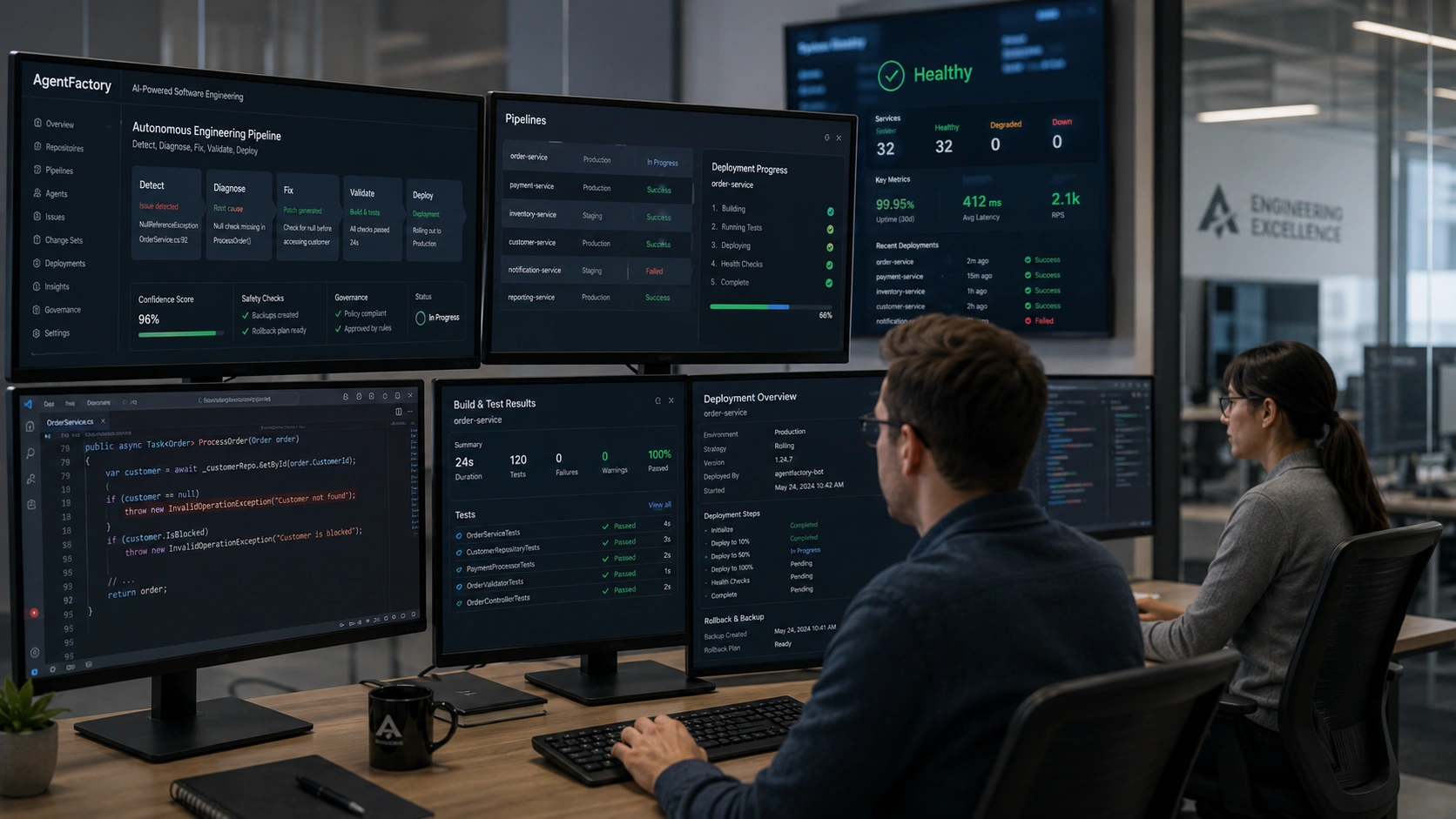
For decades, software engineering has been built around a familiar rhythm: humans discover problems, humans write code, humans send changes through a pipeline, and humans wait for build, test, deployment, and verification systems to confirm whether the change worked. Even as automation improved, the core structure stayed the same. The application remained separate from the engineering pipeline that maintained it. Yes, it is the first in the world so far.
Artificial intelligence has started to challenge that structure, but only partially. Most AI coding agents today can write code, suggest fixes, generate pull requests, explain errors, or assist developers inside existing workflows. That is valuable, but it is still fundamentally external. The agent acts like a contributor. The CI/CD platform remains the authority. The application remains passive. The system may help produce a patch, but it does not truly own its own improvement cycle.
AlpineGate AI's AgentFactory changes that model.
At AlpineGate AI, AgentFactory is being designed as a governed enterprise Digital Intelligence platform that does not merely orchestrate agents. It observes them, learns from their failures, generates new capabilities, and, in advanced mode, can internalize the build, test, publish, deployment, health-check, and rollback lifecycle. This is not just agent memory. This is not just DevOps automation. This is the beginning of autonomous engineering inside a governed enterprise platform.
The distinction matters. Most agents today “learn” through reflections. They save text notes such as, “Next time, check the database schema before generating the report,” or “Avoid leaking internal reasoning into customer-facing output.” These reflections may help, but they do not guarantee improvement. The agent still has to reason from scratch. It may misunderstand the note, ignore the note, or make a new mistake while trying to apply it.
AgentFactory treats repeated failure differently. A failure is not just a log entry. A failure is a signal. If an agent repeatedly produces invalid JSON, misses permission logic, leaks internal planning text, generates broken C# code, or fails the same quality gate, AgentFactory can recognize that pattern as a missing capability. The system can then convert that experience into something durable: a validator, a governed skill, a workflow step, a tool, a patch proposal, or even a source-code change.
This is the foundation of what I call the Experience-to-Skill Compiler.
The Experience-to-Skill Compiler turns operational experience into reusable enterprise capability. Instead of writing a note and hoping the agent remembers it next time, AgentFactory can generate a real guardrail, register it as a versioned skill, apply it automatically to future agents, and monitor whether the improvement works. In this model, the next agent does not simply “remember” the previous mistake. It starts with a stronger runtime contract.
That alone is a major step beyond ordinary agent memory. But the deeper breakthrough is AgentFactory’s internalized autonomous build lifecycle.
Traditional CI/CD systems are external to the application. A developer or AI agent modifies source code, then a separate pipeline restores packages, builds the application, runs tests, publishes artifacts, deploys a release, and verifies the result. That separation has been considered sacred for good reasons: security, control, repeatability, and accountability. But AgentFactory introduces a new architecture where the platform itself can participate in this lifecycle under governance.
This does not mean unsafe live mutation. AgentFactory should not overwrite its own running binaries directly. A serious enterprise platform cannot behave like an uncontrolled self-editing script. Instead, AgentFactory uses a governed staging model. It detects an eligible source-code issue, creates or receives a SourceCodePatch proposal, generates C# code through the governed runtime, applies the changes in an isolated workspace, runs restore, build, test, and publish steps, creates a candidate release, backs up the current runtime, deploys through a controlled mechanism, checks health, and rolls back if the result fails.
In plain English, AgentFactory can move from “I found a recurring problem” to “I generated a tested improvement and safely promoted it into the running system.”
That is a different category of platform.
The industry is still largely focused on agents that write code. AgentFactory moves beyond code generation into operational self-repair. Writing code is only one step. The harder part is determining whether the code should exist, whether it addresses a real failure pattern, whether it respects enterprise governance, whether it builds, whether it breaks anything, whether it can be deployed safely, and whether it can be rolled back.
AgentFactory’s advanced lifecycle addresses that complete chain.
The source patch does not begin as a random autonomous edit. It begins with evidence. The Experience Ledger records failures, recoveries, QA defects, user corrections, affected task types, severity, fingerprints, and outcomes. The Skill Gap Detector identifies repeated or high-impact patterns. The Improvement Planner determines whether the correct response is a simple rule, a validator, a workflow update, a tool, a plug-in, or a source-code patch. Only then does the system move toward code generation.
This is important because not every failure deserves code. Some failures need a prompt adapter. Some need a stricter output contract. Some need a validator. Some need a new workflow step. Some need a governed tool. Only a smaller class of failures should become application source-code changes. AgentFactory’s model is powerful because it does not treat every problem as a coding problem. It chooses the lightest safe improvement that can prevent the same failure from recurring.
When a source-code patch is justified, AgentFactory can generate C# changes in a separate workspace rather than the live application folder. The generated code may update controllers, services, models, views, authorization logic, navigation behavior, workflow handling, or other controlled application areas. The system blocks dangerous paths such as live binaries, build intermediates, configuration secrets, rooted paths, and path traversal. The goal is not blind autonomy. The goal is governed autonomy.
After code generation, the system must prove that the code works. The .NET SDK restores dependencies, compiles the changed source, runs available tests, and publishes a candidate release. If the build fails, the patch is not promoted. If tests fail, the patch is not promoted. If the publish step fails, the patch is not promoted. A generated idea does not become a running capability until it survives the engineering lifecycle.
Deployment follows the same principle. The live runtime is backed up. The candidate release is deployed through a controlled process. For IIS-hosted environments, this may involve app_offline.htm, file replacement from the published candidate, app pool recycling, site restart, and a post-deployment health check. If the health check fails, rollback restores the previous runtime. The system is allowed to improve itself, but not without a safety net.
This is why AgentFactory is not simply an AI coding assistant. It is a governed self-improving engineering platform.
The implications are significant. In a conventional environment, a recurring production issue may require a developer to read logs, reproduce the bug, write a fix, build locally, push to source control, wait for CI/CD, deploy to staging, validate, promote to production, and monitor the result. AgentFactory compresses that loop by letting the platform participate directly in failure analysis, fix generation, build validation, deployment, and rollback.
That does not remove governance. It makes governance executable.
Every improvement should leave a receipt: what failed, which agent was involved, what pattern was detected, what change was proposed, what files were touched, what permissions were required, what tests ran, what package was built, what hash was produced, who approved it if approval was required, whether deployment succeeded, and how rollback can be performed. This audit trail is the difference between autonomous engineering and uncontrolled automation.
AgentFactory also changes how agents evolve. In most systems, agents remain largely static unless a human updates prompts, tools, workflows, or code. In AgentFactory, the platform can detect that an agent is missing a capability and create that capability for future use. A QA failure can become a validator. A repeated manual correction can become a skill. A fragile workflow can become a governed process. A recurring software defect can become a source patch. The system becomes stronger because of the work it performs.
This is the true meaning of a self-improving agent factory.
AgentFactory is currently in a category of one because it combines capabilities that are usually separated across many systems: multi-agent orchestration, experience-ledger learning, failure-pattern detection, skill generation, validator creation, governed tool generation, C# source-code patching, isolated build/test/publish, self-redeployment, health-check rollback, runtime skill activation, enterprise permissions, and audit receipts. Individually, pieces of this idea exist across coding tools, DevOps systems, research agents, and automation platforms. The complete governed closed loop inside one enterprise Digital Intelligence platform is the breakthrough.
This is also why the phrase “internalized CI/CD lifecycle” matters. CI/CD is no longer only an external pipeline waiting for humans or agents to submit changes. In AgentFactory’s advanced model, the platform can reason about its own operational failures, generate improvements, validate them through the build lifecycle, and safely activate them. The application becomes an active participant in its own engineering process.
That is the dawn of autonomous engineering.
Not autonomy as chaos. Not autonomy as unchecked self-modification. Not autonomy as a demo script that writes files and hopes for the best.
Autonomy as governed repair.
Autonomy as tested improvement.
Autonomy as rollback-safe evolution.
AgentFactory represents a new direction for enterprise AI: systems that do not merely answer questions, automate tasks, or generate code, but continuously improve their own operating capabilities under governance. The future of AI agents is not just a collection of assistants waiting for instructions. The future is agent factories that create, evaluate, repair, govern, and evolve digital workforces.
The first generation of enterprise AI helped humans work faster.
The second generation of AI agents began performing work directly.
The next generation will improve the systems that perform the work.
That is where AgentFactory is headed.
The future is not just autonomous agents.
The future is governed self-improving agent factories.
Join the conversation! Your thoughts help the community grow.