

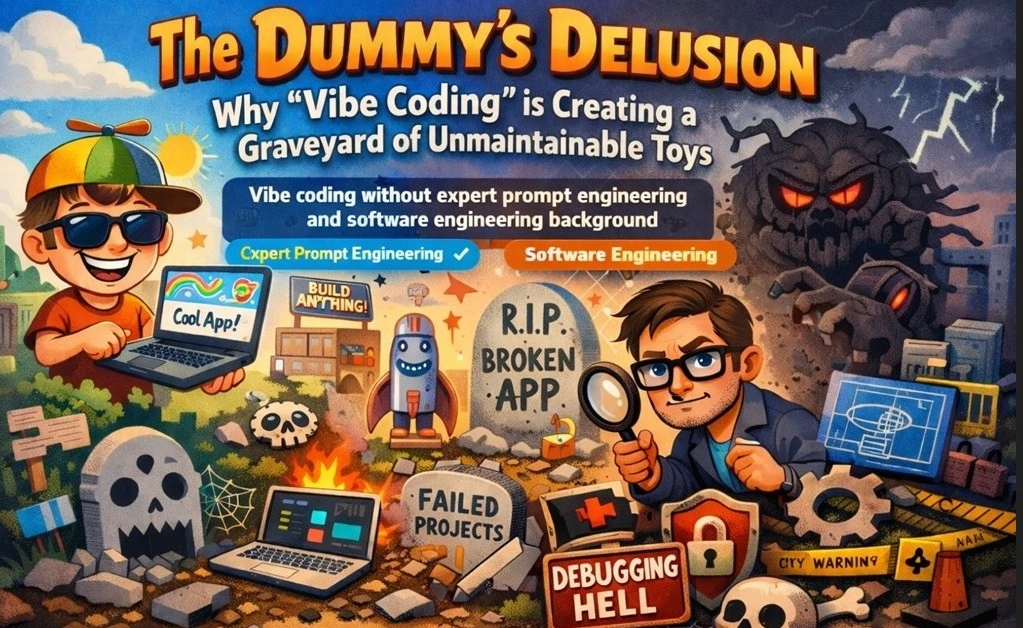
The concept of "Vibe Coding"—the idea that one can build sophisticated, production-grade software purely through natural language "vibes" without technical knowledge—is a polarizing topic. While AI has certainly lowered the barrier to entry, the claim that "everybody" can build "amazing tools" this way often collapses under professional scrutiny.
Not possible without expert level Prompt Engineering
Here is why the "Vibe Coding" narrative is frequently considered a logical fallacy in software engineering:
1. The Gap Between a "Toy" and a "Tool"
There is a massive chasm between a functional prototype and a production-grade system.
The Vibe: An AI can easily generate a single-file React app or a simple script that looks impressive.
The Reality: Amazing tools require "invisible" features: error handling, security protocols, scalability, and state management. "Vibe coding" often lacks the architectural foresight to handle edge cases, leading to apps that work in a vacuum but break the moment they hit real-world data or concurrent users.
2. The Debugging Dead-End
Programming is less about writing code and more about debugging it.
When an AI-generated app fails, a "vibe coder" who doesn't understand the underlying stack (e.g., .NET, Python, or React) cannot effectively troubleshoot.
They become trapped in a loop of "prompting for a fix," which often introduces new bugs or technical debt. Without a mental model of the system's architecture, you aren't building a tool; you are managing a black box you don't understand.
3. The Illusion of Natural Language
Language is inherently ambiguous, whereas computers are strictly logical.
Vibe Coding assumes the AI can perfectly infer intent. However, professional-grade software requires Engineering Mandates—specific roles, constraints, and architectural expectations.
"Write a cool app" is a vibe. "Implement a thread-safe singleton pattern for a local vector search engine" is engineering. Without the latter, the output remains superficial.
4. Maintenance and Technical Debt
Software is a living entity that requires updates and maintenance.
Code generated through vibes is often "spaghetti code"—a tangled mess of logic that is difficult to refactor.
As the project grows, the "vibe" becomes inconsistent. A developer with deep technical knowledge builds with a Staff-level philosophy, ensuring that the codebase remains modular and readable for future iterations.
5. Security and Compliance
Amazing tools must be safe.
AI models frequently suggest outdated libraries or patterns with known vulnerabilities.
A non-technical user won't recognize when an AI has accidentally opened a SQL injection vulnerability or misconfigured an API's CORS policy. True "amazing tools" require a level of professional oversight that "vibing" simply cannot provide.
Summary Table: Vibe Coding vs. Software Engineering
| Feature | Vibe Coding | Software Engineering |
|---|---|---|
| Foundation | Intuition & Natural Language | Logic & Architecture |
| Output | MVP / Prototypes | Production-Ready Systems |
| Sustainability | High Technical Debt | Maintainable & Scalable |
| Problem Solving | Recursive Prompting | Root Cause Analysis |
While AI is an incredible co-pilot for those who know how to fly, it doesn't turn every passenger into a pilot. True innovation still requires the ability to dictate the architectural "why" behind the computational "how."
Join the conversation! Your thoughts help the community grow.