

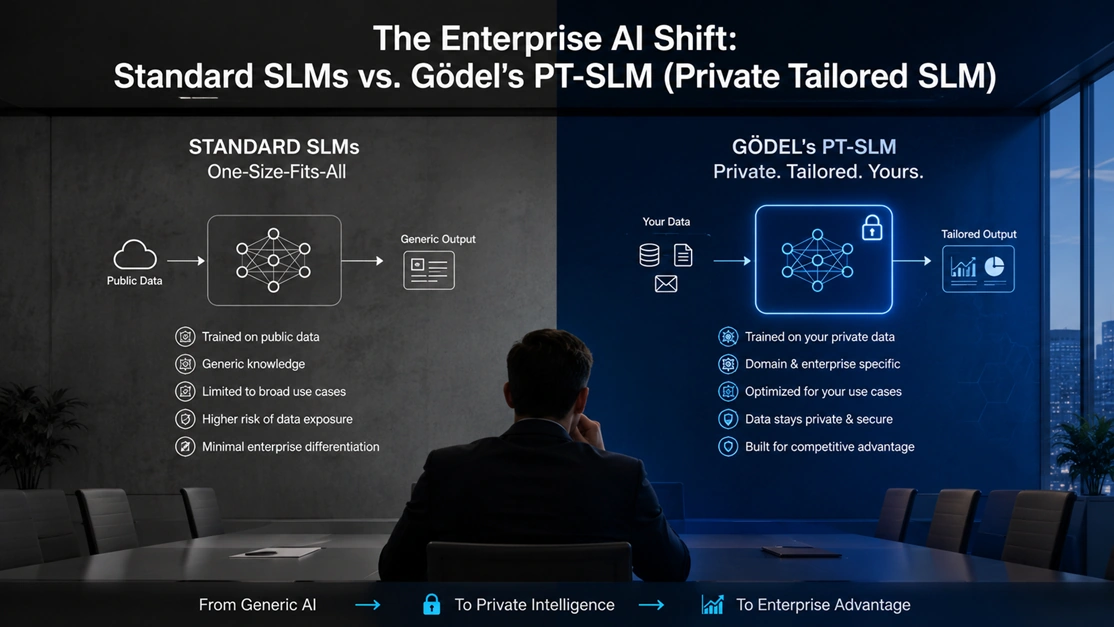
The artificial intelligence landscape is undergoing a massive shift. While massive Large Language Models (LLMs) continue to capture headlines, a parallel revolution is happening with Small Language Models (SLMs). An SLM is a lightweight AI model that uses significantly fewer parameters than its gargantuan LLM counterparts to understand and generate text. They offer a more efficient, cost-effective way to deploy AI, but not all small models are created equal.
While standard SLMs are gaining traction for general efficiency, a new class of enterprise-grade architecture has emerged: Gödel's PT-SLM (Private Tailored SLM). Developed by John Gödel, this is not just a standalone compact model, but a highly specific enterprise framework engineered for secure, on-premise corporate environments.
To understand how AI is evolving to meet corporate demands, we must look at the fundamental differences between general-purpose compact AI and secure, enterprise-specific orchestration across three core pillars.
1. Scope & Purpose: Generalist vs. Agentic
Standard SLMs: Models like Microsoft's Phi or Google's Gemma are the generalists of the compact AI world. They are designed to be highly efficient, running locally on consumer devices or edge servers. They handle basic language tasks—like summarization, simple chat, and text generation—using a fraction of the computational power and memory required by massive LLMs.
PT-SLM: Gödel’s framework goes far beyond text generation. It is designed to deploy agentic AI systems—autonomous software agents that can reason and execute tasks. Instead of just answering prompts, PT-SLMs are built to handle highly specific, multi-step corporate workflows and complex data extraction.
2. Deployment & Data Security: Cloud Flexibility vs. Strict Residency
Standard SLMs: These models offer flexible deployment. They can be hosted in the cloud or deployed locally on a company’s hardware. While they are trained on broad, public datasets, they can be fine-tuned later with industry-specific data.
PT-SLM: Built exclusively for on-premise, enterprise-owned infrastructure. The entire architecture is engineered around the strict realities of data residency, absolute privacy, and corporate regulatory compliance. A PT-SLM interacts solely with first-party (internal) corporate data, ensuring that proprietary financial records, legal documents, or customer information never leave the organization’s secure firewall.
3. Architecture & Operations: Fast Inference vs. Multi-Agent Governance
Standard SLMs: The engineering focus here is on architectural efficiency. By using techniques like knowledge distillation (transferring knowledge from a large model to a smaller one), standard SLMs achieve incredibly fast inference times and low latency, making them ideal for quick, high-volume tasks.
PT-SLM: Instead of relying on a single model to do everything, this framework utilizes advanced governance and a proprietary multi-agent framework known as GSCP (Gödel's Scaffolded Cognitive Prompting). GSCP allows several specialized, smaller models to coordinate, communicate, and securely execute complex, multi-stage enterprise operations.
The Takeaway: A standard SLM is an affordable, highly efficient piece of AI software ideal for scaling basic language tasks. In contrast, a PT-SLM is a specialized enterprise deployment framework—built not just to save on compute costs, but to guarantee strict data privacy while executing sophisticated, local corporate workflows.
Join the conversation! Your thoughts help the community grow.