

Introduction
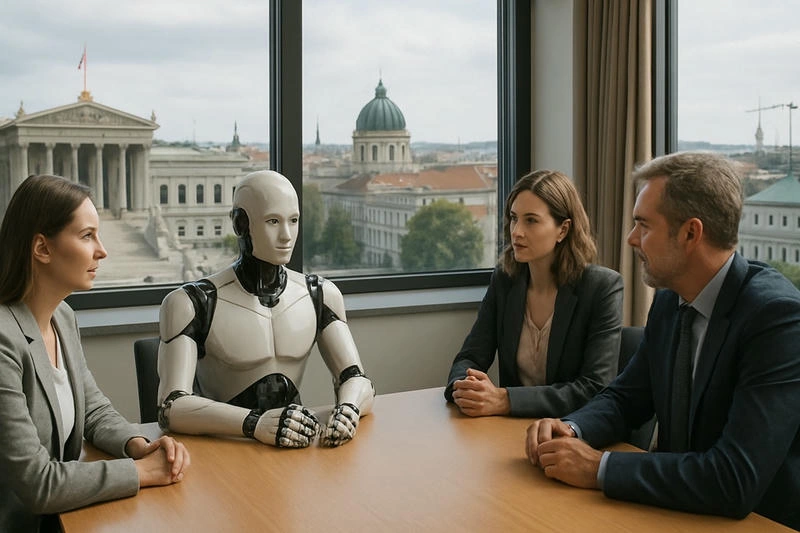
As artificial intelligence (AI) continues to evolve at an exponential pace, its fusion with robotics — particularly humanoid robots — is becoming increasingly tangible. The integration of large language models (LLMs) like GPT-4 and beyond into physical embodiments has shifted from speculative fiction to functional reality. In the next five years, we will witness a profound transformation in how humans interact with machines, not just through screens, but face to face, gesture to gesture, emotion to emotion.
This article explores the near-future trajectory of LLM-powered humanoids: their technological evolution, real-world applications, ethical implications, and societal impact — projecting how AI will extend beyond software to become our physical collaborators.
1. The Current Landscape: LLMs as Disembodied Brains
Today’s large language models — OpenAI’s GPT-4, Google’s Gemini, and Anthropic’s Claude — exist primarily as APIs or chatbots. They generate text, analyze code, summarize documents, or simulate conversation, but they do so without physical presence. Their input is strictly linguistic, and their output is purely textual.
Meanwhile, robotics companies like Boston Dynamics, Tesla (Optimus), Sanctuary AI, and Agility Robotics are developing highly capable humanoids with locomotion, manipulation, and vision — but with relatively narrow task-specific AI.
The next frontier lies at the intersection of these domains: giving humanoid robots cognitive generality, emotional awareness, and contextual conversation via LLM integration.
2. Five-Year Forecast: Key Milestones Ahead (2025–2030)
By 2030, we expect to see a massive convergence between LLMs and humanoid platforms. Here are the likely milestones:
Year 1–2 (2025–2026)
-
🤝 Early commercial pilots of LLM-humanoid hybrids in customer service, concierge roles, and elderly care.
-
🧠 Edge-deployed distilled LLMs (e.g., 10B–30B parameters) running on-device with minimal cloud latency.
-
🗣️ Natural speech, facial recognition, and multimodal input embedded in physical robots.
Year 3–4 (2027–2028)
-
💼 Enterprise adoption in manufacturing, logistics, and healthcare environments.
-
💬 Emotional intelligence systems: tone detection, facial mirroring, and proactive empathy responses.
-
🧱 Modular AI frameworks where LLMs govern high-level decisions while local AIs handle real-time control.
Year 5 (2029–2030)
-
🧍 Widespread deployment of general-purpose humanoids with integrated reasoning and long-term memory.
-
📚 Human-AI apprenticeship roles: humanoids as on-the-job learners.
-
🔐 Regulation frameworks for humanoid-AI rights, responsibility, and safety boundaries.
3. Core Enablers: What Makes This Possible?
To enable these breakthroughs, we expect critical innovation across five key areas:
⚙️ a) Real-Time LLMs at the Edge
Distilled or quantized models (e.g., LLaMA variants, GPT-J derivatives) will run on compact, high-efficiency AI chips inside robots — enabling fast, offline decisions.
🧠 b) Multi-Modal Neural Fusion
Vision, audio, and language processing will be integrated into a unified context graph, letting humanoids process not just words but gestures, faces, sounds, and spatial cues.
📈 c) Cognitive Memory Scaffolds (e.g., GSCP)
Frameworks like Gödel’s Scaffolded Cognitive Prompting (GSCP) will let robots plan, self-correct, and document their reasoning over time — essential for safe autonomy.
🔄 d) Reinforcement Learning with Human Feedback (RLHF)
Fine-tuned behavior, tone adaptation, and ethical alignment will all evolve through continuous human guidance.
🛠️ e) Modular Task Planning APIs
Robots will be built as composable systems: LLM handles intent, while local microcontrollers handle motor actions, navigation, and sensor fusion.
4. Practical Applications
🏥 Healthcare
-
Conversational assistance for elderly or disabled individuals
-
Medication reminders, mobility assistance, emotional companionship
🏪 Retail & Hospitality
-
Store greeters, shelf restockers, multilingual customer agents
-
Hotels with AI concierge staff for real-time help
🏭 Manufacturing & Logistics
-
LLMs orchestrate robot coordination, adjust to human task shifts
-
Voice-controlled assembly or inventory management
🏫 Education
-
Humanoid tutors that adapt to student emotions and pace
-
Teachers’ assistants that handle Q&A or group facilitation
5. Challenges and Ethical Frontiers
Despite the promise, integrating LLMs into humanoids brings critical risks:
-
🤖 Anthropomorphism Misuse: Users may overly trust or bond with humanoids.
-
🔍 Privacy: Real-time camera and microphone feeds require secure processing.
-
📉 Dependence: Societies may over-delegate care, labor, or companionship.
-
🧭 Alignment: LLMs must align with real-world norms, not just linguistic ones.
Careful governance, through global standards, explainable models, and robust human oversight, will be essential.
Conclusion: From Conversation to Collaboration
The next five years will transform LLMs from disembodied chatbots to embodied collaborators — thinking, speaking, and acting alongside us. While challenges abound, the opportunity to design empathetic, intelligent, and safe AI agents that can walk, listen, and help is closer than ever.
Humanoid integration will not replace human jobs en masse but will augment human potential, especially in tasks that demand presence, patience, and perception. The key is not to fear these systems — but to design them wisely, regulate them ethically, and align them meaningfully with human values.
Join the conversation! Your thoughts help the community grow.