

What is “Vibe Coding”?
Vibe Coding is the exhilarating experience of being fully immersed in coding, where ideas flow seamlessly from your mind to the screen. Your fingers seem to move on their own when you are focused and creative, effortlessly translating concepts into functional software. As the embodiment of productivity and joy, this state is chased by developers in every sprint, solo project, or pair-programming session.
With C# 13, developer ergonomics are taken to the next level with features that prioritise developer ergonomics. Cleaner syntax reduces cognitive load, while expressive capabilities allow developers to write more intuitive and readable code. As a result, developers can build robust, scalable, and maintainable software while also enjoying the coding process more. With C# 13 and industry best practices, teams can deliver high-quality solutions efficiently while fostering a powerful and sustainable development environment.
What’s New in C# 13 and How to Use It Right
Here are some of the standout features of C# 13, along with practical best practices that can help improve your codebase and coding workflow. By understanding how to apply these enhancements effectively, you can streamline your development process, write cleaner and more expressive code, and build solutions that are not only functional but also maintainable and scalable.
Developer productivity and code quality can be improved with C# 13 thanks to improved syntax and advanced language capabilities. It will provide you with actionable insights to help you integrate these features into your projects, ensuring that your codebase remains robust while your development experience is seamless.
Primary Constructors Clarity at the Core
We are defining immutable entities at the domain level, which makes this more readable and clean.
// File: Book.cs
namespace VibeBooks.Domain.Entities;

public record Book(string Title, string Author, int Year)
{
    public Guid Id { get; init; } = Guid.NewGuid();

    public void PrintInfo() =>
        Console.WriteLine($"The {Title} by {Author}, published in {Year}.");
}
Best Practices
Value objects and DTOs should be constructed using primary constructors.
You should avoid putting complex logic in constructor bodies.
Immutability can be achieved by injecting dependencies via the primary constructor.
Tip from Ziggy Rafiq
Objects that are immutable by nature should be combined with records.
Params Collections Cleaner APIs
We demonstrate creating flexible service APIs here that can be used for onboarding, logging, tags, etc.
Vibe.Application/UseCases/Users/RegisterUsers.cs
// File: RegisterUsers.cs
namespace VibeBooks.Application.UseCases.Users;

public class UserService
{
    public void Register(params string[] usernames)
    {
        ArgumentNullException.ThrowIfNull(usernames);

        foreach (var name in usernames)
        {
            Console.WriteLine($"The following Person is Registered user: {name}.");
        }
    }
}
Best Practices
APIs that require flexible input should be used for public APIs.
It is error-prone to mix parameters with optional parameters.
To avoid null reference exceptions, always validate incoming parameters.
Tip from Ziggy Rafiq
For defensive programming, use ArgumentNullException.ThrowIfNull().
Pattern Matching Enhancements — Declarative Power
Our Pattern matching aligns with Minimal API ergonomics by keeping endpoint code readable and expressive.
// File: BookEndpoints.cs (partial)
app.MapGet("/books/{id}", (Guid id, IBookService service) =>
{
    var book = service.GetById(id);
    if (book is { Title: not null, Year: > 2000 })
        return Results.Ok(book);
    return Results.NotFound();
});
Best Practices
Keep controllers thin by using them for business rule expression.
The readability of patterns is negatively affected by over-nesting.
Pattern matching should not replace SOLID OOP, where interfaces make more sense.
Tip from Ziggy Rafiq
We can combine this with switch expressions to create a clean branching logic.
Stronger Lambda Types Functional Cleanliness
Our service uses it in service logic where filtering and lookups occur, and it emphasizes strong typing.
// File: GetBooks.cs
using Vibe.Domain.Repositories;
using VibeBooks.Domain.Entities;

namespace VibeBooks.Application.UseCases.Books;

public class GetBooks
{
    private readonly IBookRepository _repository;

    public Func<Guid, Book?> FindBook { get; }
    public Func<string, IEnumerable<Book>> FilterByAuthor { get; }

    public GetBooks(IBookRepository repository)
    {
        _repository = repository;
        FindBook = (Guid id) => _repository.GetById(id);
        FilterByAuthor = (string author) =>
            _repository.GetAll().Where(b => b.Author.Equals(author, StringComparison.OrdinalIgnoreCase));
    }
}
Best Practices
In reusable contexts, name your lambdas meaningfully.
Whenever possible, use method groups (.Select(ToDto)).
When readability or tooling support is important, use explicit types.
Using Directives Top-Level
We improve developer ergonomics by reducing clutter in API projects.
global using VibeBooks.Application.Interfaces;
global using VibeBooks.Domain.Entities;
Best Practices
Each project layer should have a GlobalUsings.cs file.
Do not pollute the global namespace; only include essentials.
Service Layer
In the Service Layer, business logic, rules, and clean abstractions for use cases are encapsulated, enforced, and orchestrated between API endpoints and the repository.
// File: BookService.cs
using Vibe.Domain.Repositories;
using VibeBooks.Application.Interfaces;
using VibeBooks.Domain.Entities;

namespace VibeBooks.Application.UseCases.Books;

public class BookService : IBookService
{
    private readonly IBookRepository _repository;
    public BookService(IBookRepository repository) => _repository = repository;

    public Book? GetById(Guid id) => _repository.GetById(id);
    public List<Book> GetAll() => _repository.GetAll().ToList();
    public IEnumerable<Book> FilterByAuthor(string author) =>
        _repository.GetAll().Where(b => b.Author.Equals(author, StringComparison.OrdinalIgnoreCase));

    public void AddBook(Book book) =>
        _repository.Add(book.Id == Guid.Empty ? book with { Id = Guid.NewGuid() } : book);

    public void UpdateBook(Book book)
    {
        var existing = _repository.GetById(book.Id);
        if (existing is null) throw new InvalidOperationException($"Book {book.Id} not found.");
        _repository.Update(book);
    }

    public void DeleteBook(Guid id) => _repository. Delete(id);
}
Best Practices
Encapsulate business logic: Domain rules and workflows should be encapsulated here, not in controllers or repositories.
Validate inputs and enforce invariants: Enforce invariants by checking inputs for consistency, handling null values, and following business rules.
Coordinate repository calls: In case more than one repository is needed, orchestration should be handled by the service.
Throw meaningful exceptions: When business rules are violated, throw meaningful exceptions and provide clear error messages.
Return meaningful results: Prefer domain entities or DTOs over raw repository data when returning results.
Keep methods cohesive: Methods should represent distinct business operations (for example, AddBook, UpdateBook).
Leverage immutability: Use records and expressions to avoid accidental side effects.
Test in isolation: Without infrastructure dependencies, services should be unit tested in isolation.
Keep it thin but not anemic: The service should be thin, but not anemic. Business logic should be here, but don't bloat it with UI and persistence details.
Repository with JSON Persistence
By abstracting data access, the Repository Layer provides a clean contract for interacting with domain entities and persisting them to JSON files as a development and testing tool.
// File: InMemoryBookRepository.cs
using System.Text.Json;
using Vibe.Domain.Repositories;
using VibeBooks.Domain.Entities;

namespace VibeBooks.Infrastructure.Repositories;

public class InMemoryBookRepository : IBookRepository
{
    private readonly string _jsonFilePath;
    private readonly List<Book> _books;

    public InMemoryBookRepository(string? jsonFilePath = null)
    {
        _jsonFilePath = string.IsNullOrWhiteSpace(jsonFilePath)
            ? Path.Combine(Directory.GetCurrentDirectory(), "books.json")
            : jsonFilePath;

        _books = File.Exists(_jsonFilePath)
            ? JsonSerializer.Deserialize<List<Book>>(File.ReadAllText(_jsonFilePath)) ?? new List<Book>()
            : new List<Book>();
    }

    public IEnumerable<Book> GetAll() => _books;
    public Book? GetById(Guid id) => _books.FirstOrDefault(b => b.Id == id);

    public void Add(Book book) { _books.Add(book); SaveChanges(); }
    public void Update(Book book)
    {
        var index = _books.FindIndex(b => b.Id == book.Id);
        if (index != -1) _books[index] = book;
        SaveChanges();
    }
    public void Delete(Guid id)
    {
        var book = _books.FirstOrDefault(b => b.Id == id);
        if (book is not null) _books.Remove(book);
        SaveChanges();
    }

    private void SaveChanges() =>
        File.WriteAllText(_jsonFilePath, JsonSerializer.Serialize(_books, new JsonSerializerOptions { WriteIndented = true }));
}
Best Practices
Abstract storage details: Data access logic should be separated from business logic by using interfaces (IBookRepository).
Support CRUD operations: Implement CRUD operations consistently (GetAll, GetById, Add, Update, Delete).
Use JSON for lightweight persistence: When prototyping, testing, or local development is not needed, use JSON for lightweight persistence.
Gracefully handle missing data: When the JSON file is missing or corrupted, default to empty collections.
Always validate IDs: Before persisting changes, ensure entity IDs are unique and stable.
Persist consistently: Serialise and atomically write updates using a single SaveChanges method.
Favor immutability: Replace records instead of mutating fields when updating to avoid side effects.
Ensure portability: To resolve paths to files, use Directory.GetCurrentDirectory() or configure.
Plan for growth: By using dependency injection, you can easily replace JSON persistence with a database-backed repository as your business grows.
Keep it testable: The repository can easily be mocked or swapped for unit tests since it is behind an interface.
Full-Stack C# 13 Vibes With Clean Architecture
Developing robust, scalable applications using Full-Stack C# 13 Vibes with Clean Architecture requires combining C# 13's expressive power with a layered, well-structured approach. Clean architectures enable developers to work efficiently while maintaining high standards of code quality by creating a system that is modular, testable, and maintainable.
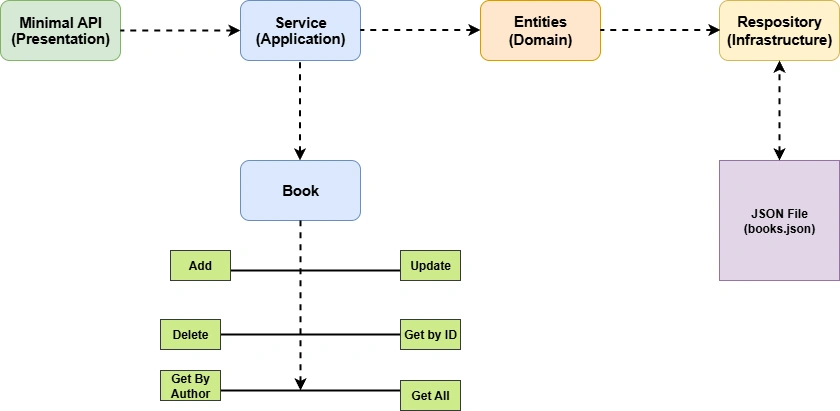
There is a clear flow of responsibilities in the architecture:
Presentation: Ensures seamless user interaction and UI logic in the presentation.
Application: Defines business workflows and orchestrates interactions between the domain and infrastructure layers.
Domain: Entities and business logic are encapsulated in a domain, creating an environment without external dependencies.
Infrastructure: Provides support for the domain layer by managing external systems, data access, and other technical concerns.
Using C# 13’s enhanced syntax and features in conjunction with this layered approach allows developers to focus on writing clean, expressive code while ensuring the architecture remains flexible and scalable. Team members are empowered to deliver high-quality software solutions efficiently through this combination, which fosters an optimal development flow.
Best Practices
Dependencies should flow inward (Domain has no outward references).
Don't create new services; use Dependency Injection.
Use cases should be placed in applications, not controllers.
Tip from Ziggy Rafiq
When scaling microservices, follow the Vertical Slice Architecture.
Minimal API with Full CRUD in C# 13 with Best Practices
This shows the real-world entry point using DI and minimal APIs.
// File: BookEndpoints.cs
namespace VibeBooks.Api.Endpoints;

public static class BookEndpoints
{
    public static void MapBookEndpoints(this WebApplication app)
    {
        app.MapGet("/books/{id}", (Guid id, IBookService service) =>
        {
            var book = service.GetById(id);
            return book is { Title: not null, Year: > 2000 } ? Results.Ok(book) : Results.NotFound();
        });

        app.MapGet("/books/all", (IBookService service) =>
        {
            var books = service.GetAll();
            return books.Any() ? Results.Ok(books) : Results.NotFound();
        });

        app.MapGet("/books/author/{author}", (string author, IBookService service) =>
        {
            var books = service.FilterByAuthor(author);
            return books.Any() ? Results.Ok(books) : Results.NotFound();
        });

        app.MapPost("/books", (Book book, IBookService service) =>
        {
            service.AddBook(book);
            return Results.Created($"/books/{book.Id}", book);
        });

        app.MapPut("/books/{id}", (Guid id, Book book, IBookService service) =>
        {
            if (id != book.Id) return Results.BadRequest("ID mismatch.");
            var existing = service.GetById(id);
            if (existing is null) return Results.NotFound();
            service.UpdateBook(book);
            return Results.Ok(book);
        });

        app.MapDelete("/books/{id}", (Guid id, IBookService service) =>
        {
            var existing = service.GetById(id);
            if (existing is null) return Results.NotFound();
            service.DeleteBook(id);
            return Results.NoContent();
        });
    }
}
Program.cs Entry Point
// VibeBooks.Api/Program.cs
using VibeBooks.Application.UseCases.Books;
using VibeBooks.Infrastructure.Repositories;
using VibeBooks.Api.Endpoints;
using Vibe.Domain.Repositories;
using VibeBooks.Application.UseCases.Users;

var builder = WebApplication.CreateBuilder(args);

builder.Services.AddScoped<IBookService, BookService>();
builder.Services.AddSingleton<IBookRepository, InMemoryBookRepository>();
builder.Services.AddSingleton<IGreeterService, GreeterService>();

var app = builder.Build();
app.MapBookEndpoints();

app.MapGet("/greet/{name}", (string name, IGreeterService service) =>
    Results.Ok(service.Greet(name)))
    .WithName("GreetUser")
    .Produces<string>(200);

app.Run();
Best Practices
Endpoints should use dependency injection instead of logic.
Use .WithName() and .Produces<>() for OpenAPI clarity.
Lambdas should be layered into services, not inlined.
Testing with Postman
GET {{Vibe.Api_HostAddress}}/books/all
GET {{Vibe.Api_HostAddress}}/books/{id}
GET {{Vibe.Api_HostAddress}}/books/author/{author}
POST {{Vibe.Api_HostAddress}}/books
PUT {{Vibe.Api_HostAddress}}/books/{id}
DELETE {{Vibe.Api_HostAddress}}/books/{id}
Clean C# 13 = Long-Term Developer Flow
| Principle | C#13 Tip by Ziggy Rafiq |
|---|---|
| DRY | Make use of primary constructors and global usings |
| SOLID | Keep SRP in services and DI in constructors |
| YAGNI | Do not over-abstract prematurely, use minimal APIs |
| Testability | Isolate business logic and write pure functions |
| Readability | Rather than clever hacks, prefer expressive patterns |
Future-Proof Your Codebase
Utilising C# 13's cutting-edge features means aligning your codebase with modern development trends, such as AI-assisted development, cloud-native applications, and WebAssembly, in order to future-proof your codebase. By integrating these features with best practices, you ensure your stack remains adaptable to emerging technologies and industry demands.
By adopting C# 13, you build systems that are:
Secure: Through robust coding practices and built-in security features, you can protect your applications from vulnerabilities.
Testable: It is important to design code that is easy to test, with clear separation of concerns and automated testing support.
Performant: The performant syntax and features are tailored for high-speed execution to optimise performance.
Maintainable: A maintainable codebase is clean, modular, and easy to update, ensuring long-term stability.
C# 13's capabilities enable your projects to thrive in a rapidly evolving tech landscape, delivering software that meets current as well as future demands.
Vibe Coding Starter Pack (Updated)
| Element | Recommendation from Ziggy Rafiq |
|---|---|
| Theme | Night Owl, Palenight |
| Font | JetBrains Mono |
| Music | Lo-fi, Deep Focus, or Synthwave |
| Editor Extensions | Roslynator, .NET Runtime Monitor, GitLens |
| Coding Workflow | TDD, Pomodoro, Live Share (remote pairs) |
Summary
Rather than just enhancing developers' code interaction, C# 13 represents a significant leap forward. Using it, you can write, test, deploy, and maintain software in a way that enhances every aspect of the development process. By integrating C# 13 with clean architecture principles, established design patterns, and modern development tools, you unlock a workflow that fosters creativity, productivity, and precision.
In addition to making coding more efficient, this combination transforms it into a fun experience. You can focus on solving problems instead of grappling with boilerplate and convoluted logic with C# 13's clean syntax and expressive features. It's about hitting that vibe zone daily, where ideas flow seamlessly into code, and every commit feels like progress.
Embrace C# 13's clean code vibe with your favourite playlist, open your repository, and immerse yourself in the process. With C# 13, clean code is a tangible, achievable vibe, and you have the ultimate tool to make it happen.
Vijay KumariPosted Sep 10, 2025, 3:31 AM
Nice article