Docker has been a fundamental part of modern software development for more than a decade. From simplifying application deployment to enabling consistent development environments, containers have changed how developers build, package, ship, and run applications.
But technology never stands still.
On November 19, 2026, Docker introduced a new brand identity with a clear message: Built to Run on Trust.
This is more than a visual refresh. It represents Docker's evolving vision for a development ecosystem increasingly influenced by Artificial Intelligence (AI), autonomous agents, and security requirements.
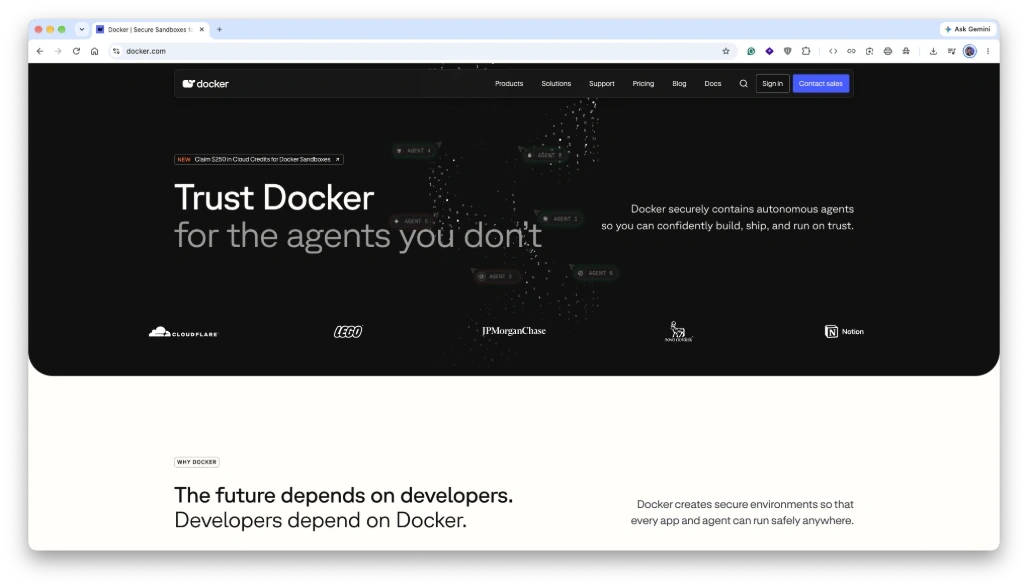
A New Identity, A New Direction
Docker's new identity brings a redesigned website, refreshed visual language, updated colours, and an evolved version of its familiar Moby whale.
The familiar Docker experience remains, but its positioning is expanding.
Traditionally, Docker has been closely associated with containerization, application portability, and consistent development environments. Now, the company is extending that story towards secure execution, AI agent isolation, and enterprise governance.
The objective is straightforward: help developers build and run applications and AI agents in environments they can trust.
Why Is Docker Evolving?
AI agents are changing how developers interact with development environments.
Unlike traditional application workloads, autonomous agents can execute commands, access files, interact with tools, install dependencies, and perform actions based on their instructions.
This introduces new security considerations.
A traditional container provides process isolation, but containers share the host operating system kernel. When autonomous agents are given access to development environments, credentials, files, and other resources, controlling their permissions becomes particularly important.
This is where Docker's new direction becomes interesting.
Docker is focusing on providing additional isolation and governance mechanisms specifically designed for agentic workloads.
Three Pillars Behind the New Docker
Docker's new positioning can be understood through three important areas.
1. Trusted Runtime
AI agents need controlled environments in which they can execute tasks.
Docker Sandboxes addresses this requirement by providing isolated environments for running agents. Docker's approach uses microVM-based isolation, providing a separate kernel boundary rather than relying solely on conventional container isolation.
This helps developers give agents room to work while maintaining stronger boundaries around their environments.
2. Trusted Supply Chain
Security doesn't start when an application runs. It starts much earlier, with the software components, dependencies, and images used to build it.
Docker continues to emphasise trusted software supply chains, secure images, and reproducible development workflows.
This is particularly important as AI agents increasingly participate in writing code, selecting dependencies, and building applications.
3. Trusted Ecosystem
Security also requires visibility and governance.
Docker is expanding its focus towards AI Governance, helping organisations establish controls around how agents operate, what resources they can access, and how their activities can be governed.
Together, these three areas represent Docker's broader approach to trust in the agentic era.
What Does This Mean for Developers?
For developers and DevOps engineers, the important takeaway is that containerization remains relevant.
Docker has explicitly stated that its existing container technology isn't going away.
Instead, the platform is expanding to address a different category of workloads.
We can look at the evolution this way:
Traditional Docker focus | Evolving Docker focus |
|---|
Application containers | Applications and AI agents |
Application portability | Controlled agent execution |
Container isolation | Additional agent isolation |
Image management | Trusted software supply chains |
Development workflows | AI-assisted development workflows |
Container security | Runtime security and AI governance |
This doesn't mean every application needs to move to a sandbox or that containers are becoming obsolete. It means developers have more security considerations to address when introducing autonomous agents into their workflows.
The Future of Docker
The introduction of the new Docker identity reflects a broader shift happening across the software industry.
AI agents are becoming part of development workflows, but autonomy also brings responsibility. Organisations need to understand what their agents can execute, which resources they can access, and how those activities can be controlled.
Docker's new direction places these questions at the centre of its platform strategy.
The technology that helped developers build, ship, and run applications consistently is now extending its vision towards helping developers run autonomous agents with greater confidence.
The whale has evolved, the website has changed, and the message is different.
But one thing remains important: building software that developers can trust.
The next chapter of Docker isn't just about running containers. It's about creating trusted environments for the next generation of software development.
Final Thoughts
Docker's new brand identity is an interesting milestone for the developer ecosystem.
As someone following containerization, DevOps, and cloud-native technologies, I believe the most important part of this announcement isn't the redesigned logo. It's the shift towards secure and governed AI agent execution.
Containers changed how we deploy applications. The next challenge is making autonomous software execution secure, controlled, and trustworthy.
The new Docker is built to run on trust.
What do you think about Docker's new direction?


Join the conversation! Your thoughts help the community grow.