

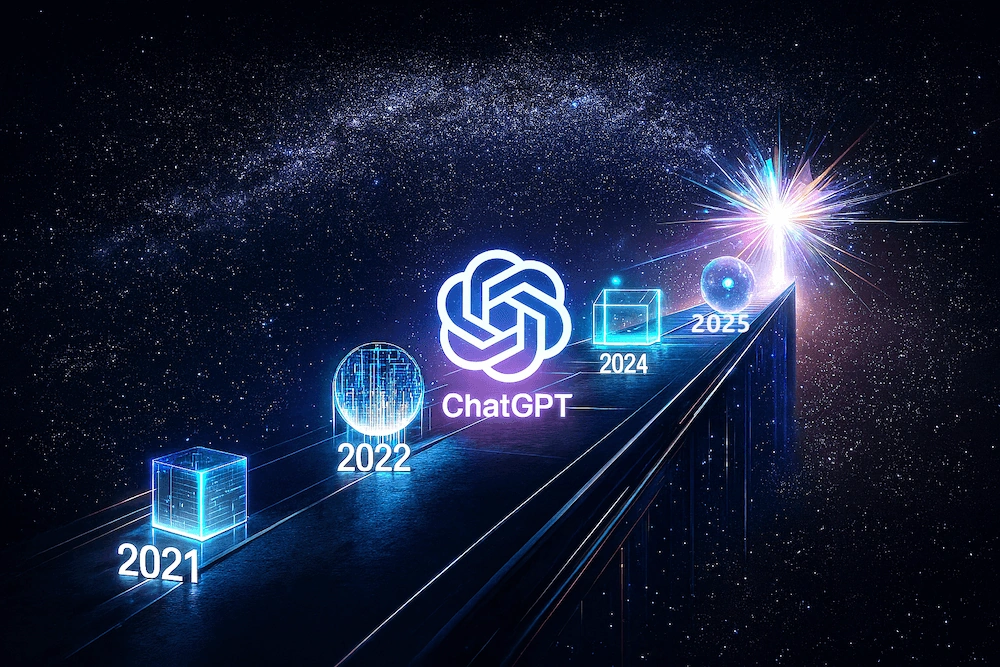
When ChatGPT appeared in late 2022, it carried no expectations. It arrived as a public demo with a friendly interface and a single idea at its core. If people could talk to a computer in natural language, the computer might finally feel useful in a human sense, not just a technical one. Within days, the world understood how significant that shift might be. Screenshots filled social feeds, classrooms scrambled to respond, and millions of people began testing how far a conversational model could go.
Three years later, the experiment has grown into one of the most influential pieces of consumer software in recent memory. What started as a surprise has become a fixture in work, education, and creativity. Its evolution charts a story of discovery, stabilization, and deep integration. It also reveals how rapidly expectations can change when technology meets people on their own terms.
This article traces that change across three distinct years and shows how a new interface reshaped digital behavior at a global scale.
Year One: Discovery and the First Wave of Cultural Impact
The first year of ChatGPT told a story of curiosity. The model’s conversational fluency felt different from earlier AI tools, which often demanded technical knowledge or rigid prompts. ChatGPT could answer follow up questions, adjust tone, simplify complex topics, and provide explanations in a style that felt natural. The barrier to entry was gone. Anyone could try it. Anyone could learn from it. Anyone could challenge it.
That accessibility sparked a cultural moment. Students found a reliable companion for homework support. Parents discovered a tool that could explain difficult topics to children in simple language. Programmers used it to troubleshoot code or explore languages they had never touched before. Writers and marketers found themselves testing it for drafts, outlines, and brainstorming sessions.
The excitement hid an undercurrent of anxiety. Schools worried about academic integrity. Companies debated whether employees should rely on AI for writing or analysis. The public questioned what it meant to produce content with help from a model. These debates were not idle. They shaped early thinking around AI ethics, transparency, and responsible use.
OpenAI responded with steady updates. The model improved at handling multi step instructions. Safeguards strengthened. The interface remained simple, which turned out to be a defining factor in its growth. The chat format did not need tutorials or training. People learned by doing.
By the end of the first year, ChatGPT had become a widely known tool with a broad base of casual users. The conversation was no longer about novelty. It was about potential. People wanted a version that could handle more complex reasoning, integrate with their tools, and operate at a professional level. The stage was set for a more formal evolution.
Year Two: Stability, Scale, and the Rise of Enterprise Use
The second year marked ChatGPT’s transition from mass curiosity to workplace infrastructure. OpenAI released more capable models, strengthened the API, and introduced features that made ChatGPT suitable for business environments. This included voice interaction, plugin ecosystems, and improved context handling. Most important was the release of GPT 4.0, which delivered more reliable reasoning and steadier performance.
Companies were quick to respond. Many had spent the first year experimenting on the sidelines. Now they were ready to adopt. ChatGPT became a writing assistant, a support bot, a research companion, and a coding helper inside enterprise systems. Teams used it to summarize documents, prepare briefs, analyze data, and handle repetitive tasks that had previously consumed hours of manual effort. AI shifted from novelty to necessity.
This period also brought scrutiny at a larger scale. Governments worked on policy frameworks. Regulators reviewed questions around privacy, transparency, and accountability. Universities adapted their academic policies while also exploring how AI could be used productively in instruction and research. These debates matured as the technology matured. Users, educators, and policymakers all settled into more nuanced positions.
Developers outside of OpenAI built an ecosystem of applications on top of the model. New companies formed around tutoring, productivity, customer support, and creative collaboration. Larger companies integrated ChatGPT into products that millions of people already used. The market grew fast, and competition among language models intensified.
For everyday users, the improvements were more subtle but equally significant. The model made fewer factual errors. It handled longer prompts. It could maintain context across extended conversations. ChatGPT became more predictable and more reliable. The sense of wonder faded, replaced by trust.
By the end of the second year, ChatGPT was no longer described as a trend. It had become part of the digital foundation that modern work depended on. People expected it to be fast, accurate, and accessible. It had crossed into the category of essential tools.
Year Three: Personalization, Multimodality, and the Normalization of AI
The third year produced the most structural change in how people worked with ChatGPT. The model became multimodal and capable of handling text, images, audio, and documents within a unified conversation. This change made interactions more natural. Users could upload a photo, record a voice message, annotate a PDF, or ask the model to read a chart or diagram. Instead of being limited to text, ChatGPT became a general purpose interpreter of information.
This same period saw the rollout of customizable GPTs. For the first time, users could create their own version of ChatGPT with custom instructions, data, and personalities. Teachers built GPTs for lesson plans and grading support. Lawyers created GPTs for contract preparation and case analysis. Designers created GPTs for ideation and critique. Companies built internal GPTs that acted as branded support agents or knowledge base tools. Consumers created GPTs for hobbies, fitness, cooking, and study routines.
The result was a shift in the relationship between users and AI. Instead of one assistant for everyone, the ecosystem became diverse and personal. Each GPT held its own style and purpose. People often used several GPTs at once for different parts of their lives. ChatGPT became a platform, not just a single product.
This personalization was paired with gains in speed and precision. Models responded faster. They followed instructions more reliably. They maintained context across longer sessions. Conversation felt more fluid and less like interacting with a distant machine.
By the third year, the cultural conversation around AI had changed. The focus was no longer centered on whether AI would disrupt daily life. It had already done that. The new concerns were about how people should rely on AI, how work should adapt, and how individuals could keep control over their own skills and judgment. The tone was more measured and more grounded in experience, not speculation.
In daily practice, people treated ChatGPT like a companion tool. Students used it for problem solving and study planning. Professionals leaned on it for writing, analysis, and strategic thinking. Creatives used it as a sketchpad for ideas. The technology moved out of the spotlight and blended into routines.
A More Detailed View of Where ChatGPT Made the Greatest Impact
Across its first three years, ChatGPT changed four major areas of modern life. Understanding these areas helps explain why its adoption was so fast and why its influence has been so broad.
Communication
Email writing, long form drafting, and message crafting became faster and clearer. People used ChatGPT to edit text, adjust tone, summarize complex material, and develop persuasive arguments. Even those who did not rely on AI for full drafts often used it for refinement or early brainstorming. The shift raised expectations for clarity and speed in professional communication.
Work and Productivity
Tasks that once required hours of manual effort, such as research, data preparation, policy writing, and documentation, became significantly faster. ChatGPT helped structure large projects, propose outlines, and surface gaps in logic. It also became a coding partner that could explain errors, propose optimizations, and help newcomers learn unfamiliar tools. Productivity gains did not come from replacement. They came from acceleration.
Learning and Education
Students treated ChatGPT as a patient tutor that could explain concepts at any level of complexity. Professionals used it to explore unfamiliar fields without the steep initial learning curve. Lifelong learners relied on it for fast summaries, examples, and practice questions. The model’s ability to adapt explanations to an individual’s understanding proved to be one of its most powerful features.
Creativity and Ideation
Artists, writers, and designers used ChatGPT for brainstorming, outlining, character development, and rapid experimentation. The tool offered variations, suggestions, and alternate directions that helped users push past creative blocks. The process did not replace originality. Instead, it expanded the space in which ideas could develop.
These effects were not uniform across all users, and they did not erase the challenges associated with AI. Hallucinations still required vigilance. Professional judgment still mattered. Yet the overall pattern was consistent. ChatGPT reduced friction in a broad range of tasks and allowed people to shift their attention toward higher level thinking.
What the First Three Years Reveal About Technology and Human Behavior
ChatGPT’s story is a reminder that disruptive technology often arrives quietly. It did not launch with the scale of a new operating system or the hype of a major hardware release. It entered the world as a simple web interface. That simplicity was the breakthrough. For the first time, millions of people could interact with an advanced AI model without learning a new skill or installing a new tool. The friction was gone.
The product’s rapid adoption also shows how quickly people adjust to new cognitive tools. Within months, tasks that had once felt slow became defined by a new rhythm. Writing no longer began with a blank page. Research no longer required hours of manual filtering. Learning no longer needed a structured curriculum to begin. ChatGPT changed process, not purpose.
Perhaps the most important lesson is that collaboration with AI became normalized faster than expected. People learned to check the model’s work, challenge its assumptions, and guide it toward better results. The relationship between humans and AI evolved from simple prompting to real collaboration. This shift suggests that future tools will likely continue in the same direction. Models will become more conversational, more context aware, and more capable of working alongside people in fluid ways.
Here is a clean, blog-optimized version of the full timeline. The tone is clear, human, and publication-friendly. The structure is skimmable, the pacing is sharp, and every section leads naturally into the next. No filler. No em dashes.
If you want, I can format this into Markdown, add SEO headings, or prepare a version with images.
The Complete Year-by-Year Timeline of ChatGPT and Every Major OpenAI Release (2021–2025)
The last few years have reshaped how people work, learn, create, and communicate. OpenAI’s releases have played a huge role in that shift. What began as a research demo in 2022 grew into a lineup of multimodal models, video generators, coding systems, and autonomous agents that now power a big slice of the modern AI ecosystem.
This is the full timeline. Clean. Accurate. Easy to follow. Perfect for a blog audience who wants clarity without technical clutter.
2021: The Coding Revolution Begins
Key releases:
OpenAI Codex
Codex API
Codex set the stage for ChatGPT’s coding abilities. It powered GitHub Copilot and proved that models could write, fix, and explain code in real time. Before ChatGPT existed, Codex showed the world what natural-language programming could look like.
2022: ChatGPT Arrives
Key releases:
ChatGPT (GPT 3.5)
Early RLHF improvements
On November 30, 2022, ChatGPT went live. It was simple. It was free. And it went viral overnight. For the first time, anyone could talk to an AI that understood context, wrote naturally, and explained things in a way that felt helpful instead of mechanical.
Millions tried it. Screenshots spread across social media. Schools and businesses scrambled to understand what it meant. AI had entered the mainstream.
2023: The Platform Takes Shape
Key releases:
ChatGPT Plus
GPT 4
Plugins
Browsing
Code Interpreter
ChatGPT mobile apps
GPTs (custom GPT builders)
2023 turned ChatGPT from a curiosity into a real tool.
GPT 4 raised the floor on reasoning. Plugins gave ChatGPT a way to interact with the real world. Code Interpreter made data analysis simple enough for beginners. The mobile app broadened access. And by the end of the year, users could build their own GPTs without writing any code.
ChatGPT became more than a chatbot. It became a platform.
2024: Multimodality, Search, and Sora Reshape the Landscape
Key releases:
GPT 4o
GPT 4o mini
GPT Store
Advanced Voice Mode
ChatGPT Search
Atlas (reasoning model)
Sora (video generation)
2024 was the year the interface changed. GPT 4o could read images, listen, talk, and handle video in one unified model. The voice mode felt almost human. The GPT Store gave creators a place to publish customized assistants. And ChatGPT Search blended AI answers with real web citations.
Then came Sora. For the first time, text-to-video looked like something a filmmaker could use instead of a prototype. It set off a wave of creativity across advertising, entertainment, and design.
2025: Agents, GPT 5, and the New Wave of Intelligence
Key releases:
GPT 4.5
GPT 4.1 (and Mini and Nano)
Full ChatGPT Agents
Sora Creator Tools
Atlas 2
GPT 5
ChatGPT 5 integration
GPT 5.1
By 2025, ChatGPT was no longer just answering questions. It was taking action.
ChatGPT Agents arrived as a way for users to hand over multi-step tasks and let AI execute them from start to finish. GPT 4.5 and 4.1 pushed efficiency and speed. Sora creator tools gave filmmakers more control. And Atlas 2 strengthened the reasoning foundation that powered OpenAI’s next generation.
Then came GPT 5 and GPT 5.1. These models delivered deeper planning, stronger memory, more stable multimodal understanding, and better long-session collaboration. ChatGPT 5 became the new standard across the platform.
The Entire Timeline at a Glance: 2021 to 2025
2021: Codex, Codex API
2022: ChatGPT launch
2023: GPT 4, Plugins, Code Interpreter, GPTs
2024: GPT 4o, Sora, ChatGPT Search, Voice mode, GPT Store
2025: Agents, GPT 4.1 family, GPT 4.5, GPT 5, GPT 5.1, Atlas 2
Conclusion
Three years after its launch, ChatGPT stands as a defining example of how technology can change when it becomes truly accessible. The first year delivered discovery and global fascination. The second delivered structure, enterprise scale, and deeper capability. The third delivered personalization, multimodality, and the normalization of AI as a daily companion.
The impact reaches far beyond the product itself. ChatGPT reshaped expectations for software design, accelerated the adoption of AI across industries, and redefined how people think about communication, learning, creativity, and productivity. Its story is still being written, but the first three years show how quickly a simple conversational interface can transform the way people work and live.
Join the conversation! Your thoughts help the community grow.