

Almost every business is migrating to a cloud, and cloud providers’ growth is in double digits quarter over quarter. AWS, Azure, and Google Cloud are the top three cloud service providers. Here is a list of the Top 10 Cloud Service Providers In 2023 (c-sharpcorner.com).
Here are the top 10 reasons why a business should consider migrating to the cloud.
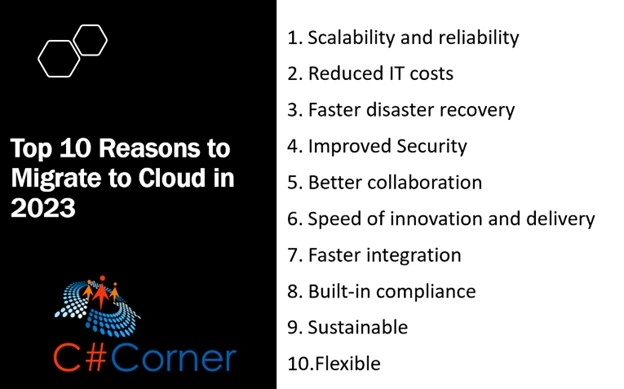
Top Sure! Here are the top 10 reasons why a business should consider migrating to the cloud.
- Scalability and reliability
- Reduced IT costs
- Faster disaster recovery
- Improved Security
- Better collaboration
- Speed of innovation and delivery
- Faster integration
- Built-in compliance
- Sustainable
- Flexible
1. Scalability and reliability
Scalability is one of the biggest advantages of cloud computing. Cloud infrastructure allows businesses to easily scale their resources up or down as needed without having to worry about the cost or logistics of investing in additional hardware. This can be particularly beneficial for businesses that experience spikes in demand, such as during seasonal sales or product launches.
With cloud computing, businesses can quickly provision additional resources, such as servers, storage, or bandwidth, to handle the increased traffic. Once the spike has passed, they can easily de-provision these resources to avoid paying for capacity that is no longer needed.
In addition to handling spikes in demand, cloud computing can also help businesses save money by right-sizing their infrastructure. By continuously monitoring resource usage, businesses can identify areas where they are overprovisioned and make adjustments to optimize their spending.
Most of cloud services are reliable and available 24/7. It is very rare when a cloud service is not available.
2. Reduced IT costs
One of the key advantages of cloud computing is its potential for cost savings. With traditional on-premises infrastructure, businesses must invest in hardware, software, and maintenance costs associated with maintaining and upgrading their infrastructure. This can be a significant expense, particularly for small and mid-sized businesses.
In contrast, cloud computing enables businesses to leverage the resources of a cloud provider, which can help reduce costs in a number of ways,
- Reduced Hardware Costs- Cloud providers own and manage the physical infrastructure required to run applications and services. By leveraging the cloud provider's infrastructure, businesses can avoid the costs associated with purchasing, deploying, and maintaining hardware.
- Reduced Software Costs- Cloud providers often offer pre-built software components, such as databases, application servers, and content delivery networks (CDNs). These services can be less expensive than traditional software licenses and can also be more flexible, as businesses only pay for what they use.
- Reduced Maintenance Costs- Cloud providers typically handle maintenance and upgrades of their infrastructure, freeing businesses from the responsibility of maintaining hardware and software. This can help businesses avoid the costs of hiring dedicated IT staff to manage their infrastructure.
- Pay-Per-Use Pricing- Many cloud providers offer pay-per-use pricing models, which means that businesses only pay for the resources they actually use. This can help businesses avoid the costs of over-provisioning their infrastructure to handle peak demand.
- Reduced IT Staff- Migrating to the cloud can potentially help businesses reduce their full-time employee (FTE) count, as it can eliminate the need for some IT roles that are traditionally required to manage on-premises infrastructure. With on-premises infrastructure, businesses typically need dedicated IT staff to manage and maintain servers, storage, networking, and other components. These staff members are responsible for tasks such as configuring and deploying hardware, monitoring performance, troubleshooting issues, and performing updates and patches.
3. Faster disaster recovery
Disaster recovery is a crucial aspect of any IT infrastructure, as it ensures that businesses can quickly recover from unexpected events such as hardware failures, natural disasters, or cyberattacks. With traditional on-premises infrastructure, disaster recovery can be complex and expensive, requiring businesses to maintain duplicate hardware and backup systems.
In contrast, cloud computing provides businesses with a range of disaster recovery options that can be more cost-effective and easier to manage. Cloud providers offer a range of services and tools that can be used to protect and recover data and applications in the event of a disaster.
Cloud providers also offer tools and services for replicating data and applications across different geographic regions. This can help ensure that data and applications remain available in the event of a regional disaster, such as a hurricane or earthquake.
4. Improved security
Cloud computing can improve security for businesses in a number of ways.
Here are a few examples,
- Physical Security- Cloud providers typically have highly secure data centers with multiple layers of physical security, such as access controls, surveillance cameras, and security personnel. By leveraging the physical security of a cloud provider, businesses can help ensure the safety of their data and applications.
- Data Encryption- Many cloud providers offer data encryption at rest and in transit. This can help protect sensitive data from unauthorized access or theft.
- Automated Backups- Cloud providers often offer automated backup services, which can help ensure that data is backed up regularly and is easily recoverable in the event of a disaster.
- Access Controls- Cloud providers often offer granular access controls, which can help businesses control who has access to their data and applications. This can help prevent unauthorized access and reduce the risk of data breaches.
5. Better collaboration
Cloud computing can improve collaboration and productivity within a business in a number of ways.
Here are a few examples,
- Remote Work- Cloud computing can enable employees to work from anywhere, as long as they have an internet connection. This can help businesses reduce their physical office space and enable employees to work from home or other remote locations. This can also help businesses attract and retain top talent, as employees appreciate the flexibility to work from anywhere.
- Real-time Collaboration- Cloud computing enables real-time collaboration between employees, regardless of their physical location. For example, employees can work together on a shared document or project in real time, even if they are in different parts of the world. This can help improve teamwork and productivity.
- Access to Information- Cloud computing enables employees to access information and applications from anywhere, as long as they have an internet connection. This can help improve productivity by enabling employees to work on projects or access information from home, while traveling, or while on the go.
- Integration with Productivity Tools- Many cloud providers offer integrations with popular productivity tools, such as Microsoft Office and Google Suite. This can help streamline workflows and enable employees to work more efficiently. Microsoft Azure’s integration with GitHub and Visual Studio is a perfect example of seamless integration of development and DevOps tools to build, test, and deploy software applications.
6. Speed and delivery of innovation
Cloud computing can also enable innovation for businesses by providing them with the tools and resources they need to quickly develop and deploy new applications and services.
Cloud providers typically offer a wide range of advanced technologies and services, such as artificial intelligence (AI), machine learning, and big data analytics. By leveraging these technologies, businesses can gain new insights, automate processes, and develop innovative new products and services.
AI is the latest innovation that is growing rapidly. OpenAI and ChatGPT are the latest crazes in AI. Azure Cloud recently launched its OpenAI integration in the cloud. Most clouds including Azure, AWS, Google Cloud, and others offer the latest technologies as part of their innovation.
By reducing the need for up-front capital investment in hardware and infrastructure, cloud computing can lower the barriers to entry for new businesses and startups. This can encourage innovation and competition in the marketplace.
7. Faster integration
Cloud computing can improve integration for businesses in a number of ways.
Here are a few examples,
- API Connectivity- Cloud providers often offer Application Programming Interfaces (APIs) that allow businesses to connect their applications and data with other systems and services. This can help businesses integrate their systems more easily and efficiently. AWS Lambdas and Azure Functions are a couple of examples of that.
- Middleware and Integration Tools- Many cloud providers offer middleware and integration tools that can help businesses integrate their systems and data more easily. These tools can help reduce the time and effort required to integrate systems and can help businesses achieve better visibility and control over their data.
- Ecosystem of Partners- Many cloud providers have developed ecosystems of partners that offer complementary services and solutions. By leveraging these partners, businesses can potentially integrate their systems and data more easily and can achieve better visibility and control over their data.
- Scalability- Cloud computing can help businesses achieve greater scalability by providing the ability to scale resources up and down as needed. This can help businesses handle spikes in demand and can improve their ability to integrate with other systems and services.
8. Built-in compliance
Cloud computing can improve compliance for businesses in a number of ways.
Here are a few examples,
- Security and Compliance Standards- Cloud providers often have robust security and compliance programs in place, which can help businesses meet regulatory requirements and industry standards. These programs may include measures such as data encryption, multi-factor authentication, and access controls.
- Data Residency and Sovereignty- Cloud providers may offer the ability to store data in specific regions or jurisdictions, which can help businesses comply with data residency and sovereignty requirements. This can help businesses avoid legal and regulatory risks and can help them meet customer expectations.
- Auditing and Reporting- Cloud providers may offer auditing and reporting tools that can help businesses track and monitor their compliance with regulatory requirements and industry standards. These tools can help businesses identify potential issues and take corrective action.
- Compliance Expertise- Cloud providers may have compliance experts on staff who can help businesses navigate complex regulatory environments and ensure compliance with applicable laws and regulations. Both Microsoft Azure and Amazon Web Services (AWS) offer a range of compliance certifications and attestations to help their customers meet various regulatory requirements including IS 27001, SOC 1, SOC 2, and SOC 3, HIPAA, GDPR, PCI DSS, FedRAMP and many others.
9. Sustainable
Sustainability is becoming an increasingly important consideration for businesses across all industries, and cloud computing can play a role in helping businesses reduce their environmental impact.
Here are some ways in which cloud computing can contribute to sustainability,
- Energy Efficiency- Cloud providers such as Microsoft Azure and Amazon Web Services (AWS) have made significant investments in energy-efficient infrastructure and technologies. By pooling computing resources and optimizing data center operations, cloud providers can achieve higher energy efficiency than many on-premises data centers. This can lead to reduced energy consumption and lower carbon emissions.
- Renewable Energy- Cloud providers are also increasingly investing in renewable energy sources such as wind and solar power to power their data centers. For example, Microsoft has committed to becoming carbon negative by 2030 and to using 100% renewable energy by 2025. AWS has committed to using 100% renewable energy by 2025.
- Reduced Hardware Waste- By migrating to the cloud, businesses can reduce their reliance on on-premises hardware that may become obsolete or require frequent upgrades. This can lead to reduced hardware waste and lower e-waste generation.
- Collaboration- Cloud computing can enable greater collaboration and remote work, which can reduce the need for travel and commuting. This can lead to reduced carbon emissions and lower environmental impact.
10. Flexible
Flexibility is another key benefit of cloud computing for businesses.
Here are some ways in which cloud computing can provide greater flexibility,
- Location Independence- With cloud computing, businesses can access their applications and data from anywhere in the world, as long as they have an internet connection. This enables businesses to work remotely and access their resources from multiple locations, which can increase flexibility and productivity.
- Scalability- Cloud computing enables businesses to scale their resources up or down quickly and easily, without the need for additional hardware or infrastructure. This can help businesses respond to changing demands and quickly seize new opportunities.
- Pay-Per-Use Model- Cloud computing typically operates on a pay-per-use model, which means that businesses only pay for the resources they actually use. This can help businesses control costs and avoid over-provisioning or under-provisioning resources.
- Choice of Services- Cloud computing providers typically offer a wide range of services and tools, which can give businesses greater flexibility in choosing the resources that best meet their needs.
- Easy Integration- Cloud computing enables businesses to integrate their applications and services more easily than traditional IT environments. This can help businesses streamline their workflows and improve efficiency.
Summary
Cloud computing offers many advantages and most important among all is time to deployment and cost savings. One size doesn’t fit all. Cloud computing is flexible enough to allow a business to use multiple clouds at the same time, i.e., hybrid cloud. The hybrid cloud allows businesses to get the best of all worlds.
More related to this - Top 10 Cloud Service Providers In 2023 (c-sharpcorner.com)
Konga MounikaPosted May 24, 2023, 11:24 AM
Good article sir
Mohamed Azarudeen ZPosted May 14, 2023, 5:48 PM
I agree, Scalability, reduced IT costs, faster disaster recovery, improved security, better collaboration, speed of innovation and delivery, faster integration, built-in compliance, sustainability, and flexibility your article explains each reason in detail. Its obvious now future is cloud.