

Torsion Pontryagin Duality for the M-Theory C-Field
A Discrete Fourier Transform Principle for Flux Sectors, Brane Charges, and Symmetry TFTs
Abstract
Topological sectors of the M-theory 3-form gauge potential C₃ and its 4-form field strength G₄ carry quantum phases and anomaly constraints that require globally consistent definitions. A particularly rich component arises from torsion in the integer (co)homology of the compactification manifold: torsion classes define discrete flux sectors, discrete gauge structures, and higher-form symmetry data in the effective theory. This article proposes a conjectural organizing principle for these torsion sectors, termed Torsion Pontryagin Duality (TPD). TPD states that torsion C-field holonomy classes and torsion G₄ flux classes are related by a finite Fourier transform whose kernel is the torsion linking pairing into ℚ/ℤ. The conjecture packages torsion electric-magnetic complementarity as a finite Heisenberg-group structure, predicts universal BF-type symmetry topological field theories in the effective description, and admits a brane-braiding interpretation in terms of wrapped M2 and M5 branes.
Keywords
M-theory; C-field; torsion flux; differential cohomology; linking pairing; finite Heisenberg group; discrete Fourier transform; generalized global symmetries; BF theory; symmetry TFT
Introduction
The M-theory C-field is globally subtle: beyond its local description as a differential form, its quantization and effective action involve shifted flux quantization and Chern–Simons type phases that must be globally well-defined. These issues motivate a formulation in differential cohomology, where curvature and holonomy data are treated on equal footing.
When the internal compactification space contains torsion in integer (co)homology, the theory acquires additional discrete sectors. These torsion sectors are physically consequential, controlling discrete gauge structures, generalized global symmetries, domain walls, and selection rules for nonperturbative effects. The question addressed here is whether there exists a single structural principle that organizes torsion C-field holonomies and torsion G₄ fluxes into one rigid quantum framework.
Mathematical background: torsion and linking pairings
Let X be a closed, oriented smooth n-manifold. The torsion subgroup Tor Hₖ(X; ℤ) supports a canonical ℚ/ℤ-valued linking form (torsion linking pairing), pairing degrees k and n−k−1. In cohomological language, Poincaré duality and the universal coefficient theorem induce a canonical torsion pairing into ℚ/ℤ. This pairing is intrinsically torsion-level: ℚ/ℤ is itself a torsion group, and the resulting pairing captures information invisible to de Rham cohomology.
For the M-theory application on a compact spin 7-manifold X₇, the relevant torsion groups are Tor H³(X₇, ℤ) and Tor H⁴(X₇, ℤ). TPD takes their linking pairing as the universal kernel controlling discrete phases in the torsion sector.

The physical setting: the M-theory C-field and torsion sectors
The C₃ potential couples electrically to M2-branes, while its magnetic dual description is encoded by C₆ and sourced by M5-branes. On a compactification manifold X₇ with torsion, one may define discrete C-field holonomy backgrounds and discrete G₄ flux backgrounds classified by torsion cohomology. These sectors influence the effective lower-dimensional theory through discrete gauge groups, higher-form symmetries, and topological couplings.
The central proposal of this note is that these discrete backgrounds are not merely independent labels. Rather, they form complementary quantum variables whose mutual compatibility is governed by the torsion linking pairing.
Conjecture: Torsion Pontryagin Duality
Assume X₇ is closed, oriented, and spin. Let T³ = Tor H³(X₇, ℤ) and T⁴ = Tor H⁴(X₇, ℤ). Introduce unitary operators U(a) and V(b) acting on the torsion-sector Hilbert space, with a ∈ T³ representing torsion C-holonomy shifts and b ∈ T⁴ representing torsion G₄ flux shifts. TPD postulates that these operators generate a finite Heisenberg group whose central extension is determined by the torsion pairing.

Under standard assumptions for such finite Heisenberg systems, there is (up to equivalence) a unique irreducible representation, and two natural coordinate descriptions: a C-holonomy description indexed by a ∈ T³ and a G-flux description indexed by b ∈ T⁴. TPD asserts that these descriptions are related by a canonical discrete Fourier transform.
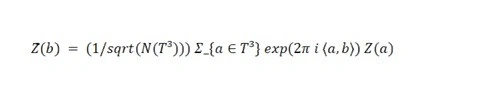
Equivalently, the torsion-sector partition function may be regarded as a state vector in a finite-dimensional Hilbert space carrying the above Heisenberg-group action, and the choice of labeling by torsion C-holonomy or torsion G₄ flux is a choice of basis related by the transform.
Effective theory consequence: a universal BF symmetry TFT
A key prediction is the presence of a universal topological sector in the effective theory, determined by torsion data. In the simplest illustrative case T⁴ ≅ ℤₖ, the effective 4D description contains a BF-type term that encodes a ℤₖ discrete gauge structure and associated higher-form symmetry data.

Within TPD, the discrete braiding phase between the particle excitation (from an M2 wrapped on a torsion 3-cycle) and the string excitation (from an M5 wrapped on a torsion 4-cycle) is exactly the Fourier kernel exp(2π i ⟨a,b⟩).
Brane interpretation: wrapped M2 and M5 braiding as the kernel
TPD admits a direct brane interpretation. A 4D particle can arise from an M2-brane wrapped on a torsion 3-cycle representing a class a ∈ T³, while a 4D string can arise from an M5-brane wrapped on a torsion 4-cycle representing b ∈ T⁴. The mutual braiding phase between these excitations is governed by the torsion linking pairing and matches the central phase in the Heisenberg commutator.
This identifies the torsion pairing as a universal piece of topological data translating internal manifold torsion into observable discrete phases in the effective theory.
Consistency checks and a computational program
· Compute T³, T⁴, and the linking pairing ⟨·,·⟩ for explicit compactification manifolds with known torsion and compare predicted phases.
· Derive the effective symmetry TFT via dimensional reduction in differential cohomology and verify that BF couplings reproduce the linking form data.
· Check domain wall interpolation rules induced by wrapped M5 branes between torsion sectors and verify group-law consistency with T⁴.
· Check nonperturbative selection rules from Euclidean wrapped branes and confirm compatibility with the Heisenberg commutation relation.
· Reduce on a circle to Type IIA and verify that the torsion duality structure maps to the expected discrete B-field and RR torsion sector relations.
Discussion
TPD reframes torsion flux sectors as a finite quantum system with complementary observables and a canonical Fourier transform relating natural descriptions. The conjecture is designed to be falsifiable: the pairing is a computable topological invariant, the Heisenberg commutator is precise, and the predicted symmetry TFT sector can be derived and compared in explicit compactifications.
A likely refinement is the inclusion of additional torsion-dependent phases arising from global action definitions and anomaly cancellation conditions. In that event, TPD should be viewed as the linear Pontryagin-dual skeleton on which quadratic refinements and gravitational corrections act.
Conclusion
Torsion Pontryagin Duality proposes that the torsion sector of the M-theory C-field is organized by a finite Heisenberg group whose central extension is determined by the torsion linking pairing of the compactification manifold, and that torsion C-holonomy and torsion G₄ flux labelings are related by a canonical discrete Fourier transform. The conjecture unifies torsion flux complementarity, symmetry TFT BF couplings in the effective theory, and brane-braiding phases for wrapped M2 and M5 excitations. If correct, it provides a compact, topology-first dictionary from torsion in X₇ to discrete quantum data in the effective theory.
References
Witten, E. (1996). On Flux Quantization in M-Theory and the Effective Action. arXiv:hep-th/9609122.
Diaconescu, D.-E., Moore, G., & Witten, E. (2000). E8 Gauge Theory, and a Derivation of K-Theory from M-Theory. arXiv:hep-th/0005090.
Freed, D. S. (2000). Dirac Charge Quantization and Generalized Differential Cohomology. arXiv:hep-th/0011220.
Freed, D. S., Moore, G. W., & Segal, G. (2007). Heisenberg Groups and Noncommutative Fluxes. Annals of Physics, 322, 236–285. arXiv:hep-th/0605200.
van Beest, M., et al. (2023). Differential cohomology and dimensional reduction in M-theory: torsion and BF couplings. JHEP 02 (2023) 226.
Casas, G. F., Marchesano, F., & Zatti, M. (2023). Torsion in cohomology and dimensional reduction. arXiv:2306.14959.
Mayrhofer, C., Palti, E., Till, O., & Weigand, T. (2014). On Discrete Symmetries and Torsion Homology in F-Theory. arXiv:1410.7814.
Conway, A., Friedl, S., & Herrmann, G. (2016). Linking forms revisited. Pure and Applied Mathematics Quarterly, 12, 493–515.
Join the conversation! Your thoughts help the community grow.