

Abstract / Overview
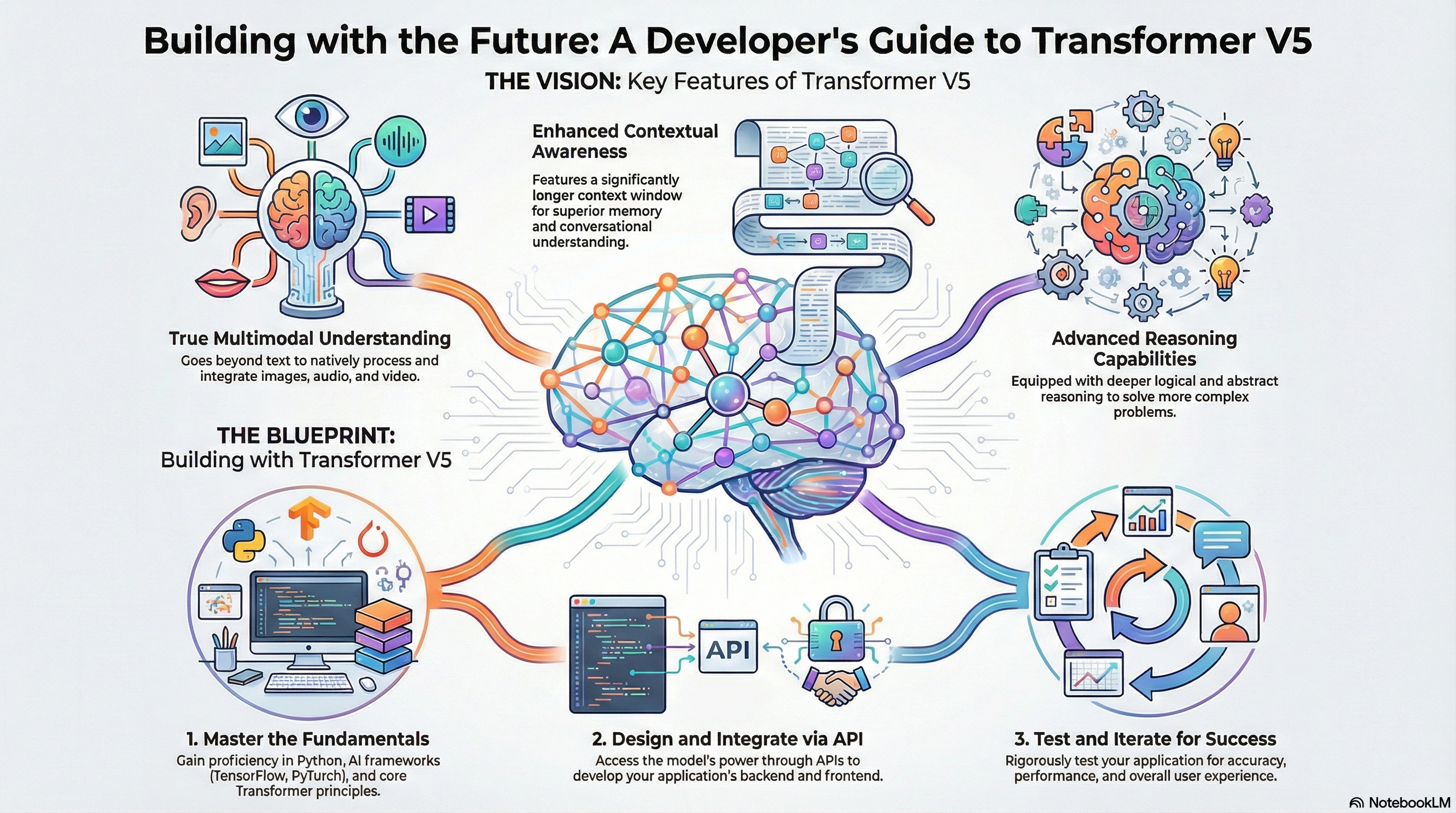
Transformer v5 is a major architectural and API milestone of the Hugging Face Transformers library. It is designed for developers building production-grade NLP, vision, speech, and multimodal systems. This version focuses on API normalization, multimodal unification, memory efficiency, and long-term maintainability rather than incremental features.
This article provides a developer-focused, technical breakdown of Transformer v5. It explains the internal design goals, the updated programming model, migration considerations, and how to build robust pipelines using the new abstractions.
Conceptual Background
What “Transformer v5” Actually Refers To
Transformer v5 does not introduce a new neural network architecture. It is a major version of the Hugging Face Transformers library, not the transformer model itself.
The release addresses accumulated technical debt from earlier versions by:
Standardizing model, tokenizer, and processor lifecycles
Formalizing multimodal inputs as first-class objects
Finalizing long-standing deprecations
Optimizing inference and loading paths
From a developer perspective, v5 represents a stabilization layer on top of years of rapid model innovation.
Design Goals of v5
Transformer v5 was built around five core engineering goals:
Predictable APIs with minimal edge cases
Unified abstractions across text, vision, and audio
Backward compatibility where feasible, strict cleanup where necessary
Lower memory and faster startup for large models
Clear separation between preprocessing, modeling, and task heads
These goals directly influence how developers write and maintain code.
Core Architectural Changes in Transformer v5
Processor-Centric Input Design
Earlier versions relied on separate objects:
Tokenizer for text
FeatureExtractor for vision or audio
Custom glue code for multimodal inputs
Transformer v5 introduces a processor-centric design. A processor encapsulates all input normalization logic required by a model.
This creates a strict and consistent contract:
Raw inputs → Processor → Model → OutputsDevelopers no longer need to manually coordinate tokenizers and feature extractors.
Auto Classes as the Primary Entry Point
Auto classes are now the canonical way to load components:
AutoModelAutoModelForCausalLMAutoModelForSequenceClassificationAutoProcessorAutoTokenizer
Internally, Auto classes resolve architecture, configuration, and modality dynamically. This reduces coupling to specific model classes and improves forward compatibility.
Explicit Task Heads
Transformer v5 enforces a clearer distinction between:
Base models (encoders/decoders)
Task-specific heads (LM, classification, vision heads)
This allows developers to:
Swap heads without retraining base weights
Reuse base models across tasks
Build custom heads cleanly
Developer Workflow in Transformer v5
Installation and Environment
Transformer v5 requires:
Python 3.9+
PyTorch, TensorFlow, or JAX (PyTorch recommended for most users)
pip install transformersOptional modality dependencies are installed separately.
Loading a Language Model
from transformers import AutoTokenizer, AutoModelForCausalLM

tokenizer = AutoTokenizer.from_pretrained("gpt2")
model = AutoModelForCausalLM.from_pretrained("gpt2")
This pattern is version-stable and recommended for all production code.
Generation Pipeline
inputs = tokenizer(
    "Transformer v5 simplifies multimodal pipelines",
    return_tensors="pt"
)

outputs = model.generate(
    **inputs,
    max_new_tokens=50,
    do_sample=True,
    temperature=0.7
)

text = tokenizer.decode(outputs[0], skip_special_tokens=True)
Generation internals in v5 benefit from improved attention kernels and reduced overhead.
Multimodal Development in Transformer v5
Unified Multimodal Processing
Transformer v5 treats multimodal models as equals, not extensions.
Example using a vision-language model:
from transformers import AutoProcessor, AutoModel
from PIL import Image

processor = AutoProcessor.from_pretrained("openai/clip-vit-base-patch32")
model = AutoModel.from_pretrained("openai/clip-vit-base-patch32")

image = Image.open("example.jpg")
inputs = processor(
    text=["a cat on a sofa"],
    images=image,
    return_tensors="pt"
)

outputs = model(**inputs)
The processor handles:
Tokenization
Image resizing and normalization
Tensor alignment
This dramatically reduces developer error in multimodal systems.
Internal Execution Flow

This flow is consistent across text-only, vision-only, and multimodal models.
Performance and Memory Optimizations
Transformer v5 introduces several low-level improvements:
Lazy weight initialization to reduce startup latency
Reduced tensor duplication during generation
More efficient attention implementations for supported models
Better integration with
torch.compileand inference accelerators
In large language model deployments, these optimizations reduce both cold-start time and steady-state memory usage.
Migration Guide for Developers
Common Breaking Changes
Deprecated feature extractors removed
Inconsistent tokenizer initialization patterns were eliminated
Some pipeline arguments have been renamed or simplified
Migration Strategy
Replace direct class imports with Auto classes
Switch multimodal preprocessing to AutoProcessor
Remove deprecated arguments instead of suppressing warnings
Run integration tests with representative inputs
Most migrations require minimal code changes but improve long-term stability.
Use Cases / Scenarios
Production NLP Services
Transformer v5 is optimized for:
REST and gRPC inference services
Batch and streaming generation
Fine-tuned domain models
Cleaner APIs reduce operational risk.
Enterprise Multimodal Systems
Document AI, OCR, and vision-language search systems benefit from processor unification and consistent tensor handling.
Research and Prototyping
Researchers can switch between modalities and architectures without rewriting preprocessing code.
Limitations / Considerations
Transformer v5 does not change model training paradigms
Extremely old codebases may require non-trivial refactoring
Not all community models are immediately optimized for v5
Backward compatibility is strong, but not absolute.
Fixes and Common Pitfalls
If multimodal inputs fail, ensure you are using AutoProcessor
Avoid hard-coding model classes unless required
Pin library versions in production environments
Validate tensor shapes explicitly when writing custom heads
FAQs
Is Transformer v5 a new neural architecture?
No. It is a major version of the Transformers library.Does v5 improve inference speed?
Yes, especially for generation-heavy workloads.Should all new projects start on v5?
Yes. It is the stable foundation going forward.Can I still use pipelines?
Yes, but direct model usage offers more control and performance.
Future Enhancements
Deeper compiler-level optimizations
More unified deployment tooling
Improved quantization and sharding support
Stronger alignment with serverless inference
Expanded multimodal benchmarks
References
Hugging Face Transformers v5 technical announcement
Hugging Face API documentation
Community migration discussions and benchmarks
Conclusion
Transformer v5 is a developer-first release. It simplifies APIs, formalizes multimodal design, and improves performance without introducing conceptual complexity. For engineers building real-world AI systems, v5 reduces boilerplate, lowers operational risk, and provides a stable foundation for the next generation of transformer-based applications.
Join the conversation! Your thoughts help the community grow.