

Introduction
In this article I describe how to create Windows Store Apps for page transition using JavaScript. Use page animation to bring the first page of an application onto the screen or when transitioning to a new page. The contents of the new page animates in two sections. When we navigate to a second page then the first data is shown from the first section and than data is shown from the second section of the same page.
Put the app in a Snap view to see the Snap version of this animation. The snap view is always a fixed 320px in width, which allows developers to refine and create a targeted view for this size. A width of 320px is a common and familiar size that developers are already designing for on various phone platforms. I assume you can create a simple Windows Store App using JavaScript; for more help visit Simple Windows Store Apps using JavaScript.
To start the creation of the apps, add three JavaScript pages by right-clicking on the js folder in the Solution Explorer and select Add > new item > JavaScript Page and then give an appropriate name. In the same way, add two HTML pages to your project.
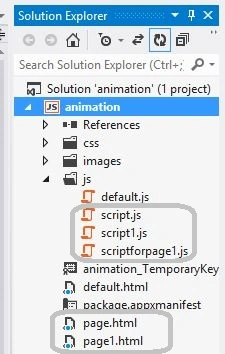
Write the following code in the default.html:
<!DOCTYPE html>
<html>
<head>
<meta charset="utf-8" />
<title>App</title>
<link rel="stylesheet" href="//Microsoft.WinJS.1.0/css/ui-light.css" />
<script src="//Microsoft.WinJS.1.0/js/base.js"></script>
<script src="//Microsoft.WinJS.1.0/js/ui.js"></script>
<link rel="stylesheet" href="/sample-utils/sample-utils.css" />
<link rel="stylesheet" href="/css/default.css" />
<script src="/js/script.js"></script>
<script src="/js/default.js"></script>
</head>
<body role="application" style="background-color: darksalmon">
<center><div id="rootGrid">
<div id="content">
<h1 id="featureLabel"></h1>
<div id="contentHost"></div>
</div>
</div></center>
</body>
</html>
Write the following code in the default.js:
(function () {
"use strict";
var sampleTitle = "";
var scenarios = [
{ url: "page.html" }
];
function activated(eventObject) {
if (eventObject.detail.kind === Windows.ApplicationModel.Activation.ActivationKind.launch) {
eventObject.setPromise(WinJS.UI.processAll().then(function () {
var url = WinJS.Application.sessionState.lastUrl || pages[0].url;
return WinJS.Navigation.navigate(url);
}));
}
}
WinJS.Navigation.addEventListener("navigated", function (eventObject) {
var url = eventObject.detail.location;
var host = document.getElementById("contentHost");
host.winControl && host.winControl.unload && host.winControl.unload();
WinJS.Utilities.empty(host);
eventObject.detail.setPromise(WinJS.UI.Pages.render(url, host, eventObject.detail.state).then(function () {
WinJS.Application.sessionState.lastUrl = url;
}));
});
WinJS.Namespace.define("App", {
sampleTitle: sampleTitle,
pages: pages
});
WinJS.Application.addEventListener("activated", activated, false);
WinJS.Application.start();
})();
Write the following code in the page.html:
<!DOCTYPE html>
<html>
<head>
<title></title>
<script src="/js/script.js"></script>
</head>
<body>
<div id="input" data-win-control="Apps.pageInput">
<button id="runAnimation">Animate the page</button><br /><br />
</div>
<div id="output" data-win-control="Apps.pageOutput">
<p id="outputText" />
</div>
</body>
</html>


Deepak MiddhaPosted Oct 1, 2012, 6:12 AM
Thanks Gaurav.
Gaurav GuptaPosted Oct 1, 2012, 3:23 AM
Great deepak! Your Articles are vary help full and provide the Deep knowledge of the subject.