

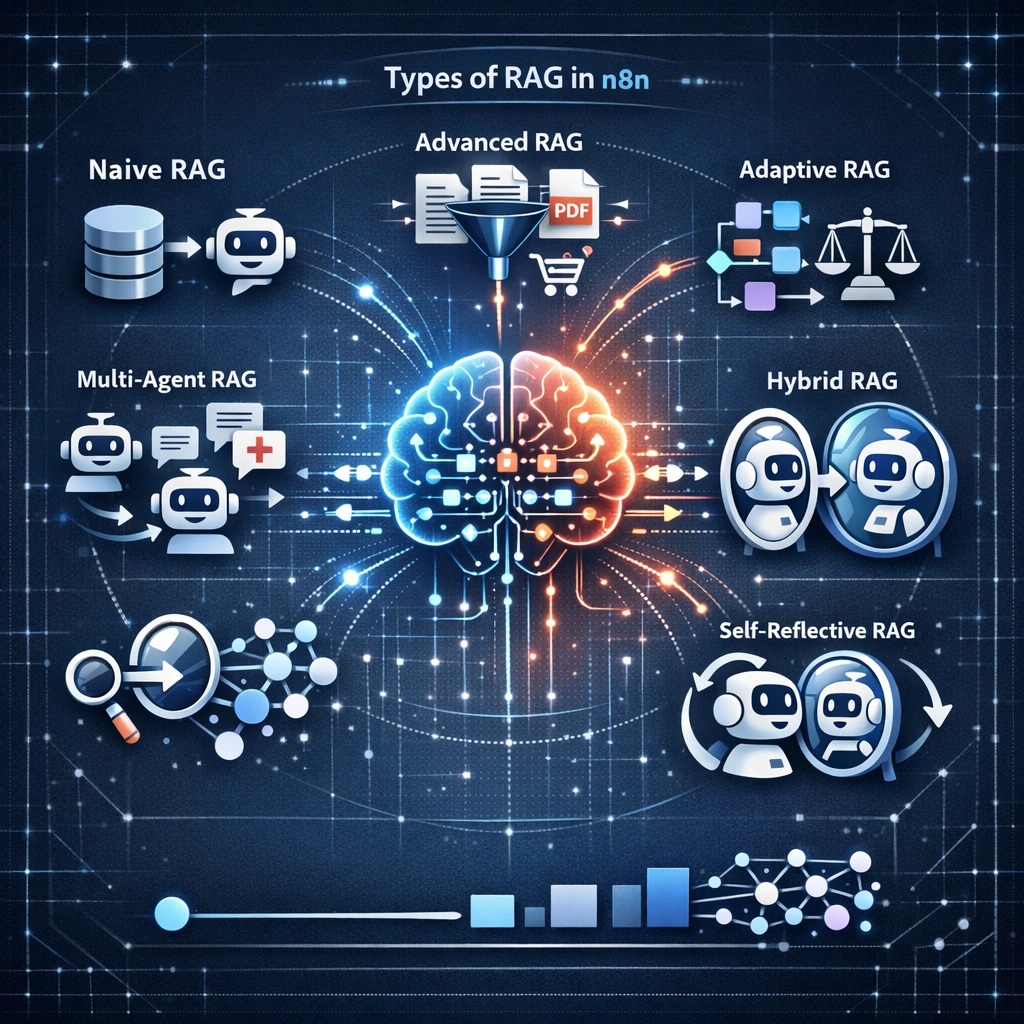
What is RAG?
Retrieval-Augmented Generation (RAG) is a technique where an AI model retrieves relevant data from an external knowledge base (like PDFs, databases, APIs) and uses it to generate accurate responses.
Instead of relying only on trained knowledge, RAG adds real-time, domain-specific context to the AI.
In n8n, RAG is implemented using workflows that:
Ingest data (PDF, DB, API)
Convert it into embeddings
Store in vector DB
Retrieve relevant data during query
Generate an answer using LLM
Why Use RAG in n8n?
Without RAG:
AI gives generic or outdated answers
High chance of hallucination
With RAG:
Accurate answers from your own data
Real-time knowledge (not limited to training data)
Full control over data sources
Reduced hallucination
n8n makes it powerful because:
You can build entire RAG pipelines visually
No need for complex backend code
Types of RAG in n8n
Now let’s break down the main types of RAG
1. Naive RAG (Simple RAG)
What
Basic RAG: Query → Retrieve → Generate
Why
Easiest to build
Good for simple use cases
Where to Use
FAQ bots
Small document search
Internal knowledge base
When to Use
When the data is small and straightforward
How (n8n Flow)
Upload documents
Convert to embeddings
Store in vector DB
Retrieve top results
Send to LLM
Real Example
HR chatbot answering:
“What is leave policy?”
Limitation: No filtering → may return irrelevant data
2. Advanced RAG (Re-ranking / Filtering)
What
Adds:
Re-ranking
Filtering the best results
Why
Improves accuracy
Removes irrelevant chunks
Where
Customer support bots
Legal / policy systems
When
When precision matters
How (n8n)
Retrieve Top 10 results
Apply scoring (AI/rules)
Select the best 3
Pass to LLM
Real Example
Banking chatbot:
Retrieves policies
Filters only relevant loan rules
3. Adaptive RAG
What
RAG that changes strategy based on query type
Why
Different queries need different retrieval logic
Where
AI assistants
Multi-purpose chatbots
When
When queries vary (fact, opinion, analysis)
How (n8n)
Classify query:
Factual
Analytical
Opinion
Apply a different retrieval strategy
Example from n8n workflow:
Fact → direct retrieval
Analytical → deeper search
Real Example
User asks:
“What is GST?” → Simple retrieval
“Compare GST vs VAT” → Multi-document reasoning
4. Multi-Agent RAG
What
Multiple AI agents working together:
Retriever Agent
Analyzer Agent
Generator Agent
Why
Handles complex workflows
Where
Enterprise AI systems
Research assistants
When
Complex tasks with multiple steps
How (n8n)
Agent 1 → Understand query
Agent 2 → Retrieve data
Agent 3 → Generate answer
Real Example
Legal AI:
The agent finds the laws
Another interprets
Another summarizes
5. Hybrid RAG (Vector + Keyword Search)
What
Combines:
Semantic search (vector)
Keyword search
Why
Improves retrieval accuracy
Where
Large datasets
Enterprise search
When
When vector search alone is not enough
How (n8n)
Query → run both searches
Merge results
Send best to LLM
Real Example
E-commerce chatbot:
“Red Nike shoes under 5k”
Uses keyword + semantic search
6. Self-Reflective / Iterative RAG
What
RAG that checks its own answer and retries
Why
Reduces wrong answers
Where
Critical systems (finance, healthcare)
When
High accuracy required
How (n8n)
Generate answer
Validate with the second prompt
If wrong → retrieve again
Real Example
Medical assistant double-checks diagnosis
Where RAG is Used in Real Life
Internal company knowledge bots
PDF-based assistants
E-commerce recommendation systems
Healthcare Q&A systems
Legal document analysis
When Should You Use Which Type?
Use Case | Best RAG Type
Simple chatbot | Naive RAG
Accurate answers | Advanced RAG
Mixed queries | Adaptive RAG
Complex workflows | Multi-Agent RAG
Large datasets | Hybrid RAG
Critical systems | Self-Reflective RAG
How to Build RAG in n8n (Simple Steps)
Data Ingestion (PDF/API/DB)
Chunking
Embedding generation
Store in Vector DB
Retrieval (Top-K results)
Prompt + LLM response
n8n allows all this in one visual workflow, avoiding complex integrations
RAG is not just one technique; it’s a design choice.
Choosing the right RAG type:
Wrong → hallucination, poor answers
Right → accurate, scalable AI system
In n8n, you can start simple (Naive RAG) and gradually move to:
Adaptive
Multi-Agent
Production-level RAG
Join the conversation! Your thoughts help the community grow.