

Introduction
Artificial Intelligence (AI) systems appear intelligent because they can learn, reason, adapt, and improve over time. Behind many of these capabilities lies a fundamental concept known as a loop.
Whether you're training a machine learning model, building an AI agent, or creating autonomous workflows, loops play a critical role in enabling AI systems to repeatedly evaluate, improve, and act until a desired outcome is achieved.
In this article, we'll explore what loops are in AI, why they matter, and how they power modern AI applications.
What Is a Loop?
A loop is a process that repeatedly executes a sequence of steps until a specific condition is met.
In traditional programming, loops are used to perform repetitive tasks efficiently. AI extends this concept by using loops for learning, decision-making, planning, and continuous improvement.
Think of a loop as:
Input → Process → Evaluate → Adjust → Repeat
This cycle continues until the AI system achieves its objective.
Why Are Loops Important in AI?
Without loops, AI systems would only perform a single action and stop.
Loops allow AI systems to:
Learn from data
Improve accuracy
Refine decisions
Adapt to changing conditions
Solve complex multi-step problems
Operate autonomously
Most modern AI systems rely heavily on iterative loops.
1. Training Loops in Machine Learning
Training a machine learning model is essentially one large loop.
The process typically follows these steps:
Receive training data
Make predictions
Compare predictions with expected results
Calculate error
Adjust model parameters
Repeat
This process may run thousands or millions of times.
Example
A model learning to recognize cats in images:
Predict: "Dog"
Actual answer: "Cat"
Error calculated
Model weights adjusted
Repeat with more images
Over time, the model becomes increasingly accurate.
Training Loop Diagram
Data → Prediction → Error Calculation → Learning → Repeat
2. Feedback Loops
Feedback loops allow AI systems to learn from outcomes and user interactions.
Popular examples include:
Recommendation Systems
Netflix, YouTube, and Spotify use feedback loops.
Process:
Recommend content
User watches or skips
System records behavior
Recommendations improve
Process repeats
The more users interact, the smarter the recommendations become.
Search Engines
Search engines continuously refine rankings based on user behavior and feedback.
3. Reinforcement Learning Loops
Reinforcement Learning (RL) is built entirely around loops.
The AI agent:
Observes the environment
Takes an action
Receives a reward or penalty
Learns from the outcome
Repeats
Example
Teaching a robot to walk:
Take a step
Did it stay balanced?
Receive reward
Adjust movement
Try again
Thousands of iterations eventually produce effective walking behavior.
Reinforcement Learning Cycle
Observe → Act → Reward → Learn → Repeat
4. AI Agent Loops
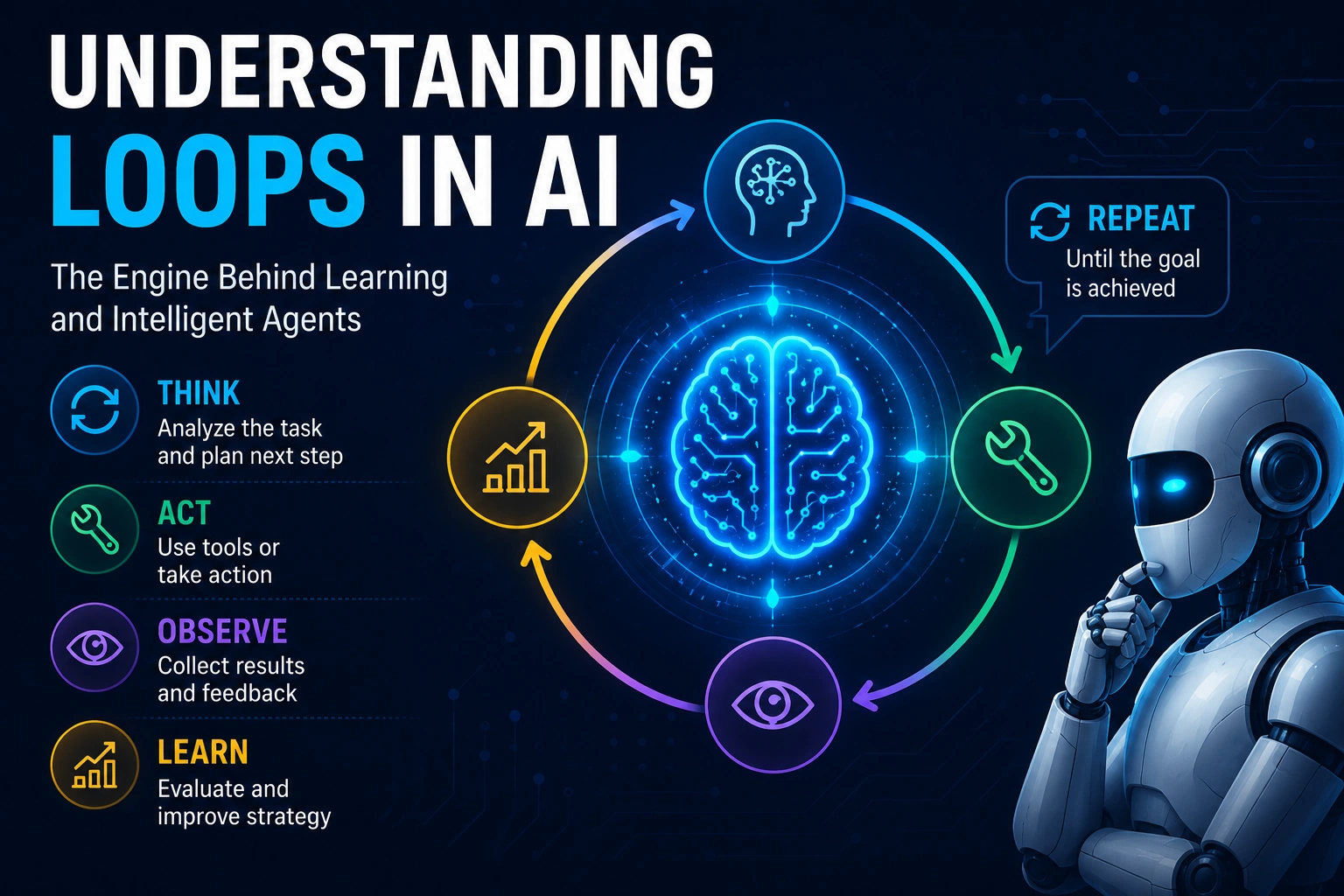
Modern AI agents such as Claude Code, OpenAI Agents, Manus, AutoGPT, and enterprise AI assistants operate using agent loops.
The most common pattern is:
Think → Act → Observe → Repeat
Example:
A user asks:
"Find the top five AI startups in healthcare and summarize them."
The agent:
Thinks about the task
Searches the web
Reads results
Evaluates findings
Searches again if needed
Creates summary
Delivers answer
Instead of generating a response in one step, the agent continuously loops until the task is complete.
5. Human-in-the-Loop AI
Many enterprise AI systems include humans within the loop.
Process:
AI generates recommendation
Human reviews
Human approves or rejects
AI learns from feedback
Process improves over time
Examples:
Medical diagnosis systems
Financial approval workflows
Legal document review
Content moderation systems
Human-in-the-loop approaches often improve accuracy and reduce risk.
6. Multi-Agent Loops
Advanced AI systems may involve multiple agents working together.
Example:
Research Agent
Collects information.
Analyst Agent
Evaluates findings.
Writer Agent
Creates reports.
Reviewer Agent
Checks quality.
These agents continuously exchange information through loops until the final result meets quality standards.
Loops in Generative AI
Large Language Models (LLMs) are trained using massive training loops.
During inference, advanced AI applications may create additional loops such as:
Reflection loops
Verification loops
Critique loops
Self-correction loops
Example:
Generate answer
Review answer
Identify weaknesses
Improve answer
Return final response
This approach often produces significantly higher-quality results.
A Simple AI Agent Loop in C#
while (!taskCompleted)
{
    AnalyzeTask();

    var result = ExecuteAction();

    taskCompleted = EvaluateResult(result);
}
This simple structure forms the foundation of many modern AI agent architectures.
Common Loop Patterns in AI
| Loop Type | Purpose |
|---|---|
| Training Loop | Learn from data |
| Feedback Loop | Improve from outcomes |
| Reinforcement Loop | Learn through rewards |
| Agent Loop | Complete complex tasks |
| Human-in-the-Loop | Include human oversight |
| Multi-Agent Loop | Coordinate multiple AI systems |
| Reflection Loop | Self-correct outputs |
Challenges with AI Loops
While loops are powerful, they also introduce challenges.
Infinite Loops
An AI agent may continue searching or reasoning indefinitely.
Cost Explosion
Every loop may consume tokens, API calls, and compute resources.
Hallucination Reinforcement
Poor feedback loops can amplify incorrect information.
Latency
Multiple iterations increase response time.
Effective AI systems include safeguards to control loop depth, cost, and quality.
The Future: Autonomous Agentic Systems
The next generation of AI systems is moving toward autonomous agents capable of:
Planning
Executing tasks
Using tools
Collaborating with other agents
Learning from results
At the core of these systems are increasingly sophisticated loops.
As AI evolves from simple chat interfaces into autonomous digital workers, understanding loops becomes essential for developers, architects, and business leaders.
Conclusion
Loops are one of the most fundamental concepts in Artificial Intelligence. They enable machines to learn, adapt, improve, and solve complex problems through repetition and feedback.
From machine learning training and recommendation systems to autonomous AI agents and multi-agent workflows, loops serve as the engine that powers modern AI.
As agentic AI becomes mainstream, mastering AI loops will become as important as understanding functions and classes in traditional software development.
The future of AI is not just about generating answers—it's about intelligently looping through thinking, acting, observing, and improving until the best outcome is achieved.
Join the conversation! Your thoughts help the community grow.