

As we navigate the AI landscape in 2026, the terminology surrounding artificial intelligence can feel like a blur of buzzwords. Organizations are rushing to adopt "agentic" systems, but treating a simple automated script the same as a fully autonomous AI can lead to disastrous architectural decisions.
To build effective AI systems, we must understand the fundamental evolution of machine action: Workflow Automation, Agent Orchestration, and Autonomous Agents.
Here is the end-to-end breakdown of how they differ, followed by a real-time use case that illustrates exactly how they operate in the wild.
1. Workflow Automation: The "Assembly Line"
The Paradigm: Deterministic, Rule-Based, Linear The Analogy: A robotic arm on a manufacturing assembly line.
Workflow automation is the foundation of modern business operations. It relies on explicit, human-coded rules: If X happens, then do Y. It excels at repetitive, predictable tasks where the environment is highly controlled.
How it works: You map out a process using tools like Zapier, Make, or traditional RPA (Robotic Process Automation). The system triggers based on specific events (e.g., a new row in a database, a webhook, a scheduled time).
The Limitation: It is brittle. If an edge case occurs that you didn’t explicitly code an "If/Then" branch for, the workflow breaks or requires human intervention. It cannot "think" or adapt.
2. Agent Orchestration: The "Project Manager"
The Paradigm: Dynamic, Multi-Agent, Goal-Oriented The Analogy: A project manager coordinating a team of specialized freelancers.
Agent orchestration represents the shift from hard-coded paths to dynamic routing. Instead of a single rigid workflow, you have an "Orchestrator" (often a central LLM or a framework like LangGraph or CrewAI) that manages a team of specialized AI agents.
How it works: You give the Orchestrator a complex objective. The Orchestrator breaks the objective down, delegates tasks to specialized agents (e.g., a "Researcher Agent," a "Coder Agent," a "Reviewer Agent"), and manages the handoffs. If the Coder Agent fails, the Orchestrator can route the error back to the Coder with new context, or ask the Reviewer Agent for help.
The Limitation: While the execution is dynamic, the boundaries are usually fixed by a human. The system is designed to solve a specific type of problem within a defined sandbox. It requires human-defined tools, APIs, and guardrails to operate safely.
3. Autonomous Agents: The "Independent Entrepreneur"
The Paradigm: Self-Directed, Adaptive, Long-Horizon The Analogy: An independent entrepreneur who identifies a market need, builds a solution, and runs the business.
Autonomous agents are the frontier of AI. They are not just executing tasks; they are perceiving their environment, setting their own sub-goals, managing their own memory over long periods, and taking actions with minimal to zero human intervention.
How it works: You give an autonomous agent a high-level, open-ended objective (e.g., "Maintain a 15% profit margin on this product line"). The agent continuously monitors real-time data, formulates strategies, writes its own scripts or queries to gather information, executes actions in the real world, evaluates the outcomes, and self-corrects.
The Limitation: Trust and alignment. Because they operate outside rigid, pre-defined workflows, they require robust sandboxing, strict ethical guardrails, and "human-on-the-loop" (rather than human-in-the-loop) oversight to ensure they don't take unintended actions to achieve their goals.
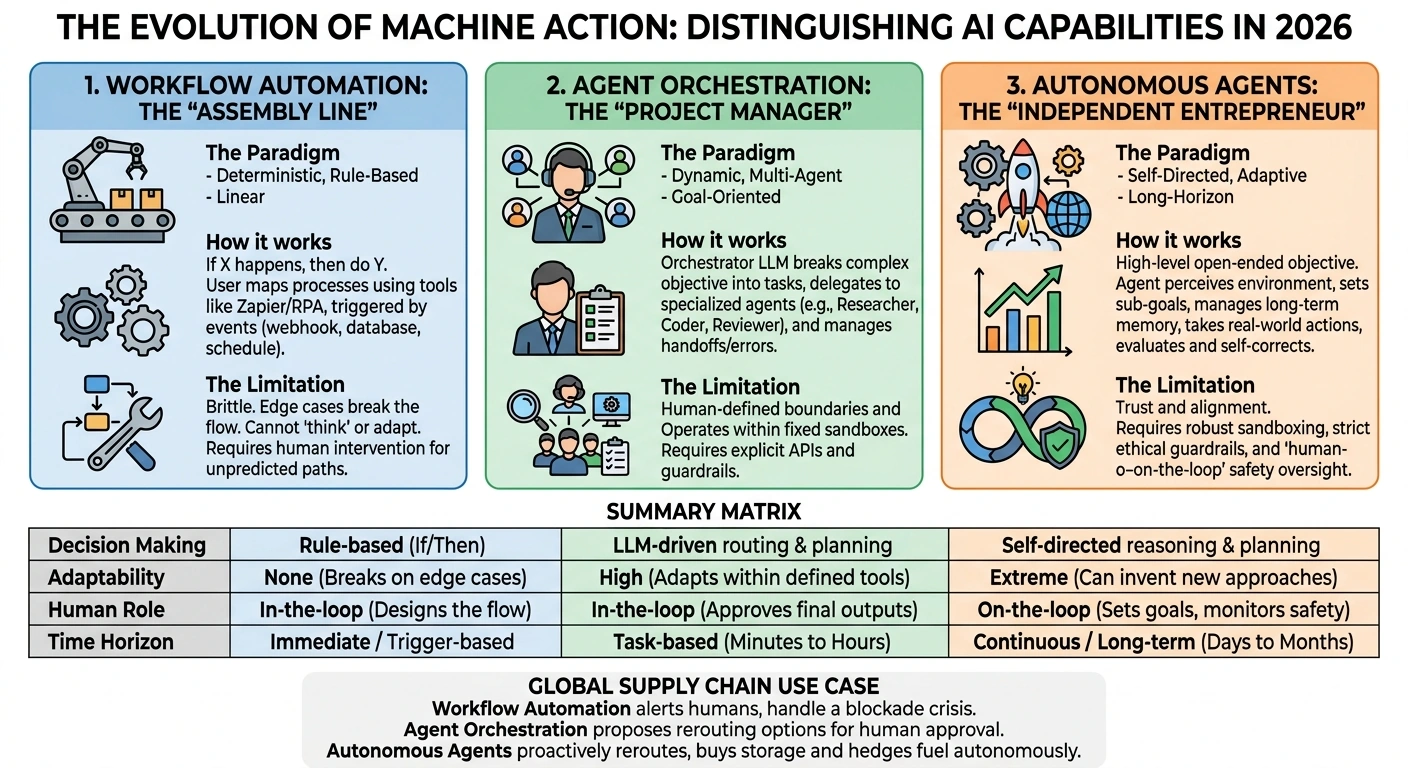
Summary Matrix
| Feature | Workflow Automation | Agent Orchestration | Autonomous Agents |
|---|---|---|---|
| Decision Making | Rule-based (If/Then) | LLM-driven routing & planning | Self-directed reasoning & planning |
| Adaptability | None (Breaks on edge cases) | High (Adapts within defined tools) | Extreme (Can invent new approaches) |
| Human Role | In-the-loop (Designs the flow) | In-the-loop (Approves final outputs) | On-the-loop (Sets goals, monitors safety) |
| Time Horizon | Immediate / Trigger-based | Task-based (Minutes to Hours) | Continuous / Long-term (Days to Months) |
Real-Time Use Case: Global Supply Chain & Fleet Routing
To truly understand the difference, let’s look at a real-time scenario: A global logistics company managing a fleet of cargo ships and trucks during a sudden, unpredicted geopolitical crisis.
The Scenario
It is 2:00 PM on a Thursday. A sudden, unannounced military blockade closes a major global shipping strait. Hundreds of ships and thousands of trucks carrying perishable goods are suddenly facing massive delays.
Here is how the three paradigms handle this real-time crisis.
1. The Workflow Automation Approach (The Alarm Bell)
The Action: An API webhook connects a global maritime tracking database to the company’s internal ERP system.
The Logic:
IFa ship's GPS coordinates remain static for > 2 hours in the blockade zoneTHENchange status to "Delayed" and send an automated Slack alert to the Human Dispatch Team.The Result: The humans are alerted immediately. However, the system does nothing else. The humans must now manually open maps, calculate new routes, call trucking companies, and email customers. The automation only notifies; it does not solve.
2. The Agent Orchestration Approach (The War Room)
The Action: The company deploys a "Crisis Response Orchestrator."
The Logic: The Orchestrator receives the real-time data about the blockade. It immediately spins up a team of specialized agents:
Geospatial Agent: Scans real-time satellite and weather data to find viable alternative ocean routes or emergency ports.
Financial Agent: Calculates the fuel cost and time penalty of the new routes vs. the cost of the spoiling perishable goods.
Communications Agent: Drafts personalized emails to the affected clients explaining the delay and offering discounts.
The Result: Within 4 minutes, the Orchestrator presents the Human Dispatch Team with three optimized rerouting options, complete with cost analyses and pre-drafted client emails. The human selects "Option B," and the system executes the updates. The AI coordinated a complex solution, but a human made the final executive call.
3. The Autonomous Agent Approach (The Self-Driving Supply Chain)
The Action: The company employs an "Autonomous Supply Chain Director" that runs continuously in the background, monitoring global news, weather, and market prices 24/7.
The Logic
Predictive Action: Three days before the blockade, the Autonomous Agent noticed a spike in regional military movements via open-source intelligence and satellite imagery. It proactively rerouted three ships to avoid the zone entirely.
Real-Time Reaction: For the ships already caught in the blockade at 2:00 PM, the Agent doesn't wait for a human. It instantly accesses a global spot-market API, autonomously negotiates and purchases emergency cold-storage warehouse space at a nearby neutral port for the perishable goods.
Financial Hedging: Recognizing that the blockade will spike the price of alternative fuels, the Agent autonomously executes micro-hedging contracts on the commodities market to protect the company's margins.
Customer Autonomy: It dynamically rewrites the SLAs (Service Level Agreements) for affected clients in real-time and issues automated crypto-micro-refunds to maintain customer trust.
The Result: The human logistics manager wakes up the next morning to a dashboard summary: "Blockade detected. 4 ships rerouted. 12 shipments secured in emergency cold storage. Fuel costs hedged. Estimated savings: $4.2M. No human intervention required."
The Takeaway for 2026 and Beyond
The future of enterprise AI is not about choosing one of these paradigms over the others; it is about layering them.
Use Workflow Automation for the boring, 100% predictable tasks (payroll, data entry).
Use Agent Orchestration for complex, high-stakes tasks that require AI reasoning but demand human accountability (legal document review, complex customer support escalations).
Deploy Autonomous Agents for continuous, open-ended optimization where the environment changes faster than humans can react (algorithmic trading, cybersecurity threat hunting, dynamic supply chain management).
Understanding the boundary between a rigid script, a coordinated AI team, and a self-directed AI entity is the key to building systems that don't just work in a demo, but survive in the real world.
Join the conversation! Your thoughts help the community grow.