

Introduction
In modern enterprise AI architectures, data exists in two distinct forms: structured transactional records (purchases, logins, support tickets) and unstructured behavioral narratives (chat logs, email sentiment, call transcripts). Traditional machine learning pipelines often treat these as separate domains, leading to fragmented user profiles. A feature store acts as the central nervous system, unifying these signals into a single, queryable entity. However, static feature stores fail to capture the dynamic context required for real-time decision-making.
This article demonstrates how to build an intelligent system that not only stores unified features but also uses them within a Multi-Agent Retrieval-Augmented Generation (RAG) framework powered by LangGraph. By combining a robust feature store with stateful agent orchestration, we can create systems that understand both what a customer did (transactional) and how they felt about it (NLP-derived), enabling highly personalized and context-aware interventions.
The Challenge: Siloed Data in Enterprise AI
Enterprises typically maintain transactional data in SQL databases or data warehouses, while NLP-derived insights reside in vector stores or document management systems. When building AI applications, engineers face several challenges:
Latency: Joining large transactional tables with vector search results in real-time is computationally expensive.
Context Loss: NLP models often lack access to recent transactional history, leading to generic responses.
Stale Features: Batch-updated feature stores may not reflect immediate behavioral shifts detected via NLP.
A unified feature store solves this by pre-computing and serving "hybrid" features—such as "sentiment-adjusted purchase frequency"—that are ready for low-latency retrieval.
Key Concepts: Transactional vs. NLP-Derived Behavioral Signals
Transactional Signals: Hard metrics like
total_spend_last_30_days,avg_order_value,support_ticket_count, anddays_since_last_login. These are precise, numerical, and time-bound.NLP-Derived Behavioral Signals: Soft metrics extracted from unstructured text, such as
frustration_score(from chat logs),intent_category(e.g., "billing inquiry" vs. "technical issue"),urgency_level, andtopic_coherence. These provide context and emotional nuance.Unified Hybrid Features: Combinations like
spend_per_sentiment_unitorticket_resolution_time_adjusted_for_complexity. These features bridge the gap between behavior and outcome.
Real-Time Use Case: Dynamic Customer Support Routing
Scenario: "GlobalBank" wants to route incoming support chats to the most appropriate agent tier. A simple rule-based system might route high-value customers to premium agents. However, a high-value customer who is currently expressing extreme frustration in their chat message requires immediate, empathetic handling, regardless of their standard tier.
Objective: Build a system where:
Feature Store provides the customer’s transactional history (
total_spend,vip_status).NLP Engine analyzes the live chat message for
frustration_scoreandintent.Multi-Agent LangGraph retrieves these unified features, reasons about the best routing strategy using historical case studies (RAG), and outputs a routing recommendation with justification.
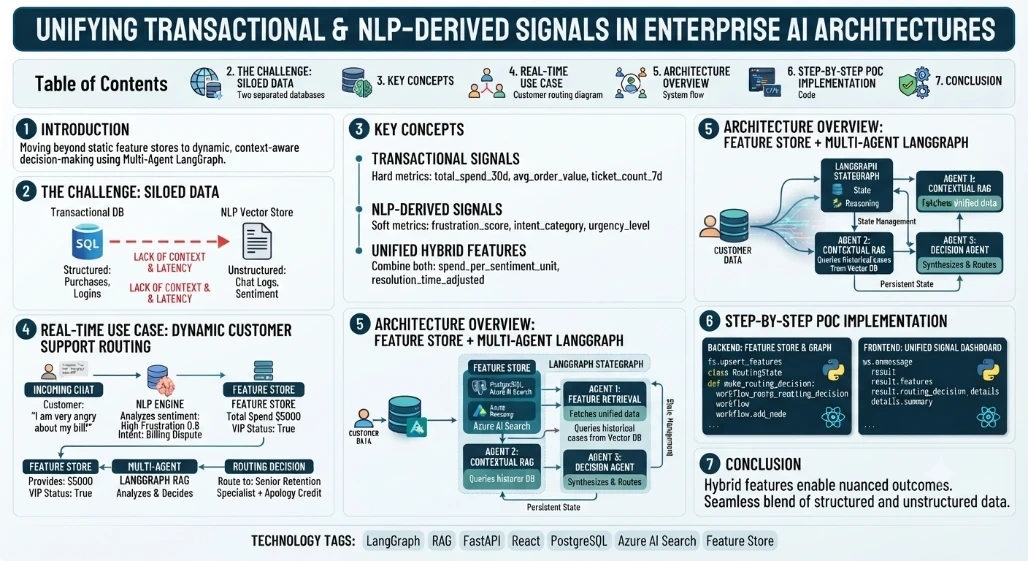
Architecture Overview: Feature Store + Multi-Agent LangGraph
We use a lightweight in-memory feature store for the POC, mimicking production systems like Feast or Tecton. The LangGraph workflow includes:
Feature Retrieval Agent: Fetches transactional and NLP features from the store.
Contextual RAG Agent: Searches a vector database for similar past cases based on unified features.
Decision Agent: Synthesizes features and retrieved cases to make a routing decision.
State Management: LangGraph’s
StateGraphmaintains the conversation context and feature snapshot across agent steps.
Step-by-Step POC Implementation
Backend: Feature Store Schema, Ingestion, and Retrieval
We define a simple feature store using Python dictionaries and Pydantic models for validation.
# backend/feature_store.py
from pydantic import BaseModel, Field
from typing import Optional
import uuid

class CustomerFeatures(BaseModel):
    customer_id: str
    total_spend_30d: float = 0.0
    vip_status: bool = False
    ticket_count_7d: int = 0
    # NLP-derived features
    avg_frustration_score: float = 0.0  # 0-1 scale
    last_intent: str = "general"

class FeatureStore:
    def __init__(self):
        self.store = {}

    def upsert_features(self, features: CustomerFeatures):
        self.store[features.customer_id] = features

    def get_features(self, customer_id: str) -> Optional[CustomerFeatures]:
        return self.store.get(customer_id)

# Mock initialization
fs = FeatureStore()
fs.upsert_features(CustomerFeatures(
    customer_id="CUST_001",
    total_spend_30d=5000.0,
    vip_status=True,
    ticket_count_7d=2,
    avg_frustration_score=0.8,
    last_intent="billing_dispute"
))
Multi-Agent Graph: State, Memory, and Reasoning
We use LangGraph to orchestrate the agents. The state holds the customer ID, current message, retrieved features, and final decision.
# backend/graph.py
from typing import TypedDict, Annotated, List
from langgraph.graph import StateGraph, END
from langchain_core.messages import HumanMessage, AIMessage
import operator
from .feature_store import fs, CustomerFeatures

class RoutingState(TypedDict):
    customer_id: str
    chat_message: str
    features: Optional[CustomerFeatures]
    retrieved_cases: List[str]
    routing_decision: str
    messages: Annotated[List, operator.add]

def retrieve_features(state: RoutingState):
    """Agent 1: Fetches unified features from the store"""
    features = fs.get_features(state["customer_id"])
    if not features:
        return {"features": None, "messages": [AIMessage(content="Customer not found")]}
    return {"features": features, "messages": [AIMessage(content=f"Features retrieved: VIP={features.vip_status}, Frustration={features.avg_frustration_score}")]}

def retrieve_historical_cases(state: RoutingState):
    """Agent 2: RAG retrieval based on unified features"""
    if not state["features"]:
        return {"retrieved_cases": [], "messages": []}

    # Simulate vector search using feature similarity
    query_context = f"VIP:{state['features'].vip_status} Frustration:{state['features'].avg_frustration_score} Intent:{state['features'].last_intent}"
    # Mock cases
    cases = [
        "Case #101: High VIP + High Frustration -> Escalated to Senior Manager with apology credit.",
        "Case #102: Low VIP + High Frustration -> Standard agent with empathy script."
    ]
    return {"retrieved_cases": cases, "messages": [AIMessage(content=f"Retrieved {len(cases)} similar cases")]}

def make_routing_decision(state: RoutingState):
    """Agent 3: Decides routing based on features and cases"""
    features = state["features"]
    if not features:
        return {"routing_decision": "Route to General Queue", "messages": [AIMessage(content="Default routing due to missing data")]}

    if features.avg_frustration_score > 0.7 and features.vip_status:
        decision = "IMMEDIATE ESCALATION: Route to Senior Retention Specialist"
    elif features.avg_frustration_score > 0.7:
        decision = "PRIORITY ROUTING: Route to Empathy-Trained Agent"
    else:
        decision = "STANDARD ROUTING: Route to General Support Queue"

    return {"routing_decision": decision, "messages": [AIMessage(content=decision)]}

# Build Graph
workflow = StateGraph(RoutingState)
workflow.add_node("retrieve_features", retrieve_features)
workflow.add_node("retrieve_cases", retrieve_historical_cases)
workflow.add_node("decide", make_routing_decision)

workflow.set_entry_point("retrieve_features")
workflow.add_edge("retrieve_features", "retrieve_cases")
workflow.add_edge("retrieve_cases", "decide")
workflow.add_edge("decide", END)

app = workflow.compile()
Frontend: Unified Signal Dashboard
A React component displays the customer’s unified profile and the agent’s reasoning trace.
// frontend/src/components/RoutingDashboard.jsx
import { useState } from 'react';

export default function RoutingDashboard() {
  const [customerId, setCustomerId] = useState('CUST_001');
  const [result, setResult] = useState(null);

  const handleAnalyze = async () => {
    // Call FastAPI endpoint that invokes the LangGraph app
    const response = await fetch(`/api/route?customer_id=${customerId}`);
    const data = await response.json();
    setResult(data);
  };

  return (
    <div className="p-6 max-w-2xl mx-auto">
      <h2 className="text-2xl font-bold mb-4">Support Routing Assistant</h2>
      <input
        type="text"
        value={customerId}
        onChange={(e) => setCustomerId(e.target.value)}
        className="border p-2 mr-2"
      />
      <button onClick={handleAnalyze} className="bg-blue-600 text-white p-2 rounded">
        Analyze & Route
      </button>

      {result && (
        <div className="mt-6 space-y-4">
          <div className="bg-gray-100 p-4 rounded">
            <h3 className="font-semibold">Unified Features</h3>
            <pre>{JSON.stringify(result.features, null, 2)}</pre>
          </div>
          <div className="bg-green-100 p-4 rounded border-l-4 border-green-500">
            <h3 className="font-semibold">Routing Decision</h3>
            <p className="text-lg">{result.routing_decision}</p>
          </div>
          <details className="bg-white p-4 rounded shadow">
            <summary className="cursor-pointer font-medium">View Agent Reasoning Trace</summary>
            <ul className="mt-2 list-disc pl-5">
              {result.messages.map((m, i) => (
                <li key={i} className="text-sm text-gray-700">{m.content}</li>
              ))}
            </ul>
          </details>
        </div>
      )}
    </div>
  );
}
Conclusion
Unifying transactional and NLP-derived signals within a feature store transforms raw data into actionable intelligence. By integrating this store with a Multi-Agent LangGraph RAG system, enterprises can move beyond static rules to dynamic, context-aware decision-making. This POC illustrates how hybrid features enable more nuanced outcomes, such as empathetic support routing. As AI systems become more autonomous, the ability to seamlessly blend structured and unstructured data will be the cornerstone of effective enterprise AI architectures.
Join the conversation! Your thoughts help the community grow.