

Update all the upper case values to the lower case, using SQL query. You can use this for large updates in the table also.
Create database
Here, we have created a database named Test_DB and you can create it with a different name also.
- USE [master]
- GO
- /****** Object: Database [Test_DB] Script Date: 7/4/2016 7:14:32 AM ******/
- CREATE DATABASE [Test_DB]
- CONTAINMENT = NONE
- ON PRIMARY
- ( NAME = N'Test_DB', FILENAME = N'C:\Program Files\Microsoft SQL Server\MSSQL11.SQLEXPRESS\MSSQL\DATA\Test_DB.mdf' , SIZE = 3072KB , MAXSIZE = UNLIMITED, FILEGROWTH = 1024KB )
- LOG ON
- ( NAME = N'Test_DB_log', FILENAME = N'C:\Program Files\Microsoft SQL Server\MSSQL11.SQLEXPRESS\MSSQL\DATA\Test_DB_log.ldf' , SIZE = 1024KB , MAXSIZE = 2048GB , FILEGROWTH = 10%)
- GO
- ALTER DATABASE [Test_DB] SET COMPATIBILITY_LEVEL = 110
- GO
- IF (1 = FULLTEXTSERVICEPROPERTY('IsFullTextInstalled'))
- begin
- EXEC [Test_DB].[dbo].[sp_fulltext_database] @action = 'enable'
- end
- GO
- ALTER DATABASE [Test_DB] SET ANSI_NULL_DEFAULT OFF
- GO
- ALTER DATABASE [Test_DB] SET ANSI_NULLS OFF
- GO
- ALTER DATABASE [Test_DB] SET ANSI_PADDING OFF
- GO
- ALTER DATABASE [Test_DB] SET ANSI_WARNINGS OFF
- GO
- ALTER DATABASE [Test_DB] SET ARITHABORT OFF
- GO
- ALTER DATABASE [Test_DB] SET AUTO_CLOSE OFF
- GO
- ALTER DATABASE [Test_DB] SET AUTO_CREATE_STATISTICS ON
- GO
- ALTER DATABASE [Test_DB] SET AUTO_SHRINK OFF
- GO
- ALTER DATABASE [Test_DB] SET AUTO_UPDATE_STATISTICS ON
- GO
- ALTER DATABASE [Test_DB] SET CURSOR_CLOSE_ON_COMMIT OFF
- GO
- ALTER DATABASE [Test_DB] SET CURSOR_DEFAULT GLOBAL
- GO
- ALTER DATABASE [Test_DB] SET CONCAT_NULL_YIELDS_NULL OFF
- GO
- ALTER DATABASE [Test_DB] SET NUMERIC_ROUNDABORT OFF
- GO
- ALTER DATABASE [Test_DB] SET QUOTED_IDENTIFIER OFF
- GO
- ALTER DATABASE [Test_DB] SET RECURSIVE_TRIGGERS OFF
- GO
- ALTER DATABASE [Test_DB] SET DISABLE_BROKER
- GO
- ALTER DATABASE [Test_DB] SET AUTO_UPDATE_STATISTICS_ASYNC OFF
- GO
- ALTER DATABASE [Test_DB] SET DATE_CORRELATION_OPTIMIZATION OFF
- GO
- ALTER DATABASE [Test_DB] SET TRUSTWORTHY OFF
- GO
- ALTER DATABASE [Test_DB] SET ALLOW_SNAPSHOT_ISOLATION OFF
- GO
- ALTER DATABASE [Test_DB] SET PARAMETERIZATION SIMPLE
- GO
- ALTER DATABASE [Test_DB] SET READ_COMMITTED_SNAPSHOT OFF
- GO
- ALTER DATABASE [Test_DB] SET HONOR_BROKER_PRIORITY OFF
- GO
- ALTER DATABASE [Test_DB] SET RECOVERY SIMPLE
- GO
- ALTER DATABASE [Test_DB] SET MULTI_USER
- GO
- ALTER DATABASE [Test_DB] SET PAGE_VERIFY CHECKSUM
- GO
- ALTER DATABASE [Test_DB] SET DB_CHAINING OFF
- GO
- ALTER DATABASE [Test_DB] SET FILESTREAM( NON_TRANSACTED_ACCESS = OFF )
- GO
- ALTER DATABASE [Test_DB] SET TARGET_RECOVERY_TIME = 0 SECONDS
- GO
- ALTER DATABASE [Test_DB] SET READ_WRITE
- GO
Create a test table
I have created a table with TestTable name, having two columns named ID and EmailAddress, where ID is the primary key.
- USE [Test_DB]
- GO
- /****** Object: Table [dbo].[TestTable] Script Date: 7/4/2016 7:13:39 PM ******/
- SET ANSI_NULLS ON
- GO
- SET QUOTED_IDENTIFIER ON
- GO
- SET ANSI_PADDING ON
- GO
- CREATE TABLE [dbo].[TestTable](
- [ID] [int] IDENTITY(1,1) NOT NULL,
- [EmailAddress] [varchar](50) NULL
- ) ON [PRIMARY]
- GO
- SET ANSI_PADDING OFF
- GO
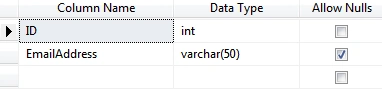
Now we have to insert some records in this table, and run the below script :
Insert value in table
- insert into TestTable(EmailAddress) values('upe**.**@***.com')
- insert into TestTable(EmailAddress) values('Upe**.**@***.com')
- insert into TestTable(EmailAddress) values('uPe**.**@***.com')
- insert into TestTable(EmailAddress) values('UPe**.**@***.com')
- insert into TestTable(EmailAddress) values('SPe**.**@***.com')
- insert into TestTable(EmailAddress) values('SPEe**.**@***.com')
- insert into TestTable(EmailAddress) values('DSF**.**@***.com')
- insert into TestTable(EmailAddress) values('FF**.**@***.com')
- insert into TestTable(EmailAddress) values('FGF**.**@***.com')
- insert into TestTable(EmailAddress) values('FF**.**@***.com')
- insert into TestTable(EmailAddress) values('UTYU**.**@***.com')
- insert into TestTable(EmailAddress) values('TYUYTU**.**@***.com')
- insert into TestTable(EmailAddress) values('RAHUL**.**@***.com')
- insert into TestTable(EmailAddress) values('RS**.**@***.com')
- insert into TestTable(EmailAddress) values('rtt**.**@***.com')
- insert into TestTable(EmailAddress) values('AWE**.**@***.com')
- insert into TestTable(EmailAddress) values('RED**.**@***.com')
See below screen
Now, we have to check the inserted record, using select query.
We found the retrieved record from the command, given below:
- select * from Testtable
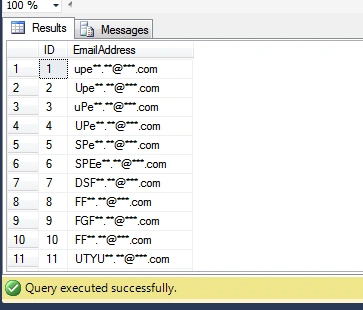
In the table, we see some records are in the upper case and some are in the lower case.
We need to update all the upper case values to the lower case. For this, we need first to know about the exact value for the upper case , which is to be update in the lower case.
How do we know if the records are in the upper case or in the lower case?
We can find these records with many queries but I am using some here:
- Select * from test_up where ASCII(left(EmailAddress, 1)) between ASCII('A')
and ASCII('Z')
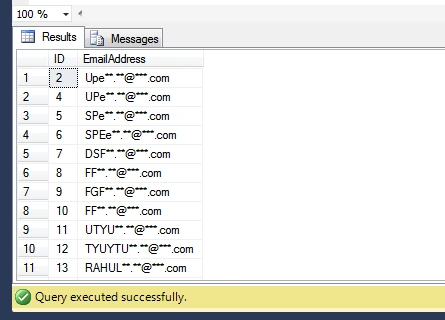
- Select * from Testtable where EmailAddress!=upper(emailaddress)COLLATE Latin1_General_CS_AS
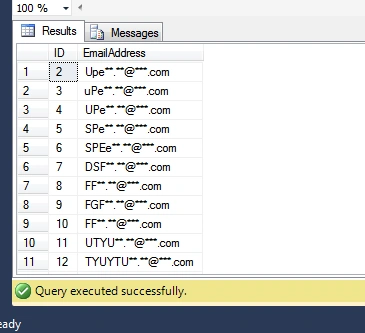
- Using function in SQL
Create a function,
Now check value using Function :- create function dbo.fnIsStringInAllUppercase(@input nvarchar(max)) returns bit
- as
- begin
- if (ISNUMERIC(@input) = 0 AND RTRIM(LTRIM(@input)) > '' AND @input = UPPER(@input COLLATE Latin1_General_CS_AS))
- return 1;
- return 0;
- end
in the select query,
From the code, given above, you can see your data, which is required to be updated.- SELECT *
- FROM Testtable
- WHERE dbo.fnIsStringAllUppercase(EmailAddress) = 1
Use the query, given below:
COMMIT TRANSACTION,- BEGIN TRANSACTION
- GO
- UPDATE [dbo].[test_up]
- SET EmailAddress = lower(EmailAddress)
- WHERE id in(select id from test_up where EmailAddress!=lower(emailaddress)COLLATE Latin1_General_CS_AS )
- GO
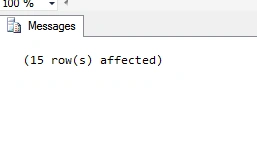
Now, we can see the table records:
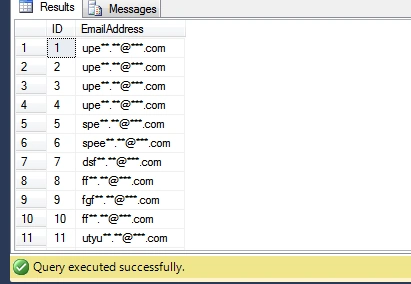
All the upper case values will convert in the lower case values.
kalu singh raoPosted Jul 7, 2016, 1:29 AM
Nice...
Gagan SharmaPosted Jul 7, 2016, 12:22 AM
Nice
RajaPosted Jul 7, 2016, 12:12 AM
Good One...