

Digital wallet creation sits at the intersection of financial inclusion, fraud prevention, and regulatory compliance. When a user’s wallet application is denied or flagged for enhanced due diligence (EDD), regulators demand explanations that are accurate, consistent, fair, and actionable. SHAP and LIME have become default tools for generating these explanations, yet in highly regulated decision systems like wallet onboarding, they exhibit critical limitations that can expose institutions to compliance risk, reputational damage, and operational failure. This article dissects those limitations in detail, then demonstrates an enterprise-grade mitigation framework: a multi-agent RAG system built with LangGraph, persistent memory, and Model Context Protocol (MCP) integration. The system does not replace SHAP/LIME but wraps them in a validation, contextualization, and audit layer specifically designed for the Wallet Creation module—ensuring every explanation delivered to users, compliance officers, or regulators is technically sound, regulation-compliant, and operationally useful.
Part 1: Limitations of SHAP and LIME in Regulated Wallet Onboarding
1. Instability Under Minor Input Perturbations
SHAP (especially KernelSHAP) and LIME are sensitive to small changes in input features. In wallet onboarding, a user updating their address by one digit or correcting a typo in their name can produce drastically different top-feature attributions for the same underlying risk score. Regulators expect deterministic explanations for identical decisions; instability undermines trust and creates audit vulnerabilities.
2. Correlated Feature Attribution Artifacts
Wallet onboarding models use highly correlated features: device_fingerprint_score, ip_geolocation_risk, behavioral_biometric_confidence, and session_anomaly_flag often move together. SHAP may arbitrarily assign importance to one while LIME distributes it across all. Neither is statistically wrong, but only one may reflect the true causal driver of denial. In regulated contexts, attributing denial to a proxy feature (e.g., IP location) rather than the actual risk signal (e.g., synthetic identity pattern) can constitute unfair lending or discriminatory practice.
3. Lack of Regulatory Semantic Alignment
SHAP/LIME output feature names and contribution values, not regulatory concepts. A regulator doesn’t care that feature_47 contributed +0.23 to denial probability; they need to know whether the denial was based on CIP (Customer Identification Program) failure, OFAC match, or insufficient income verification. Mapping raw attributions to regulatory categories requires external knowledge that SHAP/LIME cannot provide natively.
4. No Built-In Fairness or Disparate Impact Detection
SHAP/LIME explain individual predictions but do not assess whether explanations themselves are biased across protected classes. A model may be globally fair but generate less detailed or less actionable explanations for certain demographics. In wallet onboarding, where financial access is at stake, explanation disparity is itself a compliance violation under ECOA and fair servicing regulations.
5. Temporal and Policy Drift Blindness
Regulations change (e.g., new FinCEN guidance on virtual asset wallets), and model versions update. SHAP/LIME explanations are static snapshots tied to a specific model state. They cannot indicate whether an explanation generated last month remains valid under current policy or model version. In wallet creation, where onboarding rules evolve weekly, stale explanations create legal exposure.
6. Absence of Actionable Remediation Guidance
SHAP tells you what drove the decision; it doesn’t tell users how to fix it. “Your device risk score was high” is not actionable. “Please verify your identity using a government-issued photo ID uploaded through the app” is. Regulators increasingly require remediation guidance in adverse action notices. SHAP/LIME cannot generate this without external orchestration.
7. Computational Cost vs. Real-Time Onboarding SLAs
KernelSHAP and LIME are computationally expensive. Wallet onboarding must complete in <3 seconds for UX and conversion. Running full SHAP/LIME on every application is often infeasible, leading to sampled or approximated explanations that sacrifice fidelity for speed—unacceptable in regulated decisions.
8. No Audit Trail or Explanation Versioning
SHAP/LIME libraries produce outputs but no built-in mechanism for versioning, signing, or linking explanations to specific model versions, policy versions, and data snapshots. In audits, you must prove which explanation was shown to which user under which regulatory regime. Raw SHAP/LIME outputs lack this provenance.
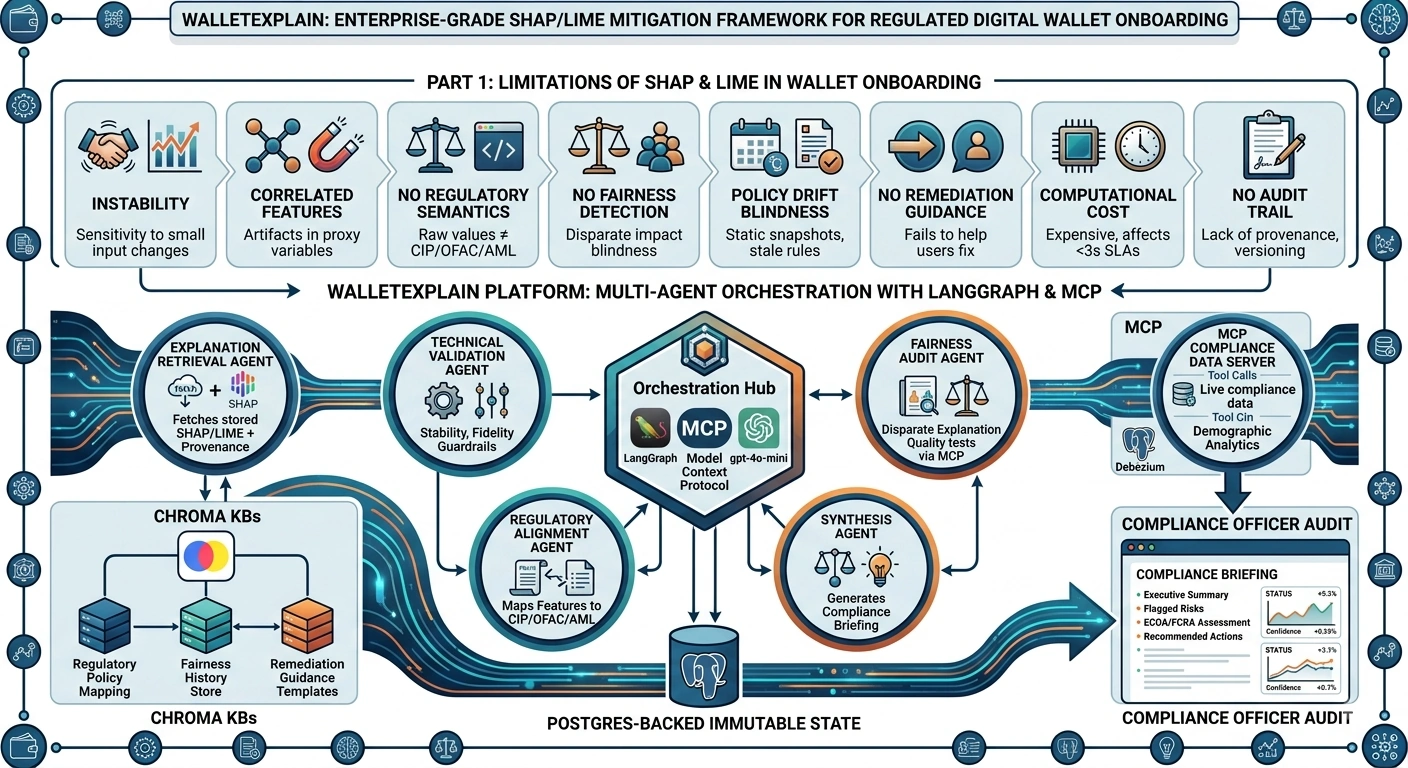
Part 2: Enterprise Mitigation Framework – “WalletExplain” Platform
Use Case Scenario
A compliance officer investigates a spike in wallet creation denials for users from Region X. She asks: “Show me the top reasons for wallet denials in Region X over the past 7 days, validate whether SHAP explanations are stable and regulation-aligned, and flag any disparate explanation quality compared to other regions.”
This requires:
Explanation Retrieval Agent: Fetches stored SHAP/LIME outputs with full provenance (model version, policy version, timestamp).
Technical Validation Agent: Re-runs stability/fidelity checks against current model state.
Regulatory Alignment Agent: Maps raw attributions to CIP/OFAC/AML categories using policy KB via RAG.
Fairness Audit Agent: Compares explanation quality metrics across regions using MCP-fresh demographic data.
Synthesis Agent: Generates compliance briefing with confidence scores, flagged risks, and recommended actions.
Step 1: Define Wallet Onboarding Explainability State
from typing import Annotated, TypedDict, Literalfrom langgraph.graph.message import add_messages
from pydantic import BaseModel, Field

class ExplanationProvenance(BaseModel):
    """Immutable metadata for audit trail"""
    model_version: str
    policy_version: str
    shap_library_version: str
    generated_at: str
    data_snapshot_id: str
    explanation_method: Literal["kernel_shap", "tree_shap", "lime"]

class RegulationMapping(BaseModel):
    """Maps raw features to regulatory categories"""
    regulatory_category: Literal["CIP_FAILURE", "OFAC_MATCH", "AML_RISK",
                                  "FRAUD_SIGNAL", "INCOME_VERIFICATION", "DEVICE_RISK", "OTHER"]
    confidence: float = Field(ge=0.0, le=1.0)
    supporting_policy_ref: str
    remediation_guidance: str | None = None

class WalletExplainState(TypedDict):
    messages: Annotated[list, add_messages]
    region_filter: str | None
    date_range: tuple[str, str] | None
    raw_explanations: list[dict] | None           # Stored SHAP/LIME + provenance
    validation_results: list[dict] | None         # Stability, fidelity scores
    regulation_mappings: list[RegulationMapping] | None
    fairness_metrics: dict | None                 # Disparate quality indicators
    compliance_briefing: str | None
Step 2: Implement Technical Validation with Stability Guards
import numpy as np
import shap
from lime.lime_tabular import LimeTabularExplainer

class WalletOnboardingValidator:
    """Validates SHAP/LIME outputs for wallet creation decisions"""

    def __init__(self, model, X_reference, feature_names):
        self.model = model
        self.X_reference = X_reference
        self.feature_names = feature_names
        # Pre-compute background dataset for KernelSHAP stability
        self.shap_explainer = shap.KernelExplainer(
            model.predict_proba,
            shap.sample(X_reference, 100),
            link="logit"
        )
        self.lime_explainer = LimeTabularExplainer(
            X_reference.values,
            feature_names=feature_names,
            mode='classification',
            discretize_continuous=True
        )

    def validate_stability(self, x_instance, original_shap_values, n_perturbations=50):
        """Tests explanation consistency under realistic wallet onboarding perturbations"""
        # Perturbations calibrated to wallet data:
        # - Address typos (categorical jitter)
        # - Device score noise (±0.05)
        # - Behavioral biometric variance (±0.03)
        perturbations = []
        for _ in range(n_perturbations):
            p = x_instance.copy()
            # Simulate realistic onboarding data entry variations
            p[3] += np.random.normal(0, 0.03)  # biometric confidence
            p[7] += np.random.normal(0, 0.05)  # device risk score
            perturbations.append(np.clip(p, 0, 1))

        top_k_original = set(np.argsort(np.abs(original_shap_values))[-3:])
        jaccard_scores = []
        for p in perturbations:
            sv = self.shap_explainer.shap_values(p.reshape(1, -1))[0][1]
            top_k_p = set(np.argsort(np.abs(sv))[-3:])
            jaccard = len(top_k_original & top_k_p) / max(len(top_k_original | top_k_p), 1)
            jaccard_scores.append(jaccard)

        return {
            "stability_score": float(np.mean(jaccard_scores)),
            "stability_std": float(np.std(jaccard_scores)),
            "passes_threshold": np.mean(jaccard_scores) >= 0.7
        }

    def validate_fidelity(self, x_instance, original_shap_values):
        """Verifies explanation matches actual model behavior"""
        masked = x_instance.copy()
        top_3 = np.argsort(np.abs(original_shap_values))[-3:]
        masked[top_3] = self.X_reference.iloc[:, top_3].median().values

        orig_prob = self.model.predict_proba(x_instance.reshape(1, -1))[0][1]
        masked_prob = self.model.predict_proba(masked.reshape(1, -1))[0][1]
        actual_shift = abs(orig_prob - masked_prob)
        expected_shift = abs(np.sum(original_shap_values[top_3]))

        return {
            "fidelity_ratio": min(actual_shift / max(expected_shift, 1e-6), 1.0),
            "passes_threshold": actual_shift / max(expected_shift, 1e-6) >= 0.75
        }
Step 3: Configure Chroma KBs + MCP Compliance Data Server
import chromadb
from langchain_chroma import Chroma
from langchain_openai import OpenAIEmbeddings
from mcp import ClientSession, StdioServerParameters
from mcp.client.stdio import stdio_client

chroma_client = chromadb.PersistentClient(path="./chroma_wallet_explain")

# KB 1: Regulatory Policy Mapping (CIP, OFAC, AML, FinCEN guidance)
policy_store = Chroma(
    client=chroma_client,
    collection_name="wallet_onboarding_policy_v4_2",
    embedding_function=OpenAIEmbeddings(model="text-embedding-3-small"),
    metadata={"regulatory_body": "FinCEN_OCC_ECOA"}
)

# KB 2: Historical Explanation Quality & Fairness Audits
fairness_history_store = Chroma(
    client=chroma_client,
    collection_name="explanation_fairness_audit_history",
    embedding_function=OpenAIEmbeddings(model="text-embedding-3-small")
)

# KB 3: Remediation Guidance Templates (regulation-approved language)
remediation_store = Chroma(
    client=chroma_client,
    collection_name="adverse_action_remediation_templates",
    embedding_function=OpenAIEmbeddings(model="text-embedding-3-small")
)

# MCP Server: Live compliance data + demographic analytics
compliance_mcp_server = StdioServerParameters(
    command="node",
    args=["./mcp-servers/wallet-compliance-server/index.js"],
    env={
        "COMPLIANCE_DB_CONN": "postgresql://compliance:***@db:5432/wallet_compliance",
        "DEMOGRAPHICS_API_KEY": "..."
    }
)

async def get_compliance_mcp_session():
    async with stdio_client(compliance_mcp_server) as (read, write):
        async with ClientSession(read, write) as session:
            await session.initialize()
            return session
Join the conversation! Your thoughts help the community grow.