

This article is about understanding various ways to find the nth salary in SQL Server. And I feel it would be a good brain teaser because in a single article you will learn various approaches such as Functions, Dense_Rank(), and Row_Number(), Self-Join, etc.
The requirement is to find the 3rd highest salary in SQL Server: A simple an practical approach.
Let’s start with the solution.
Table Creation
This is the basic need to perform queries. I’ve created a CsharpEmployee table with a few columns such as Id, Name and Salary. We’d be concentrating on the Salary column primarily.
The SQL snippet to create a table is written below:
- /****** Object: Table [dbo].[CsharpEmployee] Script Date: 08/28/2015 06:37:13 ******/
- SET ANSI_NULLS ON
- GO
- SET QUOTED_IDENTIFIER ON
- GO
- SET ANSI_PADDING ON
- GO
- CREATE TABLE [dbo].[CsharpEmployee](
- [ID] [int] NOT NULL,
- [Name] [varchar](50) NULL,
- [Salary] [int] NULL
- ) ON [PRIMARY]
- GO
- SET ANSI_PADDING OFF
- GO
- INSERT INTO [Employee].[dbo].[CsharpEmployee]
- ([ID]
- ,[Name]
- ,[Salary])
- VALUES
- (<ID, int,>
- ,<Name, varchar(50),>
- ,<Salary, int,>)
- GO
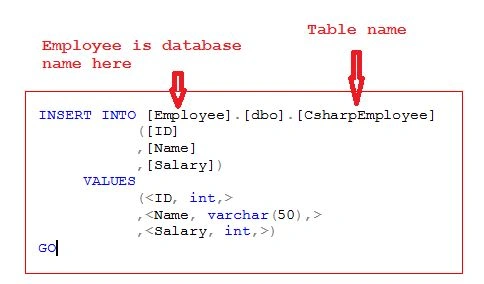
For example:
- INSERT INTO [Employee].[dbo].[CsharpEmployee]
- ([ID]
- ,[Name]
- ,[Salary])
- VALUES
- (10
- ,'Akshit'
- ,5000)
- GO
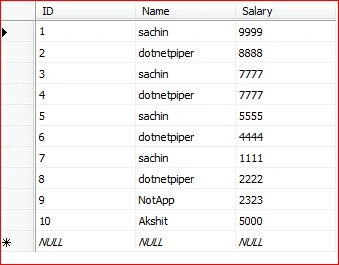
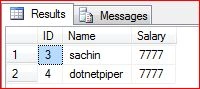
Note: I intentionally wrote salary 7777 two times for ID 3 and 4.
Approach 1
This is one of the interesting ways to get the 3rd highest salary using the Inline Table value function and using this you would also get hands-on how experience creating a Table value function and its utilization.
- Create function GetSalary(@Id int)
- Returns decimal
- AS
- Begin
- declare @salary decimal
- select @salary = salary from
- (Select Salary,Row_Number() over (order by salary desc) as Counter from CsharpEmployee group by salary) as t1
- where t1.counter = @id
- RETURN @Salary
- End
- select dbo.GetSalary(3) as Salary
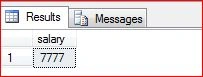
Note: We’ve used Row_Number in the Salary column and made Group By on the salary column to remove duplicacy. There are two rows having salary 7777 two times for ID 3 and 4.
Approach 2
Another way is to use the Dense_Rank() function. The beauty of this function is, it gives a unique number to each row in spite of the Salary column having the same salary in multiple rows.
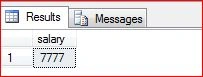
- SELECT * FROM (SELECT DENSE_RANK() OVER (ORDER BY SALARY DESC) AS rownumber,Salary FROM CsharpEmployee) AS Maxs WHERE rownumber = 3
- SELECT DENSE_RANK() OVER (ORDER BY SALARY DESC) AS rownumber,Salary FROM CsharpEmployee
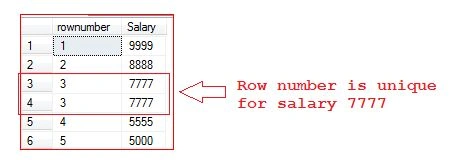
The final Output will be as in the following image:
Approach 3
This is the simplest and easiest to remember always.
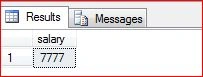
- select top 1 salary from (select distinct top 3 salary from CsharpEmployee order by salary desc) as t1 order by salary asc
Approach 4
This is the simplest and easiest to remember.
- Select * From CsharpEmployee C1 Where 3 = (Select Count(Distinct(C2.Salary)) From CsharpEmployee C2 Where C2.Salary >= C1.Salary)
Output
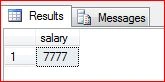
If you want to refine more on the preceding output, then kindly use the distinct clause as in the following query.
- Select distinct salary from ( Select * From CsharpEmployee C1 Where 3 = (Select Count(Distinct(C2.Salary)) From CsharpEmployee C2 Where C2.Salary >= C1.Salary)) as tempTable
Approach 5
This is another way to find the 3rd highest salary. It is a little complex if you go with more levels like 6th, 7th and so on. The reason is that you need to use a more inner query or sub-query to get the desired result.
select max(salary) from CsharpEmployee where salary < (select max(salary) from CsharpEmployee where salary < (select max(salary) from CsharpEmployee))
Output
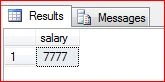
All queries at one place:
- Create function GetSalary(@Id int)
- Returns decimal
- AS
- Begin
- declare @salary decimal
- select @salary = salary from
- (Select Salary,Row_Number() over (order by salary desc) as Counter from CsharpEmployee group by salary) as t1
- where t1.counter = @id
- RETURN @Salary
- End
- select dbo.GetSalary(3) as Salary
- SELECT * FROM (SELECT DENSE_RANK() OVER (ORDER BY SALARY DESC) AS rownumber,Salary FROM CsharpEmployee) AS Maxs WHERE rownumber = 3
- select top 1 salary from (select distinct top 3 salary from CsharpEmployee order by salary desc) as t1 order by salary asc
- Select distinct salary from ( Select * From CsharpEmployee C1 Where 3 = (Select Count(Distinct(C2.Salary)) From CsharpEmployee C2 Where C2.Salary >= C1.Salary)) as tempTable
- select max(salary) from CsharpEmployee where salary < (select max(salary) from CsharpEmployee where salary < (select max(salary) from CsharpEmployee))
For sure this is one of the most common interview questions.
Santhakumar MunuswamyPosted Aug 29, 2015, 4:27 AM
Good article. Thanks for sharing
Gopi ChandPosted Aug 28, 2015, 11:48 PM
Great
Gowtham KPosted Aug 28, 2015, 8:49 PM
Goo one
Pankaj Kumar ChoudharyPosted Aug 28, 2015, 12:09 PM
Nice Explain Sir........
RakeshPosted Aug 28, 2015, 5:55 AM
Good one
Karthikeyan KPosted Aug 28, 2015, 5:52 AM
Good one sir..Thanks for share
Yashwant VishwakarmaPosted Aug 28, 2015, 5:47 AM
awesome one :)
Mohammed IbrahimPosted Aug 28, 2015, 5:46 AM
nice