

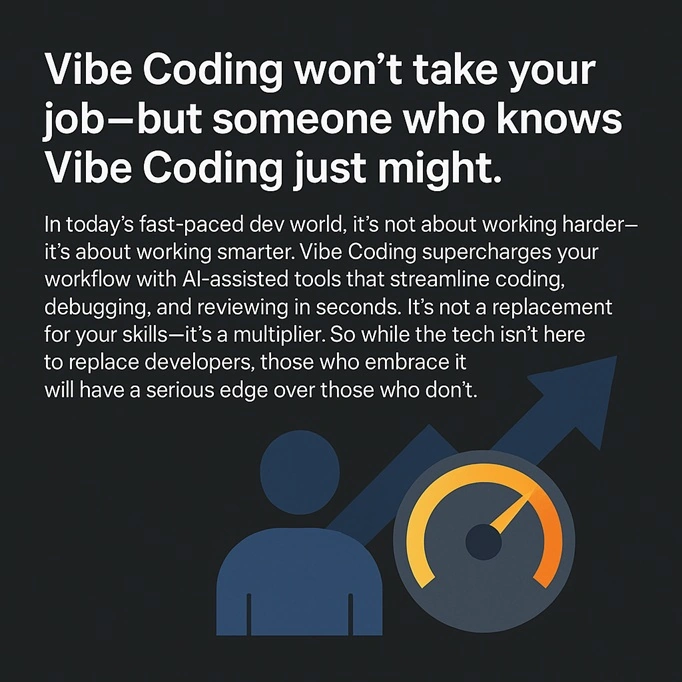
In the modern software engineering ecosystem, where releases are faster, expectations are higher, and codebases grow exponentially complex, survival isn’t about raw output—it’s about intelligent acceleration. That’s where Vibe Coding enters the picture: not as another AI assistant or code completion gimmick, but as a paradigm shift.
🧭 What Is Vibe Coding, Technically?
At its core, Vibe Coding is a fusion of human-in-the-loop development with adaptive AI, integrating large language models (LLMs), behavioral context modeling, and emotion-aware interfaces to streamline not just what you code, but how you code it.
It leverages three main technologies.
- Generative AI (LLMs & Code Models): Tools trained on massive code corpora (e.g., transformer-based architectures fine-tuned on GitHub, Stack Overflow, and issue trackers) are embedded into the dev pipeline to generate functions, optimize loops, or suggest tests.
- Intent-Aware Prompt Engineering: Rather than responding to static commands, the AI analyzes the vibe—tone, typing speed, structure, even emotional tone derived from keystroke patterns or language mood—to deliver hyper-contextual results.
- Real-Time Co-Creation UX: The IDE becomes conversational. You're not asking it for help—you’re collaborating. Think pair programming, with a silent partner who never needs sleep, rarely misses context, and adjusts to your cognitive load.
Technical Benefits Beyond Autocomplete
Vibe Coding is not a glorified auto-suggest tool. It brings serious horsepower to teams dealing with modern codebases.
1. Contextual Multimodal Understanding
Unlike traditional code assistants that treat inputs statically, Vibe Coding systems build session memory. They factor in,
- Current ticket/task context (e.g., JIRA or Notion metadata)
- Previous commit history
- Team communication (Slack, Teams) to understand business logic
- Developer-specific coding patterns
The result? Suggestions that are semantically aligned, not just syntactically correct.
2. Emotion-Aware Debugging
When developers are frustrated, they code differently. Vibe Coding tools can recognize indicators like erratic typing, comment tone, or even pause frequency, then switch modes to provide more gentle, educational responses, or escalate to suggest peer review.
This is powered by sentiment classifiers trained on technical discourse. Think of it as AI with social intelligence.
3. Code Review Enhancement
AI doesn’t replace code reviewers—but it accelerates them. Vibe Coding integrates with Git platforms to,
- Identify logic inconsistencies
- Suggest missing test cases
- Flag security issues based on threat-model databases
- Recommend refactors aligned with team patterns, not just general best practices
Integration with DevOps and Toolchains
Modern Vibe Coding platforms are API-first and extensible. They can plug into CI/CD pipelines to,
- Auto-generate changelogs
- Suggest rollback strategies
- Annotate code with natural language for handovers or audits
- Trigger post-commit AI evaluations for performance or vulnerability analysis
Some environments even support live pair programming via voice and code with real-time AI synthesis, effectively acting as an ephemeral “AI teammate” during spikes or emergencies.
🧠 Developer Role in the Age of Vibe Coding
Let’s be clear: AI isn’t here to write your entire system. It can’t replace the creativity, intuition, or domain expertise of a seasoned engineer. But it can,
- Reduce mental fatigue by handling repetitive code structures
- Suggest edge case handling in real-time
- Transform junior engineers into productive contributors much faster
Those who integrate Vibe Coding into their workflow become super-developers—not because they work longer hours, but because their output is exponentially more aligned, precise, and polished.
⚡ The Risks of Ignoring It
Failing to adopt this shift isn’t neutral. It creates inefficiencies that compound.
- Longer PR cycles
- More brittle code
- Wasted energy on boilerplate and rote tasks
- Cognitive overload that leads to burnout and bugs
Meanwhile, your competitors-or colleagues-are shipping production-grade features with the same code quality in half the time.
🔮 The Future Is Human + Machine
The best developers tomorrow will not be those who know the most frameworks, but those who know how to orchestrate intelligence. Vibe Coding is not automation—it’s augmentation.
It’s not asking, “Can AI code?”
It’s answering, “How can I code better with AI?”
And if you don’t, someone else will. And they’ll beat you to market, to the promotion, or to the offer letter.
Final Thought
You don’t need to fear Vibe Coding.
You need to learn it, master it, and lead with it.
Because the job you save might be your own.
Join the conversation! Your thoughts help the community grow.