Virtualization Defined
Virtualization is a transformative technology that allows the creation of multiple simulated environments or dedicated resources from a single physical hardware system. This is accomplished through software known as a hypervisor, which creates and runs virtual machines (VMs) by abstracting the hardware resources of a physical host. Each VM operates as a fully functional, isolated instance with its own operating system (OS) and applications, despite sharing the underlying hardware with other VMs.
Traditional Architecture vs. Virtual Architecture
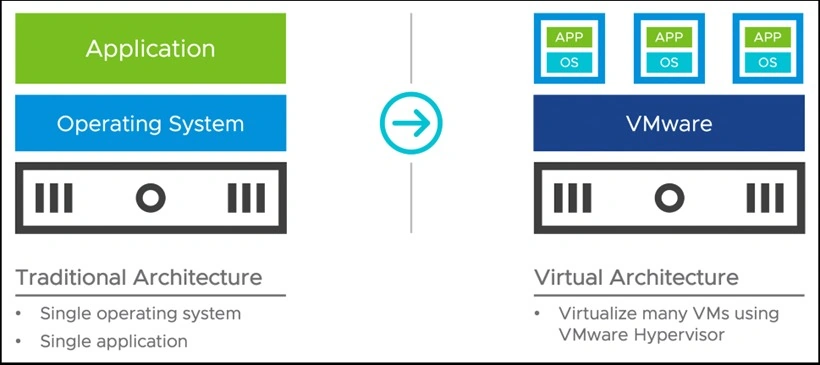
Related Image © Vmware
Traditional Architecture
In traditional architecture, a single server runs one operating system and one application. This approach often leads to underutilized resources because the hardware's full potential is not being leveraged. For example, a server may be only 15-20% utilized, which is inefficient and costly. This underutilization results from the fact that different applications and operating systems have varying resource requirements, which can leave significant portions of the server's capabilities unused. Furthermore, the need to dedicate a server to a single application or OS can lead to an increase in the number of physical servers, thereby raising both capital and operational expenditures.
Virtual Architecture
In contrast, virtual architecture, enabled by hypervisor technology, allows you to run multiple VMs on a single physical server. Each VM can run its own OS and applications, independent of the others. This approach maximizes hardware utilization, improves flexibility, and reduces costs. With virtual architecture, the physical resources of a server can be partitioned and allocated to different VMs as needed, ensuring that the server's full potential is used efficiently. This not only optimizes resource utilization but also reduces the need for additional physical servers, leading to significant cost savings.
Key Benefits of Virtualization
- Resource Optimization: By running multiple VMs on a single server, you make better use of the hardware resources, leading to increased efficiency and reduced waste. Virtualization allows for dynamic allocation of resources, such as CPU, memory, and storage, based on the needs of each VM. This means that resources can be allocated and reallocated as necessary, ensuring that they are used where they are needed most. This dynamic allocation is particularly beneficial in environments where workloads fluctuate, as it allows for resources to be optimized in real time.
- Cost Savings: Fewer physical servers are needed, which reduces capital expenditure (CAPEX) and operational expenditure (OPEX) such as power, cooling, and maintenance. By consolidating multiple applications and operating systems onto a single server, organizations can reduce the number of physical servers required, leading to significant savings in hardware costs. Additionally, the reduced number of servers means lower energy consumption and cooling requirements, further reducing operational costs. Maintenance costs are also lowered, as there are fewer physical servers to manage and maintain.
- Flexibility and Scalability: VMs can be easily moved, copied, or resized, providing a flexible and scalable infrastructure that can quickly adapt to changing business needs. Virtualization allows for the rapid deployment of new applications and services, as VMs can be created and configured in a matter of minutes. This flexibility is particularly beneficial in dynamic environments where business requirements change frequently. Furthermore, the ability to scale resources up or down as needed allows organizations to respond quickly to changes in demand, ensuring that they can meet the needs of their users and customers.
- Isolation and Security: Each VM operates in its own isolated environment, enhancing security by preventing one VM from affecting another. This isolation ensures that the applications and data within one VM are protected from issues that may arise in other VMs. In addition, virtualization provides enhanced security features such as virtual firewalls and network segmentation, which help to protect the virtual environment from external threats. The isolation and security features of virtualization are particularly important in environments where sensitive data is handled, as they help to ensure that data is protected from unauthorized access and potential breaches.
Advanced Virtualization Technologies
Virtualization has evolved significantly since its inception, with advanced technologies now available to enhance its capabilities. Some of these advanced technologies include:
- Containerization: Containerization is a lightweight form of virtualization that allows applications to run in isolated environments called containers. Unlike traditional VMs, containers share the host OS kernel but run isolated from each other. This makes them more efficient in terms of resource usage and allows for faster deployment and scaling. Containerization has become increasingly popular due to its ability to provide consistent environments for development, testing, and production, as well as its support for microservices architectures.
- Hyper-Converged Infrastructure (HCI): HCI combines compute, storage, and networking resources into a single integrated system, managed through a common software platform. This approach simplifies management and increases efficiency by reducing the complexity of traditional data center architectures. HCI systems are designed to be highly scalable, allowing organizations to easily add resources as needed. They also provide improved performance and reliability, as well as integrated data protection and disaster recovery capabilities.
- Virtual Desktop Infrastructure (VDI): VDI enables the delivery of desktop environments to end-users from a centralized data center. This approach provides several benefits, including improved security, easier management, and the ability to access desktops from any device with an internet connection. VDI is particularly beneficial in remote work scenarios, as it allows organizations to provide secure, consistent desktop environments to employees regardless of their location. Additionally, VDI can help to reduce hardware costs, as end-users can access their virtual desktops from low-cost devices such as thin clients.
Conclusion
Virtualization is a powerful technology that offers numerous benefits, including resource optimization, cost savings, flexibility, scalability, and enhanced security. By enabling the creation of multiple virtual environments on a single physical server, virtualization maximizes hardware utilization and provides a flexible, scalable infrastructure that can adapt to changing business needs. As advanced virtualization technologies such as containerization, hyper-converged infrastructure, and virtual desktop infrastructure continue to evolve, the capabilities and benefits of virtualization are only expected to grow. Organizations that leverage virtualization can achieve significant improvements in efficiency, agility, and security, positioning themselves for success in today's rapidly changing technology landscape.


Join the conversation! Your thoughts help the community grow.