

The last time I had to develop a .NET solution with a large set of sequences comparisons between them was a few years ago. This sequence was a big sequence and occasionally it was a living hell to check the results.
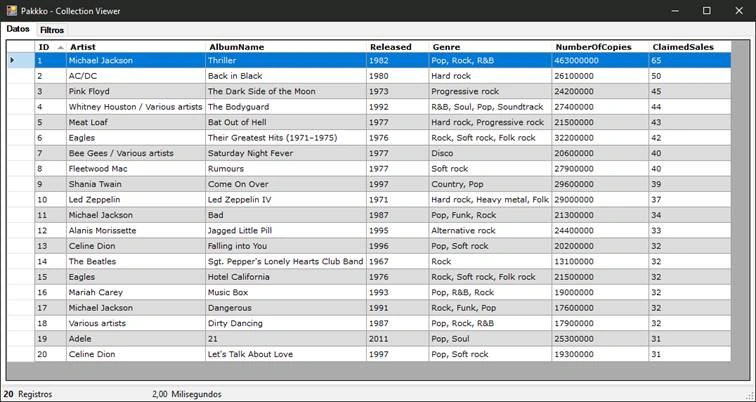
I decided to build an assembly support for visualizing and filtering the collection result sin debug mode. Sometime afterwards, I updated this assembly to a Visual Studio Visualizer, and today I share it with you, because I think is a very useful complement.
MLCollectionVisualizers is an open source project and your code is available in Git Hub.
Installation
Install MLCollectionVisualizers is very simple. We need to distinguish between Visual Studio 2015 and Visual Studio 2017.
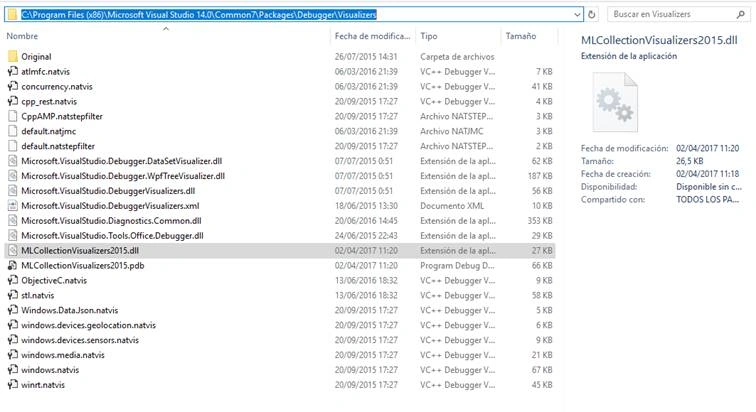
Visual Studio 2015
We must copy the MLCollectionVisualizer2015.dll in the path
C:\Program Files (x86)\Microsoft Visual Studio 14.0\Common7\Packages\Debugger\Visualizers\
Visual Studio 2017
We must copy MLCollectionVisualizer2017.dll in the path
C:\Program Files (x86)\Microsoft Visual Studio\2017\Enterprise\Common7\Packages\Debugger\Visualizers\
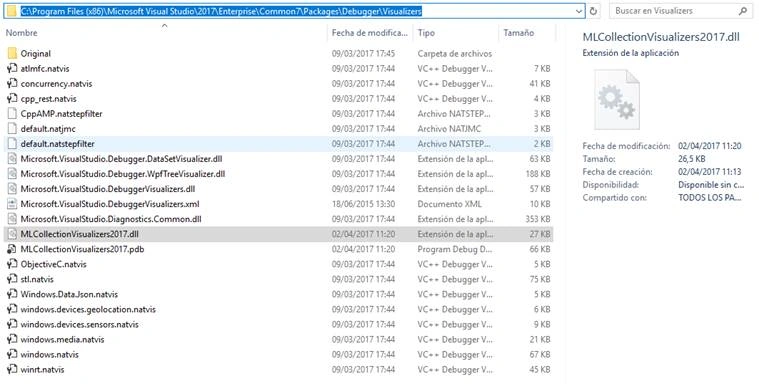
Once an assembly has been put in Visual Studio Visualizer path, reboot Visual Studio and our Collection Visualizer will be installed.
MLCollectionVisualizers
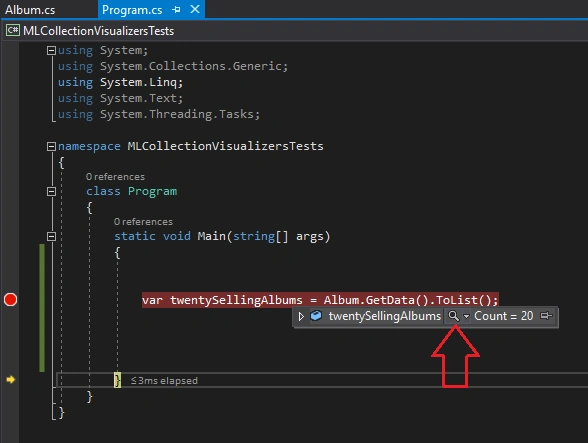
MLCollectionVisualizers is very simple to use. We have to mark our class type with SERIALIZABLE. If someone reports any discomfort, we can use the preprocessor Directives, as we did in our example.
- #if DEBUG
- [Serializable]
- #endif
- public class Album
- {
- public int ID { get; set; }
- public string Artist { get; set; }
- public string AlbumName { get; set; }
- public int Released { get; set; }
- public string Genre { get; set; }
- public decimal NumberOfCopies { get; set; }
- public int ClaimedSales { get; set; }
- }



Join the conversation! Your thoughts help the community grow.