

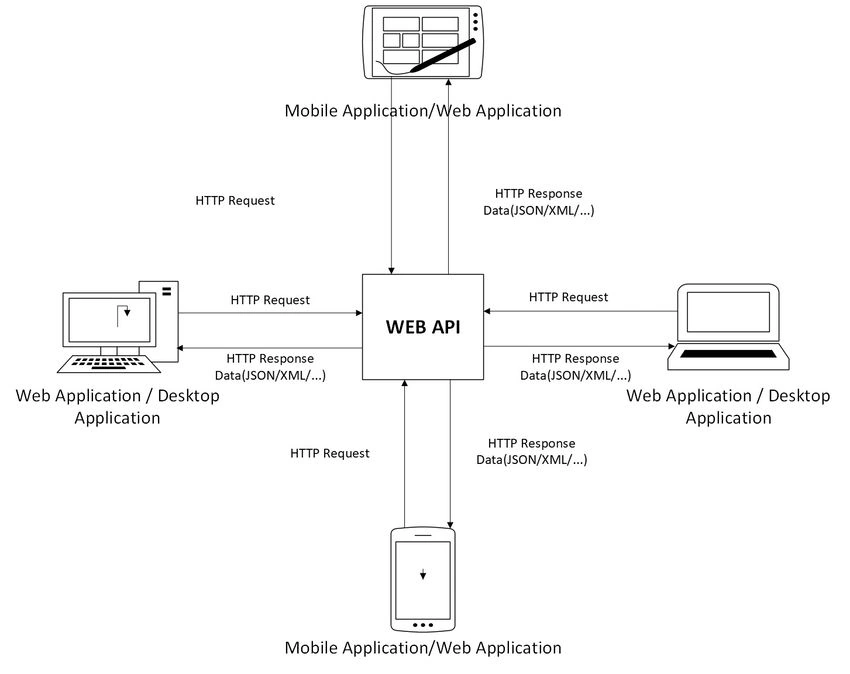
A Web API (Application Programming Interface) is a set of standardized protocols and tools that allows different software applications to communicate with each other over the internet by sending and receiving data, typically through HTTP requests and responses. This interaction allows for seamless data exchange and integration of various services and systems.
Key Concepts
Endpoints: It is a specific URL or URI (Uniform Resource Identifier) where an API can be accessed to perform a particular function or retrieve specific data. For example, https://www.c-sharpcorner.com/members/sreenath-kg might represent my profile page in the c#corner.
HTTP Methods: Standard methods used to perform operations on the resources.
GET: Retrieve data from the server.
POST: Submit data to the server, often causing a change in state.
PUT: Update data on the server.
DELETE: Remove data from the server.
Protocols
HTTP/HTTPS: Most Web APIs use HTTP (Hypertext Transfer Protocol) or its secure version, HTTPS, to facilitate communication. Common HTTP methods used include GET, POST, PUT, DELETE, etc.
Data Formats
JSON (JavaScript Object Notation): A lightweight data interchange format that's easy for humans to read and write and easy for machines to parse and generate.
XML (eXtensible Markup Language): A markup language that defines rules for encoding documents in a format that is both human-readable and machine-readable.
Request and Response: Interaction between client and server involves sending an HTTP request and receiving an HTTP response.
Request: Includes method, endpoint, headers, and sometimes a body (for POST and PUT).
Response: Includes status code, headers, and a body with the data or result of the request.
Headers: It is a component of the HTTP request and response messages used in communication between a client and a server. Headers provide essential metadata and control information for the message, including authentication credentials, content type, and data encoding.
Authentication and Authorization
API Keys: Simple tokens that identify the calling application without any user context.
OAuth: An authorization framework that allows third-party services to exchange tokens for access to user resources without sharing credentials.
Bearer Tokens: Tokens that are used for accessing protected resources.
Status Codes: Indicate the result of the HTTP request.
200 OK: Successful request.
201 Created: Successfully created a new resource.
400 Bad Request: Client-side error.
401 Unauthorized: Authentication is required.
404 Not Found: Resource not found.
500 Internal Server Error: Server-side error.
Join the conversation! Your thoughts help the community grow.