

Phase 01 — Foundation | Topic 01 — What Actually Is System Design?
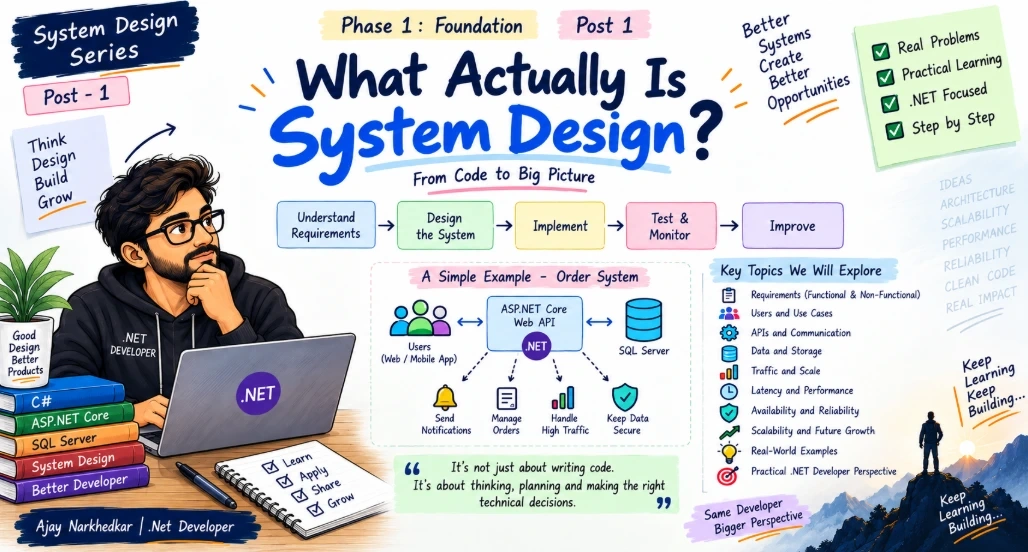
When developers hear System Design, many immediately think about:
- Microservices.
- Redis.
- Kafka.
- Kubernetes.
But System Design starts much earlier.
It starts with a simple question:
How should this software actually work?
Think About a Real-Life Example
Imagine you are working on an Online Order System.
A customer places an order.
At first, it looks simple:
User
 ↓
.NET API
 ↓
SQL Server
You can easily write the code.
But then your manager asks:
"What happens when 10,000 users place orders at the same time?"
Now you have new questions:
- Can our API handle the traffic?
- Can SQL Server handle all the requests?
- What happens if the database becomes slow?
- How will we send order notifications?
- What happens if payment fails?
- How can we make the system faster?
This is where System Design starts.
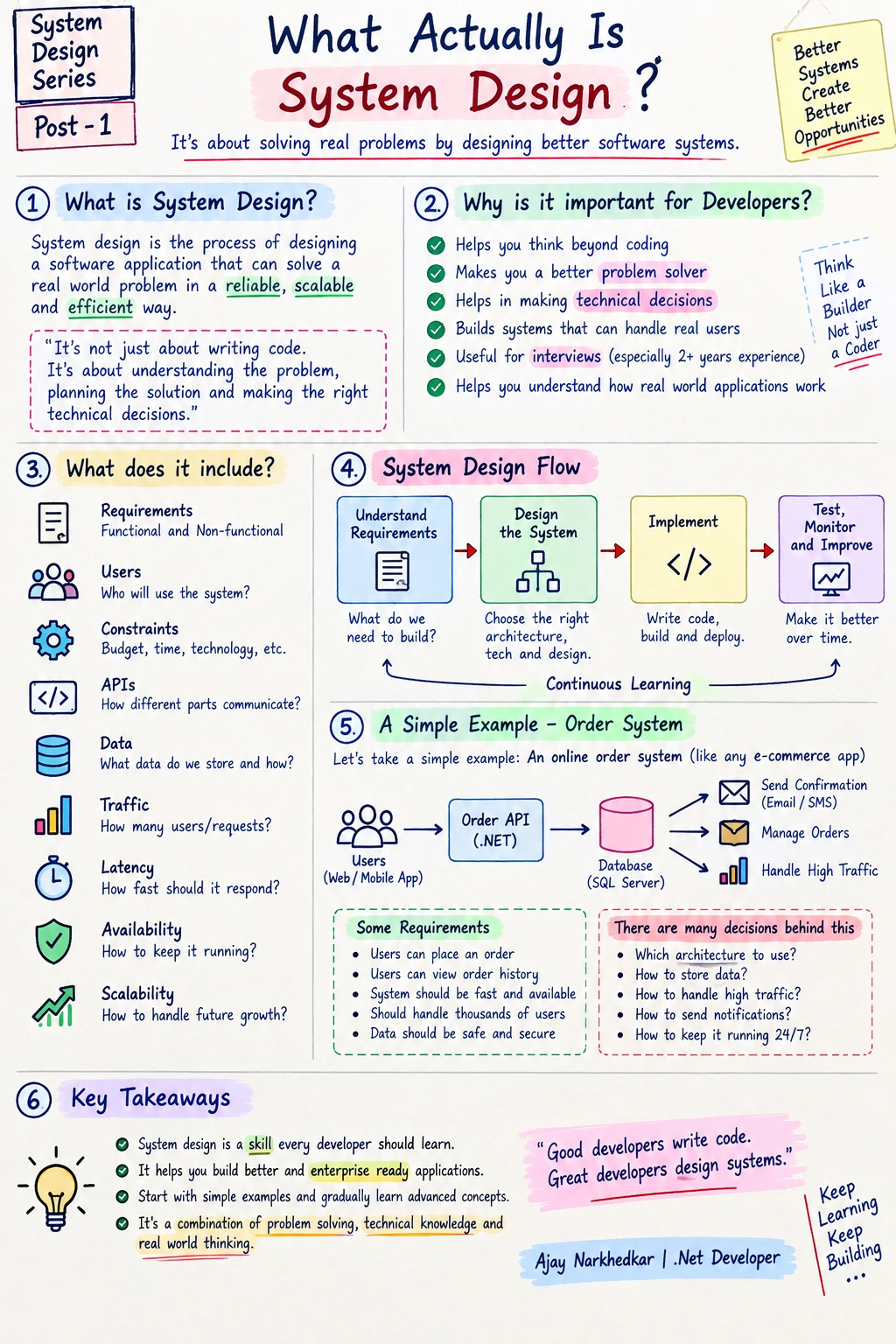
System Design Is More Than Coding
As a developer, you normally think:
"How do I implement this feature?"
System Design makes you think one step further:
"How should the complete system work?"
You start thinking about:
Requirements → APIs → Data → Traffic → Performance → Availability → Scalability
A Simple System Design Flow
Understand the Problem
        ↓
Understand the Requirements
        ↓
Design the System
        ↓
Write the Code
        ↓
Test & Monitor
        ↓
Improve the System
The important point is that coding comes after understanding the problem.
Why Does a .NET Developer Need System Design?
You may already know:
- C#
- ASP.NET Core
- Web API
- EF Core
- SQL Server
But knowing these technologies does not automatically mean you know how to build a system that can handle real users and real problems.
System Design helps you understand when and why to use these technologies.
For example:
More traffic?
→ Load Balancer
Repeated database reads?
→ Cache / Redis
Long-running work?
→ Background processing / Queue
Multiple services?
→ Messaging / Service communication
Service failure?
→ Retry / Timeout / Circuit Breaker
IMPORTANT
You don't need to learn everything at once.
Start with a simple application.
Then keep asking:
"What can go wrong when this system grows?"
That question will take you from a simple ASP.NET Core application to advanced System Design.
What We'll Learn in This Series
We will gradually cover:
Requirements → API Design → Database → EF Core → Performance → Load Balancer → Caching → Messaging → Microservices → Resilience → Security → Monitoring → Docker → Azure → Real System Design
And the focus will not be only theory.
We'll use C#, ASP.NET Core and real technical examples throughout the series.
Join the conversation! Your thoughts help the community grow.