

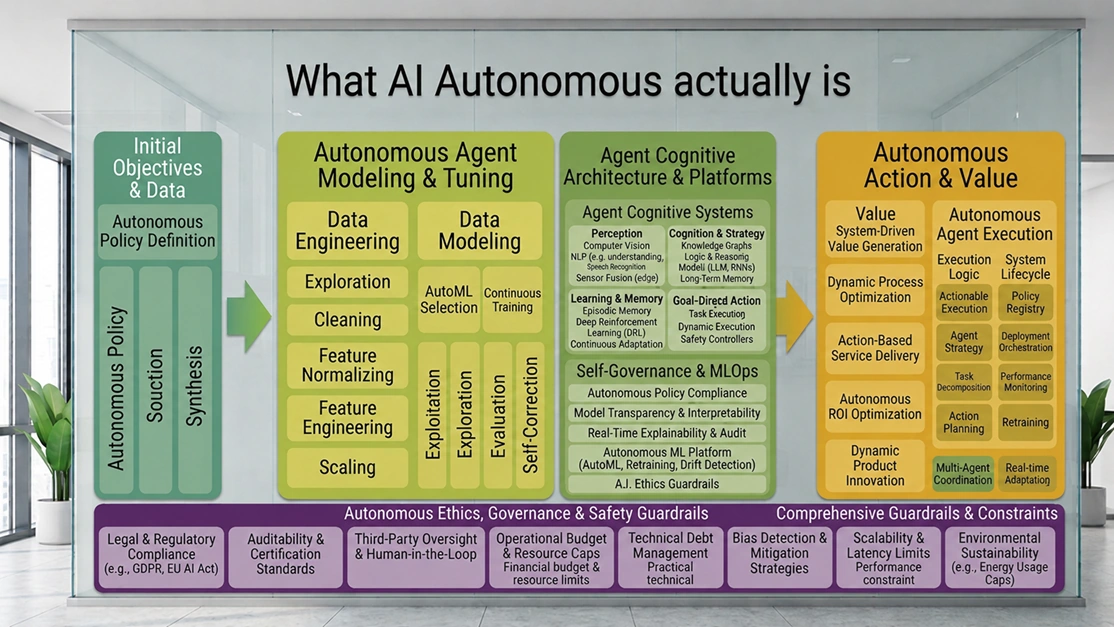
For many corporate leaders, "Artificial Intelligence" is still perceived as a black box: raw data goes in, magic happens in the middle, and business value comes out. However, as organizations transition from basic generative text prompts to fully autonomous systems, this simplified mental model breaks down. True autonomy isn't a single software model—it is a continuous, highly coordinated ecosystem spanning data engineering, cognitive modeling, agent orchestration, real-time action, and multi-layered guardrails.
To successfully deploy autonomous AI that delivers measurable ROI without introducing operational or legal risk, organizations must understand what sits under the hood. Beyond the surface-level marketing hype lies a structured, four-stage architectural pipeline supported by an essential foundation of enterprise constraints.
1. Initial Objectives & Data Curation
Autonomous execution begins long before an algorithm processes its first token or makes an automated decision. The first stage centers on establishing Autonomous Policy Definitions and curating high-integrity data assets.
Autonomous Policy & Scope Definition: Establishing clear boundaries for what the autonomous system is authorized to do, defining its operational scope, objective metrics, and escalation paths.
Data Selection & Sourcing: Identifying authoritative enterprise data streams, relational schema sources, unstructured document stores, and real-time operational feeds.
Data Synthesis & Grounding: Converting raw, disparate data into structured domain knowledge that autonomous agents can consume without hallucinating or losing context.
Without rigorous data curation and policy alignment at step one, downstream autonomous agents simply automate bad decision-making at scale.
2. Autonomous Agent Modeling, Engineering & Continuous Tuning
Once data is anchored and policy parameters are defined, the engineering layer prepares models for dynamic decision-making. Traditional machine learning focuses on static prediction; autonomous modeling requires adaptive reasoning.
Data Engineering Pipeline
Before modeling begins, data must undergo systematic preparation:
Exploration & Cleaning: Removing noise, duplicate records, and anomalous signals from operational data feeds.
Feature Normalization & Engineering: Transforming raw signals into structured attributes optimized for reasoning algorithms.
Scaling: Ensuring data pipelines handle high-volume enterprise traffic with minimal latency.
Modeling & Self-Correction
AutoML & Continuous Training: Systematically selecting optimal model architectures and continuously retraining them against incoming operational telemetry.
Exploitation vs. Exploration Balance: Balancing proven decision pathways against exploratory reasoning to discover optimized workflow solutions.
Self-Correction Loops: Integrating evaluation mechanisms that allow models to detect errors, adjust internal parameters, and self-correct during runtime execution.
3. Agent Cognitive Architecture & Platform Integration
The true engine of autonomy is the Cognitive Architecture. This layer shifts the technology from a reactive prediction tool to a self-directed digital entity capable of planning, reasoning, and executing multi-step tasks.
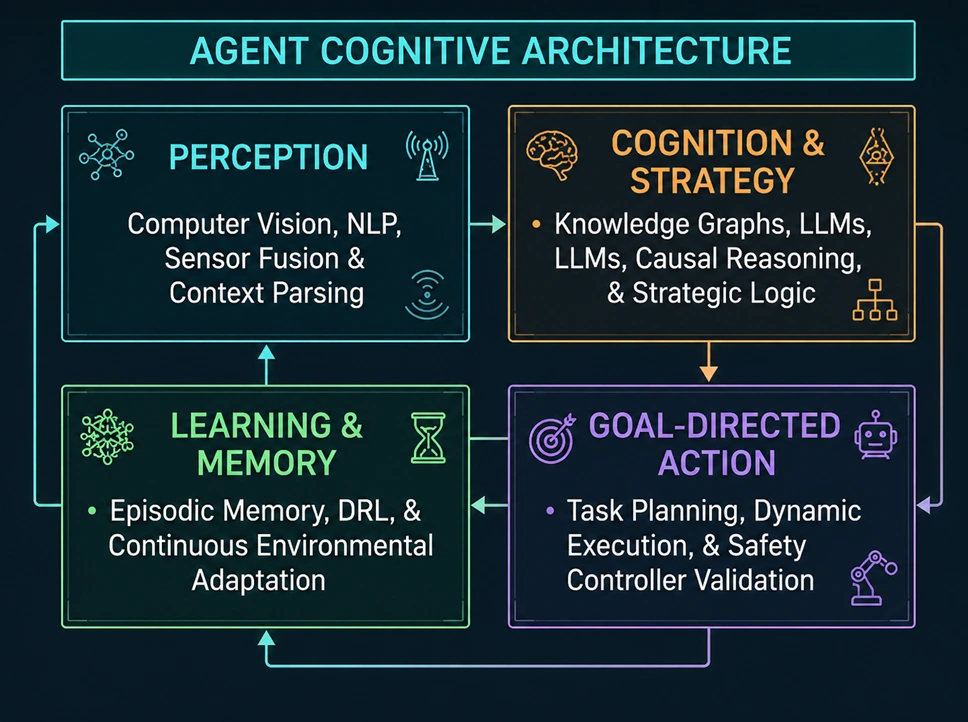
Perception: Multimodal input handling—incorporating Natural Language Processing (NLP), Computer Vision, and real-time sensor fusion to interpret human intent and environment state.
Cognition & Strategy: Combining Large Language Models (LLMs) with knowledge graphs and causal reasoning engines to formulate multi-step strategies.
Learning & Memory: Maintaining long-term episodic memory and deep reinforcement learning (DRL) feedback loops so agents remember historical outcomes.
Goal-Directed Action: Breaking down overarching business directives into discrete sub-tasks, sequencing execution steps, and validating safety controllers before triggering external tools.
4. Autonomous Action, Multi-Agent Orchestration & Value Delivery
An autonomous system is useless if it cannot drive concrete action. The final stage translates cognitive decisions into real-world enterprise outcomes through coordinated execution.
Key Milestone: Moving from conversational text generation to real-time actioning across relational databases, internal APIs, and operational systems.
Rather than relying on a single mega-agent to handle entire workflows, modern architectures deploy Multi-Agent Systems (PODs). Specialized agents—such as data extractors, policy checkers, code execution units, and quality assurance agents—collaborate under a shared objective.
Through task decomposition, agent strategy selection, and real-time performance monitoring, these digital workers deliver measurable results: dynamic process optimization, automated service delivery, continuous ROI tracking, and rapid product innovation.
The Foundation: Comprehensive Guardrails & Constraints
Notice the omnipresent foundation running across all stages: Ethics, Governance, Safety, and Constraints. An autonomous AI operating without strict constraints represents significant organizational risk.
A production-grade autonomous architecture requires continuous enforcement of:
Legal & Regulatory Compliance: Enforcing adherence to global data privacy laws (e.g., GDPR, EU AI Act) and sector-specific requirements.
Auditability & Certification: Maintaining immutable log ledgers for every autonomous decision, tool call, and parameter modification.
Human-in-the-Loop Oversight: Setting dynamic risk thresholds where high-impact actions automatically route to human supervisors for approval before execution.
Resource & Operational Limits: Hard-coding budget caps, rate limits, and latency constraints to prevent runaway compute costs or cascading failures.
Algorithmic Bias Mitigation: Continuously auditing models to eliminate demographic, historical, or sampling bias from automated decision pipelines.
How Gate2ASI AI's (Formerly AlpineGate AI's) AgentFactory Streamlines Autonomous Complexity
Implementing the comprehensive architecture detailed above traditionally requires massive engineering overhead, bespoke glue code, complex flowchart wiring, and dedicated AI research teams. This is where Gate2ASI AI’s (formerly AlpineGate AI’s) AgentFactory radically simplifies enterprise deployment.
1. Replacing Brittle Flowcharts with Intent-Driven Work Orders
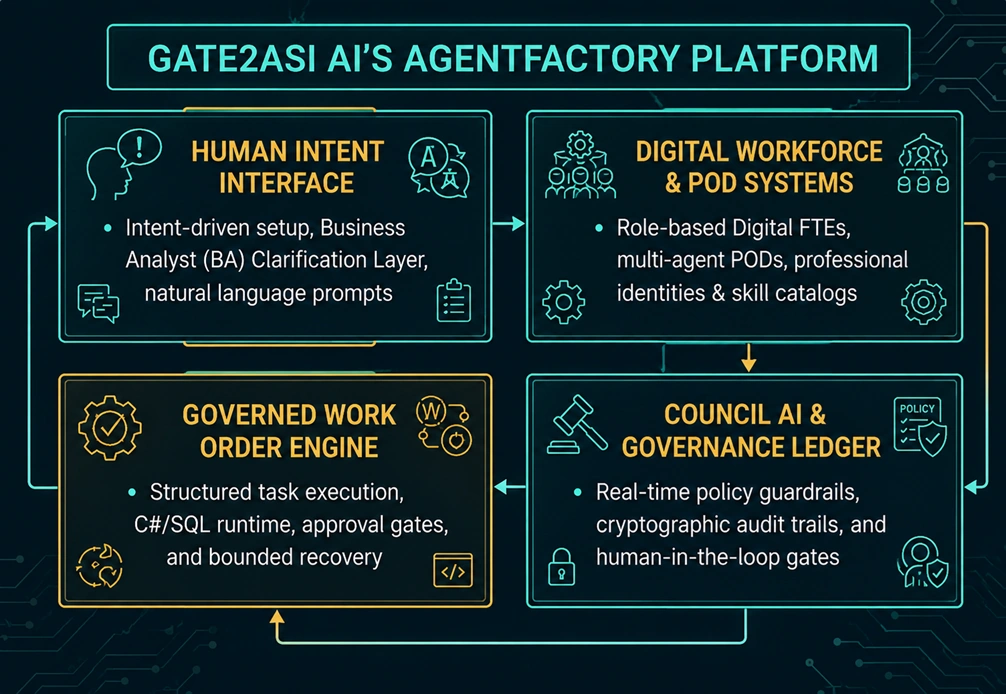
Legacy "low-code" automation tools force developers to manually draw complex flowchart nodes, decision loops, and error handlers that break whenever APIs or data formats change. AgentFactory replaces brittle flowchart wiring with Governed Work Orders. Business teams simply specify their operational intent in natural language. Behind the scenes, AgentFactory dynamically maps dependencies, sequences multi-agent tasks, and handles execution logic safely.
2. Built-in Business Analyst (BA) Clarification Layer
Vague requirements are the leading cause of AI project failure. Before executing any major Work Order, AgentFactory deploys an autonomous Business Analyst Agent. This BA agent interacts directly with business stakeholders to clarify scope, resolve ambiguous goals, confirm domain constraints, and refine technical requirements before execution begins—ensuring agents always execute against aligned business intent.
3. Digital FTEs and Specialized POD Orchestration
AgentFactory treats AI agents as real, governed digital workforce members (Digital FTEs) rather than simple text prompts. Agents possess defined roles, resume-style backgrounds, tool permissions, and persistent visual identities. Organizations can assemble these specialized agents into Digital PODs that collaborate autonomously across enterprise database schemas, C# execution routines, and external web APIs to produce complete business deliverables.
4. Enterprise Governance via Council AI & Audit Ledgers
To satisfy the extensive bottom-row constraints of our architecture, AgentFactory integrates a dedicated Council AI Governance Layer. Council AI continuously inspects agent actions in real time, validating policy compliance, enforcing resource caps, and preventing unauthorized operations. Every action, tool invoke, and output generates a cryptographic evidence ledger, giving IT and legal teams complete audit-ready transparency.
The Road Ahead: Enterprise Autonomy Without Tech Debt
True autonomous AI is not a single magical model; it is a carefully coordinated discipline uniting data curation, cognitive architecture, multi-agent execution, and continuous governance. Trying to stitch together these components manually often leads to unmaintainable spaghetti logic and runaway operational costs.
By leveraging platforms like Gate2ASI AI’s AgentFactory, enterprises bridge the gap between high-level operational vision and low-level technical execution. By converting natural human language into governed, multi-agent digital workforces, organizations can unlock real autonomous productivity—keeping the administrative overhead low while maintaining an enterprise-grade ceiling.
Join the conversation! Your thoughts help the community grow.