

Access Modifiers In C#
Access modifiers in C# specify the scope of accessibility of a member of a class or type of the class itself. For example, a public class is accessible to everyone without any restrictions, while an internal class may be accessible to the assembly only.
Why use Access Modifiers?
Access modifiers are an integral part of object-oriented programming. Access modifiers are used to implement encapsulation of OOP. Access modifiers allow you to define who does or doesn't have access to certain features.
Six different types of Access Modifiers
In C# there are 6 different types of Access Modifiers.
| Modifier | Description |
| public | There are no restrictions on accessing public members. |
| private | Access is limited to within the class definition. This is the default access modifier type if none is formally specified |
| protected | Access is limited to within the class definition and any class that inherits from the class |
| internal | Access is limited exclusively to classes defined within the current project assembly |
| protected internal | Access is limited to the current assembly and types derived from the containing class. All members in the current project and all members in the derived class can access the variables. |
| private protected | Access is limited to the containing class or types derived from the containing class within the current assembly. |
using System;
namespace AccessModifiers
{
    class Program
    {
        class AccessMod
        {
            public int num1;
        }

        static void Main(string[] args)
        {
            AccessMod ob1 = new AccessMod();
            // Direct access to public members
            ob1.num1 = 100;
            Console.WriteLine("Number one value in main {0}", ob1.num1);
            Console.ReadLine();
        }
    }
}
Public Modifier
The public keyword is an access modifier for types and type members. Public access is the most permissive access level.
There are no restrictions on accessing public members.
Accessibility
- Can be accessed by objects of the class
- Can be accessed by derived classes
Example. In the following example, num1 is direct access.
Private Modifier
Private access is the least permissive access level.
Private members are accessible only within the body of the class or the struct in which they are declared.
Accessibility
- Cannot be accessed by an object
- Cannot be accessed by derived classes
Example. In the following example, num2 is not accessible outside the class.
using System;
namespace AccessModifiers
{
    class Program
    {
        class AccessMod
        {
            public int num1;
            private int num2;
        }
        static void Main(string[] args)
        {
            AccessMod ob1 = new AccessMod();
            // Direct access to public members
            ob1.num1 = 100;
            // Access to private member is not permitted
            // ob1.num2 = 20; // This line will cause a compilation error
            Console.WriteLine("Number one value in main {0}", ob1.num1);
            Console.ReadLine();
        }
    }
}
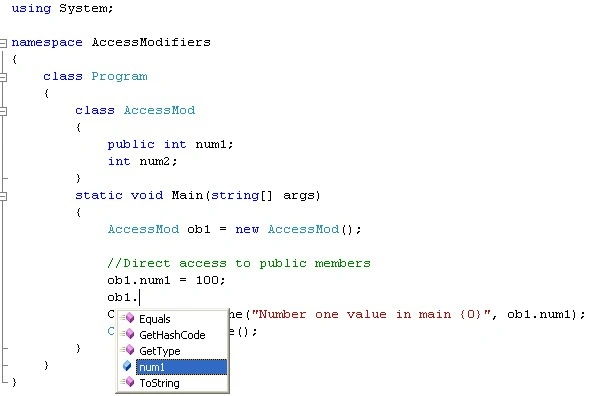
The above program will give compilation error, as access to private is not permissible. In the figure below, you can see the private member num2 is unavailable.
Protected Modifier
A protected member is accessible from within the class in which it is declared, and from within any class derived from the class that declared this member.
A protected member of a base class is accessible in a derived class only if the access takes place through the derived class type.
Accessibility
- Cannot be accessed by an object
- By derived classes
using System;
namespace AccessModifiers
{
    class Program
    {
        class Base
        {
            protected int num1;
        }
        class Derived : Base
        {
            public int num2;
            static void Main(string[] args)
            {
                // Base ob1 = new Base(); // This line will cause a compilation error
                Derived ob2 = new Derived();
                ob2.num1 = 20; // Access to protected member as it is inherited by the Derived class
                ob2.num2 = 90;
                Console.WriteLine("Number2 value {0}", ob2.num2);
                Console.WriteLine("Number1 value which is protected {0}", ob2.num1);
                Console.ReadLine();
            }
        }
    }
}
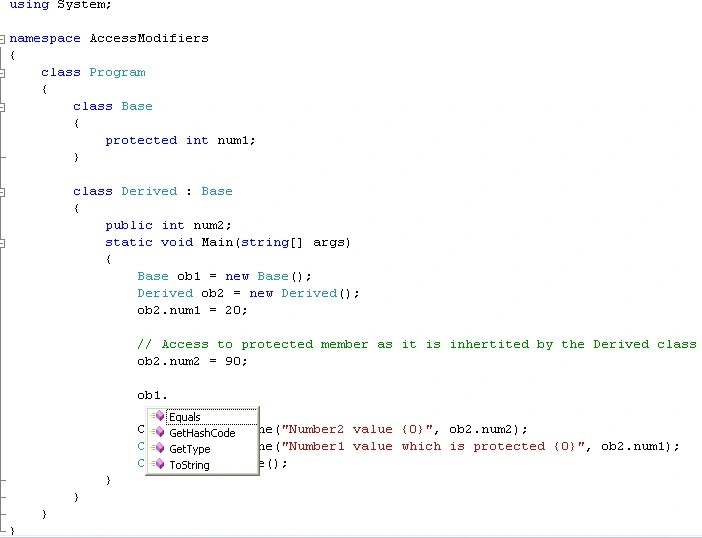
In the above program we try to access the protected members in the main it is not available as shown in the picture below num1 is not listed in Intellisense.
Internal Modifier
The internal keyword is an access modifier for types and type members. We can declare a class as internal or its member as internal. Internal members are accessible only within files in the same assembly (.dll).
In other words, access is limited exclusively to classes defined within the current project assembly.
Accessibility
In some assemblies (public)
- Can be accessed by objects of the class
- Can be accessed by derived classes
In other assembly (internal)
- Cannot be accessed by an object
- Cannot be accessed by derived classes
Protected Internal Modifier
The protected internal accessibility means protected OR internal, not protected AND internal.
In other words, a protected internal member is accessible from any class in the same assembly, including derived classes.
The protected internal access modifier seems to be confusing but is a union of protected and internal in terms of providing access but not restricting. It allows:
- Inherited types, even though they belong to a different assembly, have access to the protected internal members.
- Types that reside in the same assembly, even if they are not derived from the type, also have access to the protected internal members.
Default Access
A default access level is used if no access modifier is specified in a member declaration. The following list defines the default access modifier for certain C# types:
- Enum: The default and only access modifier supported is public.
- Class: The default access for a class is private. It may be explicitly defined using any of the access modifiers.
- Interface: The default and only access modifier supported is public.
- Struct: The default access is private with public and internal support as well.
The default access may suffice for a given situation, but you should specify the access modifier you want to use to ensure proper application behavior.
Note. Interface and enumeration members are always public and no access modifiers are allowed.
Conclusion
I hope that this article would have helped you in understanding accessibility modifiers. Your feedback and constructive contributions are welcome.
DP BhattaPosted May 6, 2022, 9:53 AM
The default access for a class is not private but it is internal.
Alex ANealsPosted Nov 29, 2021, 7:09 PM
Just a small correction. Change your subheading "Why to access modifiers?" to "Why access modifiers?" the "to" is not needed in this case.
Masthan BPosted Apr 6, 2019, 11:02 AM
Nice article. The default access modifier for the class is internal always until unless you set public.
Kapil GaurPosted Mar 20, 2019, 3:43 AM
Nicely Written C# Curator. We also have this article as video on C# Corner : > https://www.c-sharpcorner.com/article/access-modifiers-in-c-sharp/
Faisal PathanPosted Mar 20, 2019, 12:27 AM
C# Curator Mahesh Chand I think you should mention this line "default access modifier for Class is internal, Internal if it is directly declared inside the namespace and Private if it is nested." . can you please change this line? so freshers can learn right thing. thank you.
Abinash HotaPosted Jan 2, 2019, 5:47 AM
Nice article for freshers...
Hamid KhanPosted Sep 19, 2017, 4:45 AM
Good............,........
bheema munagalaPosted Aug 4, 2017, 2:13 PM
Class: The default access for a class is internal. It may be explicitly defined using any of the access modifiers.
SubashPosted Mar 17, 2017, 9:49 PM
Very good work keep sharing
Darko MarkovskiPosted Jun 17, 2016, 11:56 AM
Pretty good stuff but I could also find it on the http://msdn.com site as well.
Ashish SrivastavaPosted Apr 29, 2016, 5:23 AM
nice
Syed Md. KamruzzamanPosted Jan 29, 2016, 12:43 AM
Hi Puran, default access modifier for class is internal not private
Syed Md. KamruzzamanPosted Jan 29, 2016, 12:40 AM
wow, very easy to understand. thanks a lot
Pravin PatelPosted Dec 16, 2015, 11:54 PM
The default access modifier for Class is internal not Private as the class
Rajeesh MenothPosted Dec 10, 2015, 7:04 AM
Hi Puran Mehra , The default access modifier for Class is internal not Private ..
Saravanan NpPosted Oct 10, 2015, 12:15 AM
Really helpful for all beginner. Thanks Puran
susheel vishwakarmaPosted May 13, 2015, 11:00 AM
It was nice, but you didn't mention the use of internal access modifier practically.
Ankit singhPosted Apr 11, 2015, 4:42 AM
Realy good & simple.......
Abhishek JaiswalPosted Jun 23, 2014, 2:28 AM
good one!
sweta singhPosted Mar 26, 2014, 6:28 AM
The default access modifier for Class is internal not Private as the class with no access modifier can be accessed from any type within the same assembly
Sunil DeshalahrePosted Feb 12, 2013, 1:47 AM
Thank for article...I was looking for such a simple example to teach students.
deva nathanPosted Oct 1, 2012, 9:10 AM
Really good and simple . it is so useful for beginner
Jagdeep MankotiaPosted Sep 6, 2012, 7:31 AM
Thanks a Ton. This is one of the best and easiest post to understand the Access Modifiers on C#
Vineet Kumar SainiPosted Jan 21, 2012, 1:37 AM
Very Good Post......
Rajdeep PathakPosted Jun 14, 2011, 7:26 AM
Hi Mr. Puran, I had one doubt that how can we acheive the following. using System; namespace xxx { private class xyz { //code goes here } }
Rockin BenjaminPosted Nov 15, 2010, 8:12 AM
Deafult access modifier of a class is Internal.
Asad ButtPosted Aug 25, 2009, 2:24 PM
better explained than many of the books. will expect same again. cheerrs
Roberto BattistoniPosted Aug 24, 2009, 4:03 AM
I think there is an error in the "protected internal" part. It should be that: it has an internal visibility in the same assembly it has a protected visibility in a different assembly In fact "protected internal" is an OR between the "protected" and "internal" Microsoft MSDN say this: "protected internal The type or member can be accessed by any code in the same assembly, or by any derived class in another assembly."