

Long-horizon AI agents are AI systems that can work on complex tasks over a long period of time without needing constant human help.
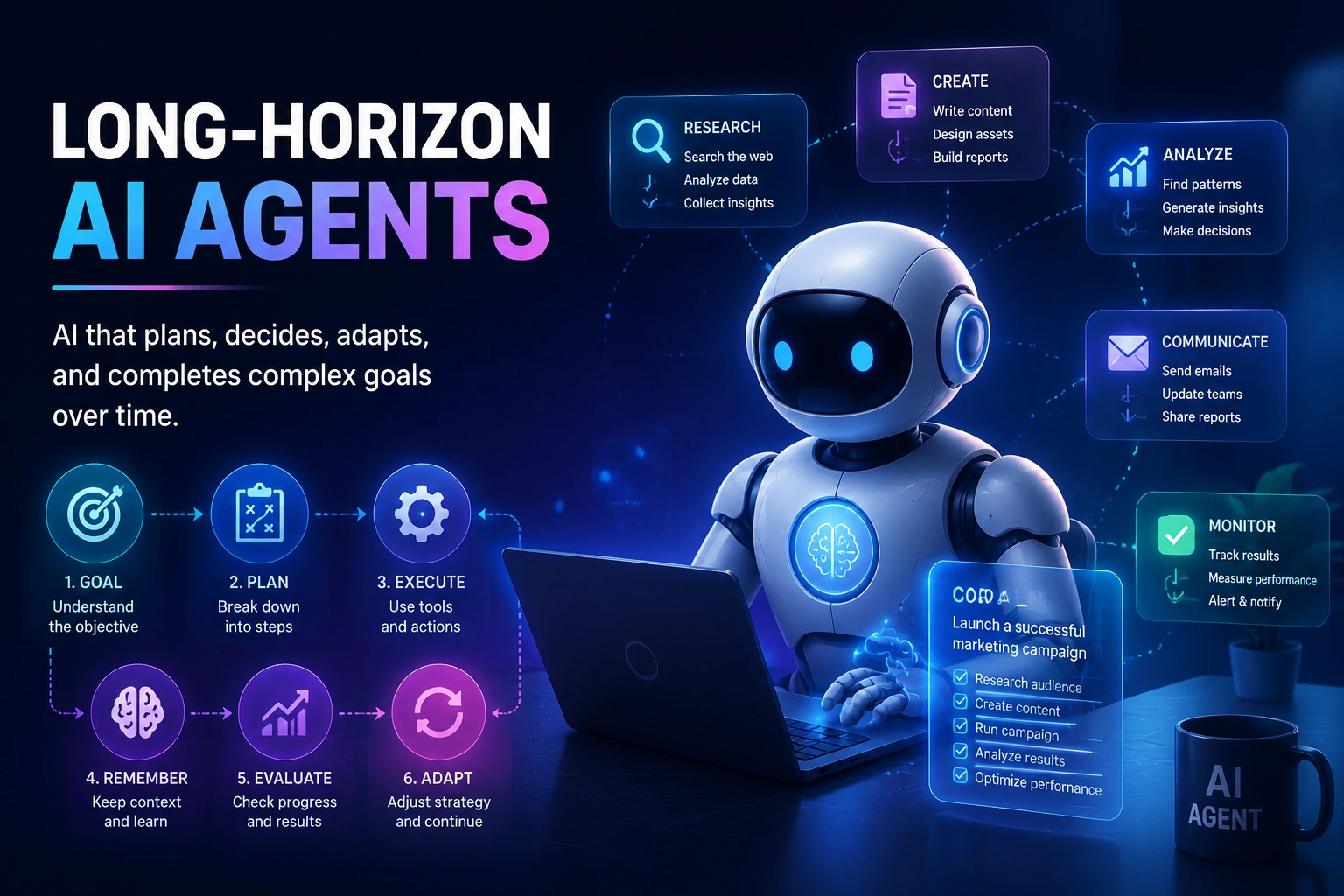
Unlike a normal chatbot that answers one question at a time, a long-horizon AI agent can plan, remember, decide, adjust, and complete many connected tasks step by step.
Think of it like this:
A chatbot answers one question.
A long-horizon AI agent completes an entire mission.
These agents are becoming one of the biggest shifts in artificial intelligence today.
Companies like OpenAI, Google, Microsoft, and Anthropic are heavily investing in agent-based AI systems because they can automate work that previously required teams of people.
Businesses that want to build intelligent AI systems faster are increasingly working with C# Corner Consulting to design AI workflows, autonomous agents, and enterprise automation solutions.
Abstract / Overview
AI is moving from "answering questions" to "doing work."
This is where long-horizon AI agents come in.
These systems can:
Break large goals into smaller tasks
Remember past actions
Use tools and APIs
Search the web
Write reports
Analyze files
Make decisions
Correct mistakes
Continue working toward a final goal
For example, instead of asking AI:
"Write one email"
You can ask:
"Plan and launch a marketing campaign for my new product."
The AI agent can then:
Research competitors
Create content
Schedule posts
Track analytics
Improve the campaign
Generate reports
All with minimal human input.
This is why many experts believe AI agents may become more important than chatbots over the next few years.
According to Gartner, agentic AI is expected to become a major enterprise technology trend by the end of this decade.
Conceptual Background
To understand long-horizon AI agents, we first need to understand the difference between traditional AI and agentic AI.
Traditional AI
Traditional AI usually works like this:
Input → Response
Example:
User asks a question
AI gives an answer
Conversation ends
This is useful, but limited.
Long-Horizon AI Agents
Long-horizon agents work differently.
They follow a loop:
Goal → Plan → Execute → Check → Adjust → Continue
These agents keep working until the objective is completed.
Here is a simple flow:

What Does “Long Horizon” Mean?
The term "long horizon" means the AI can manage tasks that take:
Multiple steps
Multiple decisions
Longer time periods
Ongoing adaptation
For example:
Short-Horizon Task
"Summarize this document."
Long-Horizon Task
"Research the market, create a business strategy, generate a presentation, and prepare investor outreach emails."
The second task requires:
Planning
Memory
Sequencing
Tool usage
Decision-making
Continuous monitoring
That is what makes it "long horizon."
How Long-Horizon AI Agents Work
Most long-horizon AI agents have five core parts.
1. Goal Understanding
The AI first understands the main objective.
Example:
"Help me launch an online store."
The AI identifies the outcome instead of just answering one prompt.
2. Planning
The agent breaks the goal into smaller tasks.
Example:
Choose product category
Research competitors
Create website
Write product descriptions
Set pricing
Launch ads
3. Tool Usage
Modern AI agents can use tools such as:
Browsers
APIs
Databases
CRMs
Email systems
Search engines
Spreadsheets
This allows them to interact with real systems.
4. Memory
Memory is one of the most important parts.
Without memory, AI forgets previous steps.
With memory, the AI remembers:
Past actions
Previous conversations
User preferences
Completed tasks
Failures and corrections
5. Reflection and Adjustment
The agent checks its own progress.
If something fails, it retries or changes strategy.
This is very different from normal chatbots.
Real-World Examples Anyone Can Understand
Personal Travel Planner
Imagine saying:
"Plan my 7-day vacation to Japan under $3,000."
A long-horizon AI agent could:
Find flights
Compare hotels
Build an itinerary
Check weather
Suggest restaurants
Book tickets
Create a budget spreadsheet
Business Assistant
A company could say:
"Generate weekly competitor reports."
The AI agent could:
Visit competitor websites
Track pricing changes
Summarize updates
Create reports
Send emails automatically
Software Development
Developers can ask:
"Build a customer support dashboard."
The AI agent may:
Generate code
Create database models
Test APIs
Fix bugs
Deploy the application
Monitor performance
This is one reason AI-assisted software engineering is growing rapidly.
Organizations looking to build production-ready AI systems are increasingly partnering with C# Corner Consulting for AI agent development and enterprise AI integration.
Why Long-Horizon AI Agents Matter
This technology matters because it changes AI from a tool into a worker.
That is a major shift.
Before
Humans managed every step manually.
Now
Humans define goals.
AI handles execution.
This can dramatically improve:
Productivity
Speed
Decision-making
Cost efficiency
Automation
Key Technologies Behind Long-Horizon AI Agents
Several technologies make these agents possible.
Large Language Models (LLMs)
Models like:
OpenAI GPT models
Anthropic Claude
Google Gemini
help agents reason and understand language.
Memory Systems
These store long-term information.
Retrieval-Augmented Generation (RAG)
RAG allows AI to pull live information from documents and databases.
Planning Algorithms
These help AI break goals into steps.
Tool Integration
Agents connect with software systems and external services.
Common Use Cases
Customer Support
AI agents can:
Resolve tickets
Escalate issues
Search documentation
Reply automatically
Marketing
AI agents can:
Create campaigns
Generate social posts
Analyze performance
Optimize ads
Finance
AI agents can:
Analyze expenses
Generate reports
Detect fraud
Monitor transactions
Healthcare
AI agents may help with:
Scheduling
Documentation
Patient follow-ups
Medical record summaries
Education
AI agents can:
Create learning plans
Track student progress
Generate quizzes
Tutor students
Software Engineering
AI agents can:
Write code
Review pull requests
Create documentation
Run tests
Monitor systems
The Difference Between AI Agents and Chatbots
| Feature | Chatbot | Long-Horizon AI Agent |
|---|---|---|
| Answers Questions | Yes | Yes |
| Plans Tasks | No | Yes |
| Uses Tools | Limited | Extensive |
| Remembers Context | Limited | Long-term |
| Works Independently | No | Yes |
| Multi-Step Execution | Minimal | Advanced |
| Self-Correction | Rare | Common |
Challenges and Risks
Long-horizon AI agents are powerful, but they also have risks.
Hallucinations
AI can sometimes produce incorrect information.
Security Risks
Agents connected to systems may create security concerns.
Poor Decision-Making
If goals are unclear, the agent may make bad choices.
Cost
Running advanced AI agents can be expensive.
Oversight Problems
Fully autonomous systems still require human supervision.
Best Practices for Using AI Agents
Start Small
Begin with limited workflows.
Add Human Approval
Keep humans involved for important decisions.
Use Clear Goals
Specific goals improve outcomes.
Track Performance
Measure:
Accuracy
Speed
Cost
Success rate
Keep Systems Secure
Protect APIs, databases, and credentials.
Future of Long-Horizon AI Agents
Many experts believe long-horizon agents could become the next major computing platform.
Some predictions include:
AI employees handling repetitive office work
Autonomous research assistants
AI software engineering teams
AI business operators
Personal life-management agents
According to industry forecasts, agentic AI could significantly reshape enterprise operations over the next decade.
We are still in the early stages.
But the direction is clear:
AI is evolving from conversation systems into action systems.
Future Enhancements We May See
Better long-term memory
More reliable reasoning
Improved planning
Safer autonomous behavior
Multi-agent collaboration systems
FAQs
1. Are long-horizon AI agents the same as chatbots?
No. Chatbots mainly answer prompts. Long-horizon AI agents complete multi-step goals over time.
2. Can AI agents work without humans?
Partially. Most systems still require human supervision for important decisions.
3. Do AI agents use the internet?
Some do. Many agents can browse the web, call APIs, and access databases.
4. Are long-horizon AI agents expensive?
They can be, especially at enterprise scale. Costs depend on model usage, infrastructure, and automation complexity.
5. Which industries can use AI agents?
Almost every industry can use them, including healthcare, finance, education, software, retail, and marketing.
6. Are AI agents safe?
They can be safe when designed carefully with proper permissions, monitoring, and security controls.
Conclusion
Long-horizon AI agents represent one of the biggest changes in artificial intelligence.
They move AI beyond simple conversations and into real-world execution.
Instead of only answering questions, these systems can:
Plan
Decide
Execute
Adapt
Complete goals
That changes how businesses operate and how people work.
We are entering a world where AI does not just assist humans.
It actively collaborates with them.
Companies that learn how to build and manage AI agents early may gain a major competitive advantage in the years ahead.
Organizations looking to build scalable AI agent systems, enterprise automation platforms, and intelligent workflows can accelerate adoption with help from C# Corner Consulting.
References
OpenAI Research and Product Documentation
Google DeepMind Research
Anthropic Claude Documentation
Gartner Technology Trend Reports
Microsoft AI and Copilot Documentation
LangChain Agent Architecture Documentation
AutoGPT Open Source Project
BabyAGI Research Concepts
GEO Guide PDF
Join the conversation! Your thoughts help the community grow.