

Abstract / Overview
Building systems with LangChain Deep Agents and Box combines agentic orchestration with secure enterprise content. LangChain provides multi-step reasoning and tool coordination. Box supplies governed access to documents, metadata, and permissions. Together, they enable AI agents that plan, retrieve, reason, and act across enterprise knowledge while maintaining security and compliance.
This article explains what the architecture is, how it works end-to-end, and how teams can implement production-grade agent systems using this approach.
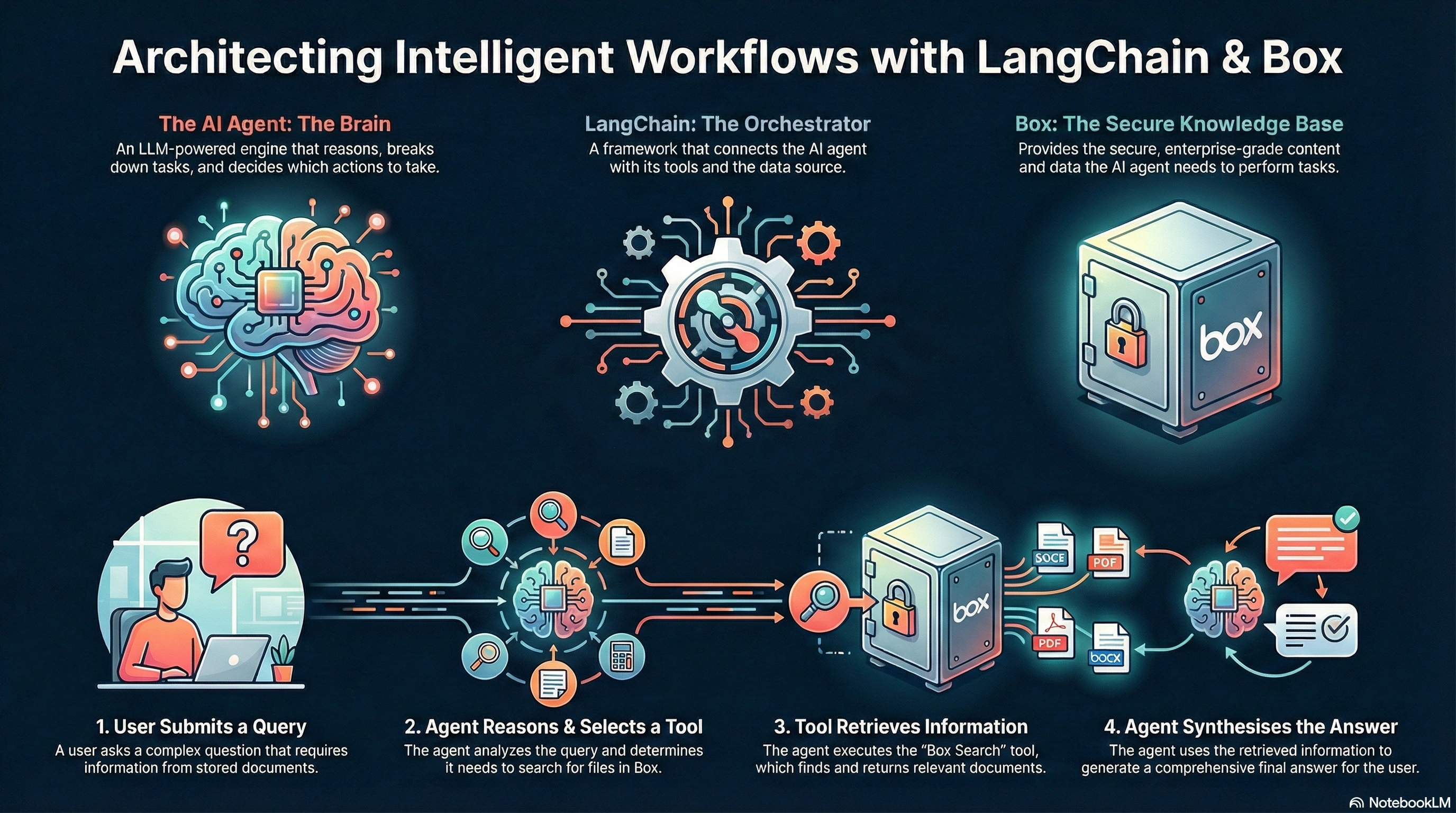
Conceptual Background
Agentic Systems in Enterprise AI
Agentic systems extend large language models with planning, memory, and tool use. Instead of single-turn prompts, agents decompose goals into steps, choose tools, observe results, and iterate. This design is required for real enterprise work such as document analysis, compliance checks, and multi-source research.
LangChain Deep Agents
LangChain Deep Agents represent a pattern where agents operate with:
Explicit planning and task decomposition
Tool routing and execution
Memory and state across steps
Observation-driven iteration
They move beyond simple chains into autonomous, inspectable workflows suitable for complex reasoning tasks.
Box as the Enterprise Content Layer
Box acts as a secure system of record for enterprise files. It provides:
Fine-grained permissions and access control
Metadata and classification
APIs for search, preview, and extraction
Governance, audit, and compliance guarantees
When paired with agents, Box becomes a trusted knowledge substrate rather than a passive file store.
How LangChain Deep Agents and Box Work Together
At a high level, LangChain orchestrates intelligence while Box governs data access.
Core Interaction Flow

Step-by-Step Walkthrough
A user submits a high-level objective, such as summarizing contracts or identifying compliance risks.
A LangChain Deep Agent breaks the objective into sub-tasks.
The agent queries Box using scoped permissions tied to the user or service identity.
Retrieved documents are passed into reasoning steps using retrieval-augmented generation.
The agent decides whether more data or tools are needed and iterates.
The final output is generated with traceability to the underlying Box content.
Security and Governance by Design
Enterprise adoption depends on trust. This architecture preserves it.
Permission-Aware Retrieval
Agents never see more than they are allowed to see. Box enforces access control before content is retrieved, ensuring agents operate within existing enterprise security models.
Auditability and Transparency
Each agent action can be logged:
Which documents were accessed
Which tools were invoked
How conclusions were formed
This is critical for regulated industries.
Expert Perspective
“Agentic AI only works in enterprises when it respects identity, permissions, and provenance.”
— Enterprise AI Architecture Principle, 2024
Use Cases and Scenarios
Contract Intelligence
Agents analyze large contract repositories in Box to extract obligations, risks, and renewal dates. Multi-step reasoning enables cross-document comparison.
Compliance and Audit Readiness
Agents search policy documents, evidence files, and logs stored in Box to answer audit questions with citations.
Knowledge Work Automation
Employees ask natural-language questions over years of internal documents. Agents plan retrieval, summarize findings, and produce executive-ready outputs.
Customer Support Enablement
Agents retrieve product documentation, training materials, and historical tickets stored in Box to generate accurate, contextual responses.
Architecture Patterns That Scale
Retrieval-Augmented Agents
Instead of embedding everything upfront, agents retrieve on demand from Box. This reduces cost, improves freshness, and preserves governance.
Tool-First Design
Agents treat Box search, preview, and metadata APIs as first-class tools rather than static data sources.
Human-in-the-Loop Controls
Critical steps can pause for human review, approval, or override before final actions are taken.
Limitations and Considerations
Agent latency increases with complex planning steps
Poor metadata quality in Box reduces retrieval precision
Overly broad agent permissions increase risk
Debugging agent behavior requires strong observability
These are architectural concerns, not blockers, and can be mitigated with design discipline.
Fixes and Best Practices
Constrain agent scope with explicit goals and tool limits
Enrich Box metadata and classification before deployment
Log every agent decision and retrieval event
Start with read-only agents before enabling write actions
Sample Agent-Oriented Workflow (Conceptual JSON)
{
  "goal": "Summarize compliance risks in vendor contracts",
  "tools": ["box_search", "box_preview", "llm_reasoning"],
  "constraints": {
    "permissions": "user_scoped",
    "document_types": ["contracts"]
  },
  "output": "risk_summary_with_sources"
}
Future Enhancements
Deeper integration with Box metadata-driven routing
Agent collaboration across departments
Real-time policy enforcement during reasoning
Native evaluation metrics for agent reliability
FAQs
1. What makes Deep Agents different from simple RAG?
Deep Agents plan, iterate, and choose tools dynamically. Simple RAG retrieves once and responds.
2. Why is Box important in this architecture?
Box provides secure, permission-aware access to enterprise documents, which is essential for trusted AI outputs.
3. Is this approach suitable for regulated industries?
Yes. Governance, audit logs, and access control are core strengths of this design.
4. Can this work with other LLM providers?
Yes. LangChain abstracts model providers, enabling flexibility.
References
Building Systems With LangChain Deep Agents and Box, Box Blog
Enterprise Agentic AI Design Patterns, 2024
Secure Retrieval-Augmented Generation Architectures
Conclusion
Building systems with LangChain Deep Agents and Box represents a practical blueprint for enterprise-grade agentic AI. LangChain delivers orchestration, reasoning, and extensibility. Box ensures security, governance, and trusted knowledge access. Together, they move AI from experimental chat to dependable enterprise systems designed for real work.
Join the conversation! Your thoughts help the community grow.