
New to .NET, wondering what this buzz word .NET is today's happening in the development of enterprise applications and Web Services on Windows platforms! Here is a precise introduction for you. Come on let's party!
This article focuses on the following topics:
- What is .NET?
- Why .NET?
- Microsoft's .NET Framework
- CLR, CTS and CLS - an Overview
- .NET Framework Class library
- .NET compliant Languages and
- C# - a brief introduction
Introduction
The .NET Platform and .NET-Aware Programming Languages, particularly C# are already making a turnaround in the way Applications are developed in the enterprise world. This new programming model is a boon for building XML Web Services and applications. Say it may be Web Applications, XML Web Services, desktop or mobile applications; .NET Framework has got every thing you need to develop these applications with excellent performance and throughput. Moreover Microsoft's IDE, Visual Studio .NET, comforts the user by providing a cool development environment. The .NET Platform is the world order of Windows development and it is possible for non-Windows development in the future.
The .NET Framework allows different programming languages & libraries to work together seamlessly which is made possible by the Common Type System. Microsoft has developed a new language named c# specifically for this new platform which will not come under the scope of this article, anyway I will get you started with C# and specify, why it is the programming language most suited for the .NET platform!
What is .NET any way?
.NET is Microsoft's innovative strategy to simplify building XML Web Services and to develop, deploy, and maintain desktop, enterprise, Internet and Smart devices applications in the Internet age.
The .NET platform is thus a runtime environment on which applications coded in any of the managed languages run. It acts as a software layer between the applications written on the .NET and the operating system. For the time being, the operating systems can be any of the Windows platforms.
Cool right! To make you feel more clear and comfortable, the term .NET actually means the set of tools and technologies as follows: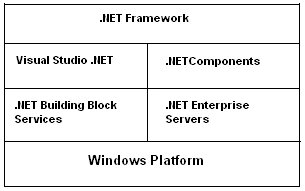
Fig 1: Microsoft .NET
The .NET Framework is the keystone of Microsoft .NET. The .Microsoft's .NET vision of connecting information, people, systems, and devices is made true by the .NET Framework.
Why .NET?
The most beauty in .NET is that we don't have to learn a new language to program on the .NET platform. The platform is very much language agnostic and there are only a few syntactical issues to start programming in a language for the .NET platform.
.NET platform presents us with the following:
- Multiple Language Development.
- Robust runtime environment, CLR.
- Cool Development environment, Visual Studio .NET.
- High level of communication among applications.
- Support for ubiquitous protocols namely SOAP, XML, HTTP, and HTML.
- A huge and powerful class library with over 2000 classes.
And many more!
.NET Framework
The term .NET framework stands for the collection of technologies that form the development basis for the Microsoft .NET platform.
It is a development and execution environment that allows different programming languages & libraries to work together effortlessly to create Windows-based applications that are easier to build, manage, and deploy.
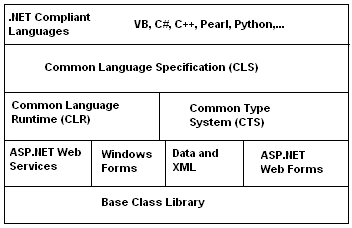
The major constitutes of .NET Framework are:
- Framework Class Libraries (FCL)
- Common Language Runtime (CLR) and
- Common Language Specification (CLS)
liamsieditedPosted Jan 30, 2011, 9:57 AMEdited Feb 2, 2011, 2:34 PM
its really help me
liamsieditedPosted Jan 28, 2011, 5:16 AMEdited Feb 2, 2011, 2:34 PM
thanks
ismaileditedPosted Jan 28, 2011, 5:01 AMEdited Jan 28, 2011, 5:04 AM
hi