

One of the most common and legitimate fears around multisig wallets is this question.
What happens if one of the signers loses their private key?
Loosing keys is a common problem in crypto. People lose hardware wallets, devices break, access gets locked, or laptops are wiped. In crypto, private key loss is not an edge case. It is a certainty over time.
The good news is that multisig wallets are designed with this reality in mind. The bad news is that poor multisig design can still lead to frozen funds.
Whether a lost key becomes a problem depends entirely on how the multisig wallet was set up.
If a multisig wallet is designed correctly, losing one signer’s private key does not put funds at risk and does not stop the wallet from functioning. If a multisig wallet is designed poorly, losing keys can permanently lock funds. Multisig does not magically solve key management. It gives you tools to design around human failure.
Why Multisig Exists in the First Place
A single wallet fails catastrophically when its private key is lost. There is no fallback. Funds are gone forever.
Multisig wallets exist precisely to avoid that single point of failure. Instead of depending on one key, control is distributed across multiple keys with a defined approval threshold. The entire purpose of a multisig is to tolerate individual key loss without collapsing.
What Happens in a 2 of 3 Multisig
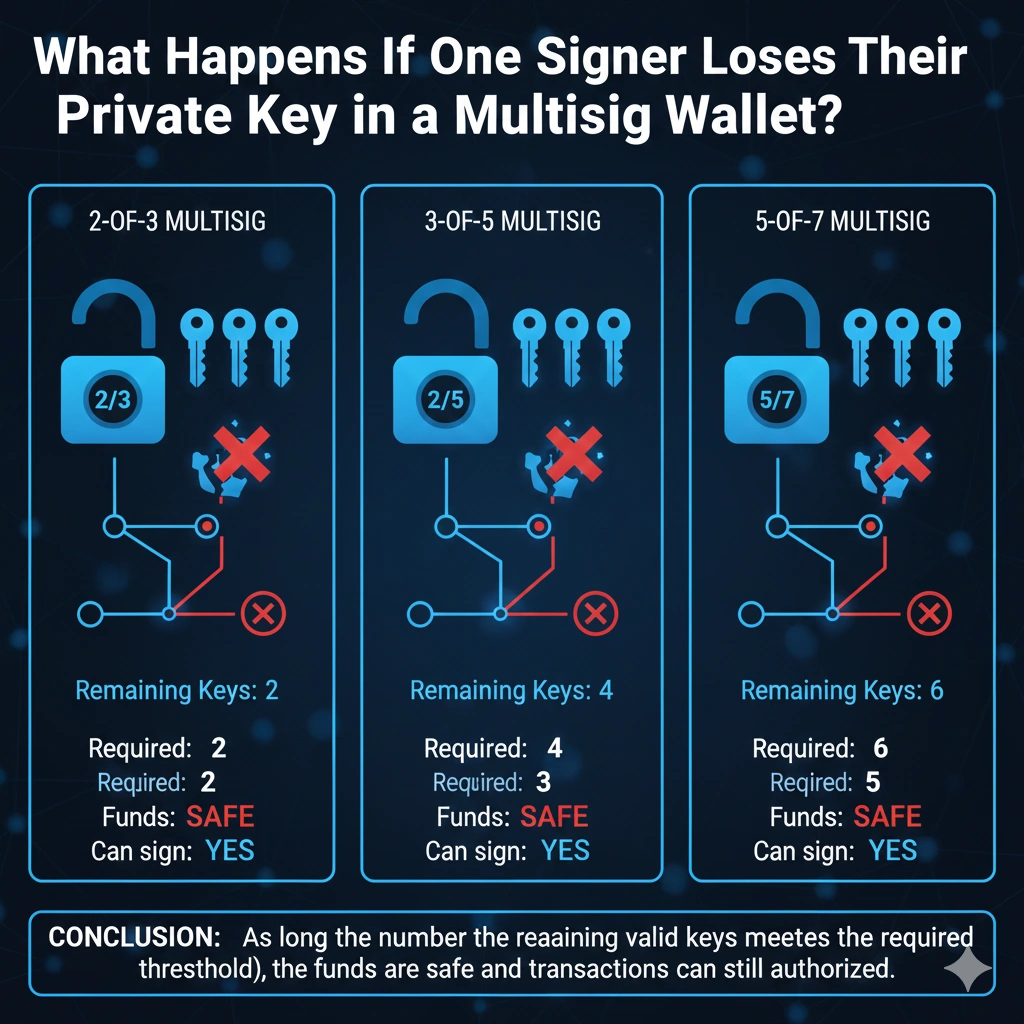
This is the most common and most forgiving setup. There are three authorized signers. Any two approvals are required to move funds.
If one signer loses their private key, the remaining two signers can still approve transactions. The wallet continues to function normally. Funds are not frozen. Security is not compromised.
From an operational standpoint, this is exactly how multisig should behave.
At that point, the team can decide whether to rotate the lost signer out and add a new signer to restore redundancy.
What Happens in a 3 of 5 Multisig
In a 3 of 5 setup, the system is even more tolerant.
One lost key is a non issue. Even two unavailable signers may still leave the wallet operational. This is why larger teams and DAOs often prefer higher signer counts with reasonable thresholds.
The cost is coordination, but the benefit is resilience.
When Key Loss Becomes Dangerous
Key loss only becomes a real problem when the number of lost or unavailable keys drops below the required approval threshold.
For example, in a 2 of 3 multisig, losing two keys means the wallet can no longer reach two approvals. At that point, funds are effectively frozen.
The same applies to any configuration. The wallet is only as usable as its ability to meet the approval threshold.
This is not a bug. It is the trade off that multisig enforces.
Why Some Multisig Wallets Still Fail
Most multisig disasters are not caused by multisig itself. They are caused by bad design decisions.
Common mistakes include using thresholds that are too high for the number of active signers, failing to plan for signer turnover, storing multiple keys with the same person, or never rotating signers when someone leaves the organization.
In these cases, multisig gives a false sense of security. The wallet looks robust, but it is actually fragile.
How Professional Teams Design for Key Loss
Experienced teams assume that keys will be lost eventually. They design multisig wallets to survive that reality. This usually includes having more signers than the minimum required, using hardware wallets for every signer, distributing keys across people and locations, and defining a clear process for removing and replacing signers.
Most teams managing serious funds use battle tested multisig implementations such as Safe, which allows signers to be changed through approved multisig transactions. This makes recovery from key loss possible as long as the approval threshold can still be met.
What Multisig Cannot Fix
Multisig cannot recover a lost private key. No wallet can. If too many keys are lost and the approval threshold cannot be reached, funds are permanently inaccessible. The blockchain will not make exceptions. This is why multisig is about reducing risk, not eliminating it.
Why This Matters for DAOs and Treasuries
For DAOs, foundations, and protocol treasuries, key loss planning is a governance responsibility. A multisig wallet that cannot survive normal human failure is not secure. Investors increasingly look for evidence that teams understand this. A well designed multisig setup signals maturity. A poorly designed one is a red flag.
Can You Assign 1 of the Keys
Yes. Iin a properly designed 2-of-3 multisig, the remaining 2 signers can remove or replace the third signer, as long as the multisig contract allows signer changes through normal approvals. Most modern multisig wallets do.
Here’s how it works in practice,
In a standard 2-of-3 multisig, if one signer loses their private key, the other two signers can collectively update the signer set and replace the lost key without losing access to funds. This is not a loophole. It is an intentional feature.
Why This Is Possible
Multisig wallets do not treat “changing signers” as a special action. It is just another transaction governed by the same approval rules.
If the wallet requires 2 approvals for any action, then removing a signer, adding a new signer, and changing the threshold, all require 2 approvals.
So if two valid signers still have their keys, they still control the wallet.
How This Works in Real Multisig Wallets
Most Ethereum multisig wallets today are implemented using Safe.
In Safe:
• Owners (signers) are stored in the contract
• Owner changes are done via multisig transactions
• The same approval threshold applies
That means in a 2-of-3 Safe:
• Any 2 owners can propose and approve a transaction
• That transaction can remove the lost owner
• A new owner can be added
• The wallet returns to a healthy 2-of-3 state
This is exactly how key-loss recovery is supposed to work.
Important Caveat
This only works if the approval threshold can still be met.
Examples:
• 2-of-3 → 1 lost key → ✅ recoverable
• 2-of-3 → 2 lost keys → ❌ funds frozen
• 3-of-5 → up to 2 lost keys → ✅ still recoverable
Multisig does not recover keys. It recovers control as long as the threshold can still be satisfied.
Why This Is a Feature, Not a Risk
Some people worry that “2 signers can kick out the third” sounds dangerous. In reality, this is exactly how governance works.
If two signers already have the power to move funds, they already have power. Preventing signer changes would actually make multisig more fragile, not more secure.
The real protection comes from:
• who the signers are
• how keys are distributed
• whether signers are independent
Multisig enforces shared control, not trustless democracy.
The Bottom Line
If one signer loses their private key, a properly designed multisig wallet continues to work. If a multisig wallet fails because of one lost key, the problem is not the technology. It is the design. Multisig wallets reward teams that plan for reality. They punish teams that assume perfection.
Join the conversation! Your thoughts help the community grow.