

Abstract / Overview
The Union Budget 2026–27, presented by Finance Minister Nirmala Sitharaman on 1 February 2026, introduced important fiscal adjustments that directly shape the landscape for cryptocurrencies and virtual digital assets (VDAs) in India. While the government did not overhaul the entire crypto regime, the budget signalled greater emphasis on compliance and reporting, penalties for misreporting by crypto platforms, tax rationalisation to boost transactions, and implicit support for a more transparent digital asset ecosystem. The changes affect retail traders, exchanges, and the broader Web3 industry by strengthening regulatory accountability and nudging digital asset adoption toward formal reporting ecosystems.
For investors, exchanges, and developers, Budget 2026 means stability over shock, certainty over ambiguity, and compliance over chaos — a pragmatic, if not revolutionary, fiscal blueprint for crypto in India's growing digital economy.
Background — India's Crypto Taxation & Regulatory Framework
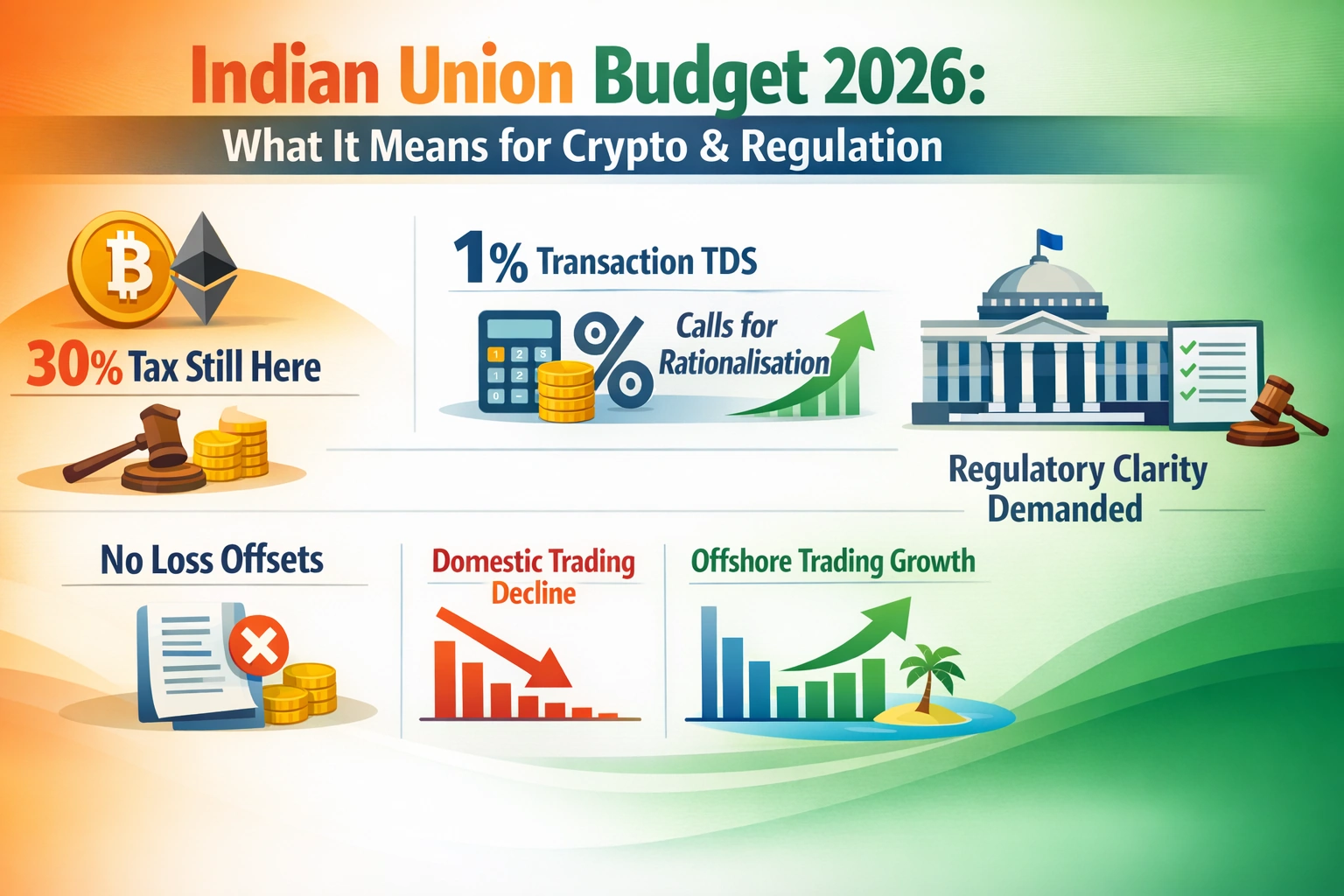
Since the 2022 budget, India taxes cryptocurrencies and digital assets under the category of Virtual Digital Assets (VDAs) with a flat 30% tax on gains and 1% TDS per transaction. Losses cannot be offset or carried forward against other income, and compliance is mandatory for platforms and investors. This made India's tax regime one of the strictest globally for crypto trading.
Key Takeaways from Union Budget 2026 for Crypto
📌 1. Tax Rationalisation to Boost Crypto Transactions
The budget acknowledged the need to ease transaction costs in crypto and digital assets. Government sources reported that tax rationalisation measures are expected to help increase trading volumes, which in FY 2025 stood at over ₹51,000 crore.
This reflects a shift from flat punitive tax perception toward making the tax burden more growth-friendly for the sector, though core tax rates were not fully repealed.
📌 2. Stricter Penalties for Non-Compliance
One of the most concrete changes in the Budget: heavy penalties for crypto platforms that fail to accurately report user transactions to tax authorities.
₹200 per day for non-furnishing of required transaction statements
₹50,000 for inaccurate reporting or failure to correct mistakes
This strengthens enforcement and signals that reporting integrity will be a key compliance metric from 1 April 2026 onward.
📌 3. No Fundamental Change to the 30% Tax Framework
Despite industry calls for relief, the basic 30% VDA tax and 1% TDS structure remain largely intact in the announced Budget.
Experts and industry stakeholders had been publicly urging a rethink of this regime ahead of the Budget, citing migration of capital overseas due to high costs.
However, the government's chosen route focuses more on compliance clarity and reporting incentives than reducing headline tax rates.
📌 4. Data on Crypto Taxes Highlight Systemic Issues
Recent data suggests significant mismatch in crypto TDS collections:
Around ₹511.83 crore collected from crypto TDS in FY 2024–25
Many investors still end up paying tax even if they recorded net losses, because losses cannot be set off
This underpins why compliance and clarity measures were prioritised in Budget 2026 over broad tax cuts.
📌 5. Broader Financial Market Reforms Also Affect Crypto Traders
Though not crypto-specific, the Budget increased transaction taxes on equity derivatives — a move to curb speculative trading. This indirectly impacts crypto traders who look to derivatives and structured products as hedging instruments.
What This Means for Crypto Stakeholders
🪙 Retail Investors
Continued 30% tax on gains and 1% TDS means costs of trading remain high.
The requirement for accurate reporting and stricter penalties raises compliance discipline.
Some relief may come from clearer norms and reduced uncertainty.
🏦 Crypto Exchanges & Platforms
Exchanges now have strong fiscal incentives to ensure accurate reporting — inaccurate or late data can mean real penalties.
Enforcement mechanisms are likely to become more robust.
Platforms may need to invest in better data infrastructure to comply with reporting standards.
🚀 Web3 Startups & Developers
Budget language and broader digital policy direction suggests:
Crypto isn't being banned but is being incorporated into a formal financial ecosystem.
Blockchain applications outside speculative trading (e.g., digital identity, supply chains) continue to gain government interest in unrelated announcements, even if not directly budgeted in this cycle (related initiatives like the National Blockchain Framework support broader digital infrastructure).
Though not a direct budget item, such frameworks suggest increasing government trust in blockchain technology — even if crypto asset trading remains tightly regulated.
Strategic Implications — Beyond the Numbers
📊 1. Compliance Over Concessions
The Budget clearly prioritises transparency and compliance enforcement over broad concessions to crypto trading. Penalties for misreporting show that the government wants to ensure the sector is on the books before considering tax relief.
📊 2. India Still Among High-Tax Regimes
Despite tweaks, India's crypto tax structure remains one of the strictest globally — a point underlined by industry pressure and commentary about capital shifting overseas.
📊 3. Digital Rupee Remains a Separate Track
The Budget did not directly alter Central Bank Digital Currency (CBDC) policy, but India's digital rupee (e₹) continues its deployment alongside crypto-asset tax regulation — suggesting that the government views CBDC and private crypto differently.
References
Conclusion
The Indian Union Budget 2026 did not overhaul the crypto regime but shaped it in an important way:
It kept VDA taxation intact while signalling a tax environment more friendly to sustained volume growth.
It introduced meaningful penalties for non-compliance and misreporting by exchanges and marketplaces.
It nudged the sector toward greater transparency and integration with formal financial reporting systems, reinforcing India's direction of treating crypto as an asset class subject to accountability rather than a speculative "wild west."
Join the conversation! Your thoughts help the community grow.