

Abstract / Overview
A System One model is a new type of AI model designed to make fast, structured decisions that software can use directly.
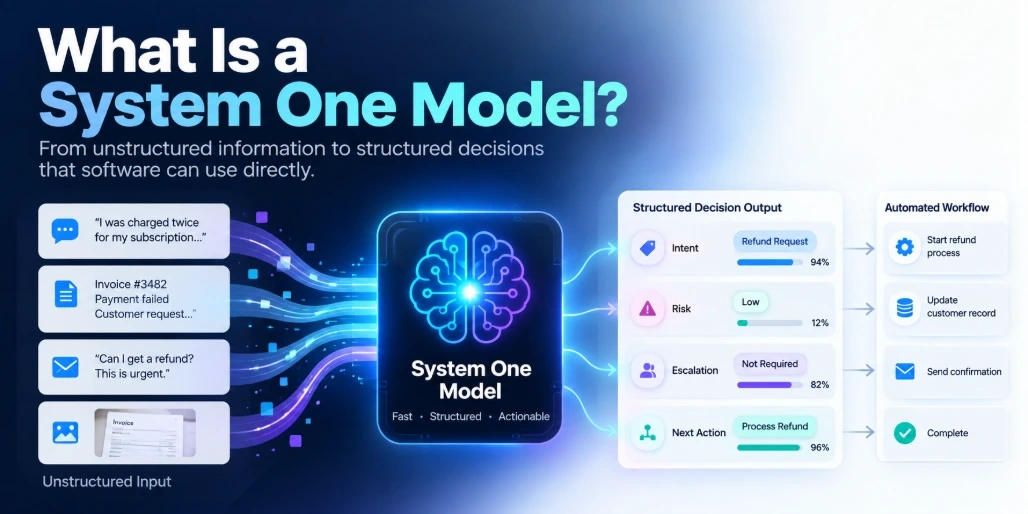
Traditional large language models (LLMs) are mainly designed to generate text. System One models take a different approach: they turn unstructured information into structured decisions, probabilities, scores, or classifications.
TypeSafe AI introduced the term System One Models in September 2026 and launched Jev as its first public model in this category. TypeSafe describes Jev as an AI model built for automation rather than chat.
The idea is important because many software systems do not need an AI model to write an essay. They need an answer such as:
Is this transaction suspicious?
Which customer-intent category does this message belong to?
Should this request be escalated?
Which workflow should run?
How likely is this customer to churn?
Does this document satisfy a particular rule?
For these tasks, generating a long text response can be unnecessary. A System One model is designed to make the decision itself.
What Is a System One Model?
A System One model is an AI model optimized for machine-to-machine decision making.
Instead of primarily producing a string of text, it produces a structured result that an application can consume.
A simplified example looks like this:
Customer message
       ↓
System One Model
       ↓
Intent: "Refund Request"
Confidence: 94%
       ↓
Software workflow
       ↓
Start refund process
The important difference is what happens after the AI responds.
With a traditional LLM:
Input → LLM → Text → Parse → Validate → ApplicationWith a System One model:
Input → System One → Structured Decision → ApplicationTypeSafe's current documentation describes System One API operations for tasks such as asking yes/no questions, selecting from choices, evaluating statements, and assigning ratings.
Why Is It Called "System One"?
The name comes from the distinction popularized by psychologist Daniel Kahneman between System 1 and System 2 thinking.
System 1 refers to fast, intuitive judgments.
System 2 refers to slower and more deliberate reasoning.
AI researchers have used this distinction to describe different ways AI systems can process problems. Research on reasoning LLMs has also used the System 1/System 2 framework to describe the difference between fast responses and deliberate reasoning.
However, there is an important distinction:
A System One model is not simply a traditional LLM with less reasoning.
TypeSafe uses "System One" as the name for a model class designed specifically for structured decisions inside software. Its first model, Jev, was built with a different architecture, sampler, and training approach rather than simply being a smaller conventional LLM.
Traditional LLM vs System One Model
The easiest way to understand the difference is to look at what each model is optimized to produce.
Capability | Traditional LLM | System One Model |
|---|---|---|
Primary purpose | Generate and understand language | Make machine-usable decisions |
Output | Text | Structured values |
Typical interaction | Human ↔ AI | Software ↔ AI |
Output flexibility | Very high | Intentionally constrained |
Latency | Can be relatively high | Designed for very fast decisions |
Confidence | May be inconsistent | Confidence is part of the output |
Hallucination risk | Exists | Structured design aims to prevent invalid output |
Best suited for | Chat, writing, coding, agents | Classification, routing, scoring, verification, automation |
This does not mean System One models replace LLMs.
They solve a different problem.
How Does a System One Model Work?
A System One architecture can be understood through four major ideas.
1. Unstructured input
The model can receive information such as:
"The customer cancelled their subscription last week
but was charged again today."
The input can still contain natural language and other application data.
2. A defined decision
Instead of asking the model to write a response, the software defines the decision it needs.
For example:
Is this a duplicate billing complaint?

Yes
No
Or:
Choose the customer intent:

Refund
Cancellation
Technical Issue
Billing
Other
3. Structured output
The model returns a result that follows a defined structure.
For example:
{
  "intent": "Billing",
  "confidence": 0.94
}
The surrounding application can consume this directly.
4. Software takes the action
The application can then decide what happens next.
AI Decision
    ↓
Confidence check
    ↓
High confidence?
   /        \
 Yes        No
 ↓          ↓
Automate   Human review
This is particularly useful for systems where the AI should not have unlimited freedom.
What Makes System One Different From JSON Mode?
This is an important distinction.
Many modern LLMs can already return structured JSON.
So why create a new model class?
Because structured output and structured intelligence are not exactly the same thing.
An LLM can generate:
{
  "intent": "refund"
}
But the underlying model is still generating tokens.
The application may still need to:
validate the response
handle malformed output
determine whether the model is confident
deal with unexpected values
retry failed calls
interpret uncertainty
System One models are designed around the decision itself.
TypeSafe says its models produce type-safe structured values and calibrated probabilities as part of the model's output.
What Is Calibrated Confidence?
This is one of the most important concepts behind System One models.
Suppose an AI system needs to determine whether a transaction is fraudulent.
Instead of returning:
Frauda decision model could return something conceptually like:
{
  "decision": "fraud",
  "probability": 0.96
}
The application can then create a policy:
Confidence > 95%
→ Automatically block

Confidence between 70% and 95%
→ Send for review

Confidence < 70%
→ Allow or request additional information
This turns AI uncertainty into something that software can use.
TypeSafe specifically positions calibrated confidence as a core part of System One models.
System One Models and AI Agents
System One models could become particularly useful inside AI agents.
Consider a customer-service agent.
A general LLM might handle the conversation:
Customer
   ↓
LLM Agent
   ↓
Understand request
   ↓
Plan response
   ↓
Call tools
   ↓
Respond
A System One model could provide decision checkpoints:
                ┌→ Safety check
                │
Customer → Agent ─→ Intent classification
                │
                ├→ Fraud assessment
                │
                ├→ Escalation decision
                │
                └→ Action selection
The LLM handles flexible language and reasoning.
The System One model handles narrow, repeatable decisions.
The software controls the final workflow.
This creates a potentially powerful architecture:
LLM + System One model + deterministic code
Where Can System One Models Be Used?
Customer Support
A System One model can classify incoming requests.
For example:
Message
  ↓
Intent
  ├── Refund
  ├── Cancellation
  ├── Billing
  ├── Technical Support
  └── Human Escalation
Fraud Detection
The model can evaluate transaction information and provide a probability or score.
The application can then decide whether to:
approve
reject
investigate
request additional verification
Sales Automation
A sales system could evaluate:
lead quality
buying intent
account fit
urgency
likelihood of conversion
The result can trigger different workflows.
AI Guardrails
System One models can also act as independent evaluators.
For example:
User Input
   ↓
LLM
   ↓
Generated Response
   ↓
System One Safety Check
   ↓
Pass → Deliver
Fail → Block / Review
TypeSafe specifically lists verification, scoring, judging, guardrails, and jailbreak detection among potential System One use cases.
Real-Time Applications
Fast decision-making can be useful in applications where waiting several seconds for a large model is undesirable.
Examples include:
real-time recommendations
interactive applications
fraud checks
routing
personalization
game logic
voice applications
workflow automation
System One vs System Two
The distinction can be summarized simply.
System One
Fast → Focused → Structured → Automated
System Two
Slow → Deliberate → Complex → Reasoning-heavy
A practical AI architecture may use both.

The goal is not necessarily to choose one model for everything.
The better architecture may be to use the appropriate intelligence for each part of a workflow.
Why This Matters for AI Automation
Today's AI applications often use LLMs as general-purpose engines.
That works well when humans are directly interacting with the model.
But software automation creates different requirements.
A production system may need:
predictable output
low latency
controlled behavior
explicit uncertainty
machine-readable decisions
reliable integration
low cost at high volume
This is where the System One approach becomes interesting.
TypeSafe reports that Jev is designed for very fast structured decisions and publishes substantially lower latency and cost figures for its own System One workloads. These figures are vendor-reported and depend on the workload and comparison setup, so they should not be treated as universal performance benchmarks.
Is a System One Model Just a Small LLM?
Not necessarily.
TypeSafe explicitly distinguishes Jev from simply being a smaller LLM.
The company describes System One as a different model class with its own architecture, sampling method, and training approach.
That distinction matters.
Making an LLM smaller can reduce cost and latency.
But a model designed from the beginning around structured decisions can optimize for a different target.
The fundamental question changes from:
"How can AI generate better text?"
to:
"How can AI make useful decisions that software can safely act on?"
What Is Jev?
Jev is TypeSafe AI's first public System One model.
TypeSafe announced Jev in September 2026 and made it available through early access. The company describes it as a model that accepts unstructured state and produces typed probabilistic decisions.
Its API currently exposes decision-oriented operations including:
yes/no questions
choice selection
scoring
statement evaluation
The official API documentation provides a /v1/systemone endpoint for System One requests.
This makes Jev particularly relevant to developers building AI-powered workflows rather than traditional chat applications.
A Simple Example
Imagine an e-commerce platform receives this message:
"I returned my headphones two weeks ago,
but I still haven't received my refund."
A traditional LLM might generate:
"I'm sorry to hear that. Please contact our support team..."A System One workflow could instead make several decisions:
Is this a refund issue?
        ↓
Yes: 97%

Is human escalation required?
        ↓
No: 82%

Refund status should be checked?
        ↓
Yes: 96%
The application can then execute:
Check refund status
        ↓
Find transaction
        ↓
Check refund record
        ↓
Take appropriate action
The AI is not trying to be the entire application.
It becomes an intelligence component inside the application.
Why Developers Should Pay Attention
The biggest change may not be another chatbot.
It may be the movement of AI from human-facing interfaces into software infrastructure.
Today, many people think about AI like this:
Human → ChatGPT → AnswerThe System One direction looks more like:
Software → AI Decision → Software ActionThat is a major architectural shift.
It could make AI useful in places where generating natural-language responses is unnecessary or inefficient.
Limitations and Open Questions
System One models are still a new category.
Several questions need to be tested in real production environments.
Generalization
A model that performs well on narrow decisions may not perform equally well across every domain.
Calibration
Confidence scores are useful only when they are well calibrated.
A confidence value should not automatically be treated as proof that a decision is correct.
Complex reasoning
System One models are not intended to replace every reasoning model.
Some problems require:
multi-step reasoning
planning
coding
research
creative generation
long-form explanation
Traditional LLMs and reasoning models remain useful for these tasks.
Vendor claims
Performance numbers published by TypeSafe are based on specific workflows and evaluation methods. They should be independently tested against the workload an organization actually cares about. TypeSafe itself publishes methodological details and caveats around its workflow evaluations.
The Future: AI as a Decision Layer
One possible future architecture looks like this:
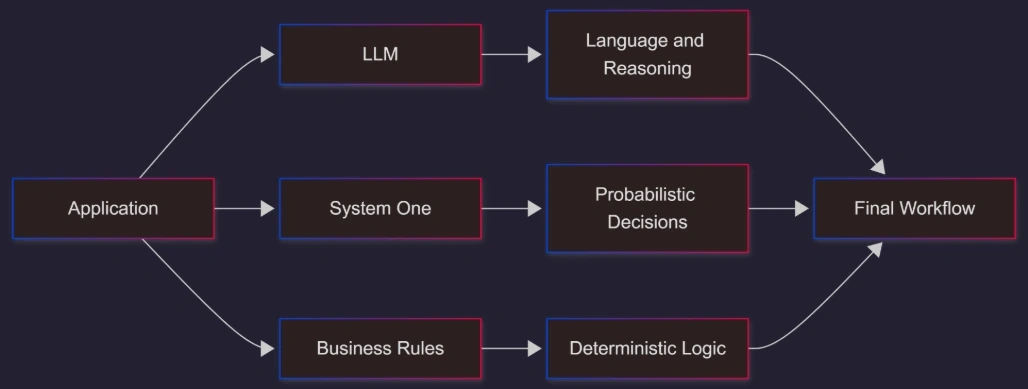
This architecture separates responsibilities.
LLM: Understand and generate.
System One: Decide and classify.
Code: Enforce rules and execute actions.
That separation could make complex AI systems easier to build and control.
System One Models vs AI Agents
These concepts are related but different.
An AI agent is a system that can use models, tools, memory, and workflows to accomplish a goal.
A System One model is an intelligence component that can provide structured decisions to that system.
For example:
AI Agent
│
├── LLM
│   └── Conversation and reasoning
│
├── System One Model
│   ├── Intent
│   ├── Risk
│   ├── Classification
│   └── Confidence
│
├── Tools
│   ├── CRM
│   ├── Database
│   └── APIs
│
└── Code
    └── Business rules
This combination could be especially useful for enterprise AI.
What Developers Can Build With System One Models
Potential applications include:
AI-powered workflow routers
customer-support decision engines
fraud detection systems
sales qualification systems
document classification
AI safety filters
content moderation
compliance checks
intelligent API routing
real-time recommendation systems
autonomous software workflows
LLM output verification
The strongest applications are likely to be those where the decision can be clearly defined and the resulting action can be handled by software.
Frequently Asked Questions
1. What is a System One model?
A System One model is an AI model designed primarily for fast, structured decision-making inside software rather than open-ended text generation.
2. Is System One the same as System 1 thinking?
The concept is inspired by the System 1/System 2 distinction in cognitive science. However, "System One Model" is being used by TypeSafe as the name of a specific new model category focused on machine-usable decisions.
3. What is Jev?
Jev is TypeSafe AI's first public System One model. It is designed to produce typed decisions, probabilities, and confidence information for software workflows.
4. Can System One models replace ChatGPT or other LLMs?
No. They target different workloads. LLMs remain useful for conversation, writing, coding, reasoning, and other open-ended tasks.
5. What is the biggest advantage of System One models?
Their key idea is to make AI decisions easier for software to consume directly through structured outputs and explicit uncertainty.
6. Are System One models hallucination-free?
TypeSafe states that Jev's type-safe design prevents type errors and describes its structured output approach as avoiding hallucinated values. That does not mean every underlying judgment is guaranteed to be factually correct.
7. Are System One models useful for AI agents?
Potentially. They can provide narrow decision points such as intent classification, risk assessment, routing, verification, and escalation inside larger agent workflows.
8. Will System One replace System Two reasoning?
Not necessarily. The two approaches address different classes of problems. Complex tasks may still benefit from deliberate reasoning, while simple and repeatable decisions may benefit from fast decision models.
What Comes Next?
The interesting development is not simply another AI model.
It is a change in how developers think about AI.
For years, the dominant pattern was:
Give AI a prompt → receive text.
The System One approach suggests another pattern:
Give AI a decision → receive structured intelligence → let software act.
That can make AI feel less like a chatbot and more like a software primitive.
Future developments are likely to focus on:
better calibrated decisions
more reliable AI workflows
lower inference costs
faster real-time AI
hybrid LLM + System One architectures
AI verification layers
machine-native AI APIs
large-scale autonomous workflows
For teams building AI products, this is worth watching closely.
Conclusion
A System One model is designed to make AI useful to software, not just useful to people.
Traditional LLMs are excellent at generating flexible language. Reasoning models can spend additional computation on difficult problems. System One models take another path: they focus on fast, structured decisions that applications can directly consume.
TypeSafe's Jev is an early example of this approach.
The broader idea is bigger than one model.
As AI moves from chat interfaces into production software, applications will need different types of intelligence for different jobs. A future AI stack may therefore combine LLMs for language, reasoning models for complex problems, System One models for fast decisions, and conventional code for deterministic rules.
That combination could become an important building block for the next generation of AI automation.
References
TypeSafe AI, “Introducing System One Models & Jev,” September 15, 2026.
TypeSafe AI, official homepage and System One overview, accessed September 2026.
TypeSafe AI, API Documentation, including the
/v1/systemoneendpoint and decision schemas.TypeSafe AI, Workflow Evals, methodology for evaluating structured AI workflows.
Li et al., “From System 1 to System 2: A Survey of Reasoning Large Language Models,” arXiv, 2025.
Ziabari et al., “Reasoning on a Spectrum: Aligning LLMs to System 1 and System 2 Thinking,” arXiv, 2025.
Join the conversation! Your thoughts help the community grow.