

Abstract / Overview
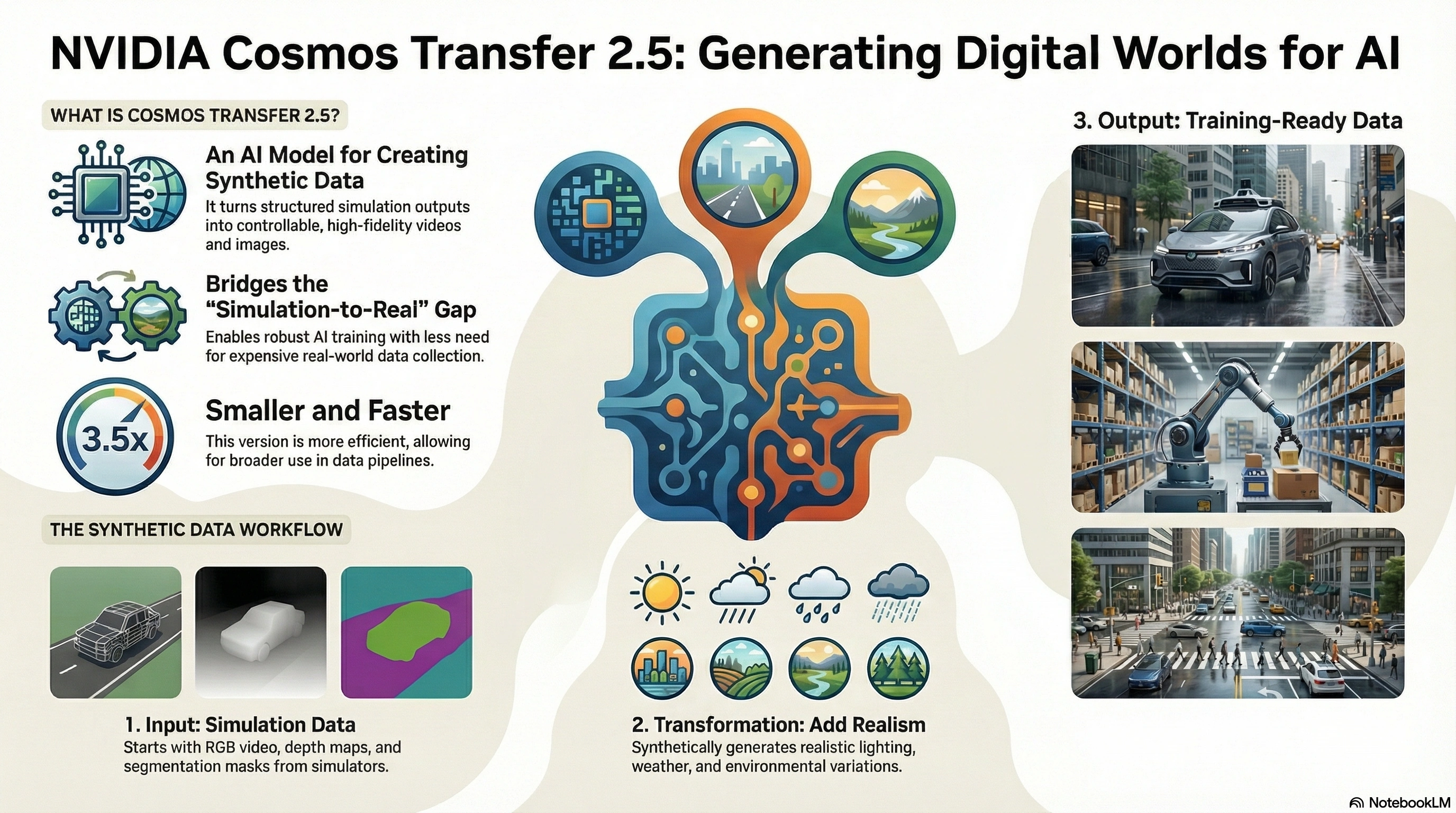
Cosmos Transfer 2.5 is a next-generation world model developed by NVIDIA that produces high-fidelity, controllable, physics-aware synthetic data from structured simulation inputs such as segmentation maps, depth, and RGB scenes. Built as part of the Cosmos World Foundation Models (WFMs) suite, Cosmos Transfer 2.5 enhances photorealism, scale, and diversity of synthetic datasets for physical AI applications such as robotics and autonomous systems. The model is engineered to reduce the domain gap between simulation and the real world, enabling more robust training of perception and planning systems with fewer real-world data collection requirements. (NVIDIA Blog)
Conceptual Background
What Is a World Model?
In AI, a world model refers to a neural architecture that represents and simulates environment states, predicting physical dynamics and scene evolution based on inputs such as images, depth, or text prompts. World models are increasingly vital for physical AI, where agents must understand and interact with real environments. (Wikipedia)
NVIDIA Cosmos World Foundation Models
NVIDIA Cosmos is a platform of open world foundation models designed to support physical AI development by generating synthetic data that is both photorealistic and physics-consistent. Cosmos WFMs include:
Cosmos Predict: Generates continuous video sequences from multimodal conditions.
Cosmos Transfer: Transforms simulation outputs into realistic world states.
Cosmos Reason: A vision-language model for multimodal understanding and reasoning. (NVIDIA)
Cosmos Transfer 2.5 is the latest evolution in this family, focused on augmenting synthetic data pipelines with higher fidelity, richer control, and smaller compute footprint compared to its predecessor. (NVIDIA Blog)
What Cosmos Transfer 2.5 Does
Synthetic Data Augmentation and Photorealism
Cosmos Transfer 2.5 takes structured simulation outputs — including segmentation maps, depth maps, and other spatial cues — and generates photorealistic, physics-aware videos and images that serve as synthetic training data for AI systems. It can:
Add realistic lighting, weather, and environmental variations across scenes.
Support multi-camera consistency for robotics and autonomous systems.
Scale dataset diversity rapidly without manual scene recreation. (NVIDIA Blog)
Efficiency and Model Improvements
Compared with earlier Cosmos Transfer versions, 2.5 is:
3.5× smaller and faster, enabling broader usage within data pipelines.
Better aligned with textual prompts and physics constraints.
More suitable for real-time or multi-GPU workflows. (NVIDIA Blog)
How Cosmos Transfer 2.5 Works
Inputs and Conditioning
Cosmos Transfer 2.5 uses multimodal structured inputs such as:
RGB video sequences
Depth maps and segmentation masks
LiDAR and pose trajectory maps
It conditions on these inputs, optionally along with text prompts, and generates enhanced world states that bridge the gap between idealized simulation and real-world appearance. (NVIDIA Docs)
Integration into Workflows
A typical synthetic data pipeline might involve:
Generate ground-truth simulation data — using tools like NVIDIA Omniverse, CARLA, or Isaac Sim.
Extract structured modalities — RGB, depth, segmentation, etc.
Run Cosmos Transfer 2.5 inference — to produce photorealistic synthetic data.
Use generated data — for training perception networks or evaluating AI systems.
This modular setup enables flexible customization based on domain requirements (e.g., autonomous driving, robotics navigation). (Omniverse Docs)
Use Cases / Scenarios
Robotics
Robotics models often require diverse environments and lighting to generalize. Cosmos Transfer 2.5 can convert simulator scenes into realistic videos with varying conditions, allowing robots to train under many scenarios without expensive real-world data collection. (NVIDIA Developer)
Autonomous Vehicles
Vehicle perception systems need variations in weather, time of day, and traffic conditions. Cosmos Transfer 2.5 synthetically generates these variations from base scenes, accelerating training of sensors and perception models. (NVIDIA Developer)
Smart Cities and Traffic Systems
Synthetic traffic video data — with controllable congestion, weather, and lighting — helps train vision models for city infrastructure, surveillance, and intelligent transportation systems. Recipes in the Cosmos Cookbook demonstrate how 2.5 supports large-scale scenario variations. (nvidia-cosmos.github.io)
Limitations / Considerations
Compute Requirements: While smaller than previous versions, running high-fidelity world generation still requires substantial GPU resources.
Domain Specificity: Pretrained models are optimized for physical AI tasks; extreme domain shifts may require post-training or fine-tuning.
Realism Boundaries: Despite photorealism, synthetic data may still exhibit artefacts that differ subtly from true real-world data.
FAQs
Q: How does Cosmos Transfer 2.5 differ from traditional data augmentation?
A: Traditional augmentation modifies existing images (e.g., crop, color jitter). Cosmos Transfer 2.5 synthesizes entirely new world scenarios with physics and multimodal control, adding richer diversity than simple augmentation.
Q: Can Cosmos Transfer 2.5 replace real data?
A: It significantly reduces reliance on real data but usually complements real datasets to ensure generalization.
Q: Is Cosmos Transfer 2.5 open source?
A: Yes — models and code are available under the NVIDIA Open Model License, with inference examples provided on GitHub. (NVIDIA Blog)
Conclusion
Cosmos Transfer 2.5 represents a major advancement in world models for synthetic data generation, enabling developers to produce photorealistic, physics-aware datasets at scale. By transforming structured simulation outputs into realistic visual scenes with rich variations, it addresses key challenges in training physical AI, such as the simulation-to-real gap and data scarcity. Its integration within the broader NVIDIA Cosmos ecosystem — alongside Predict and Reason models — offers powerful tools for accelerating development in robotics, autonomous driving, and other embodied AI domains. (NVIDIA Blog)
Join the conversation! Your thoughts help the community grow.