

Abstract / Overview
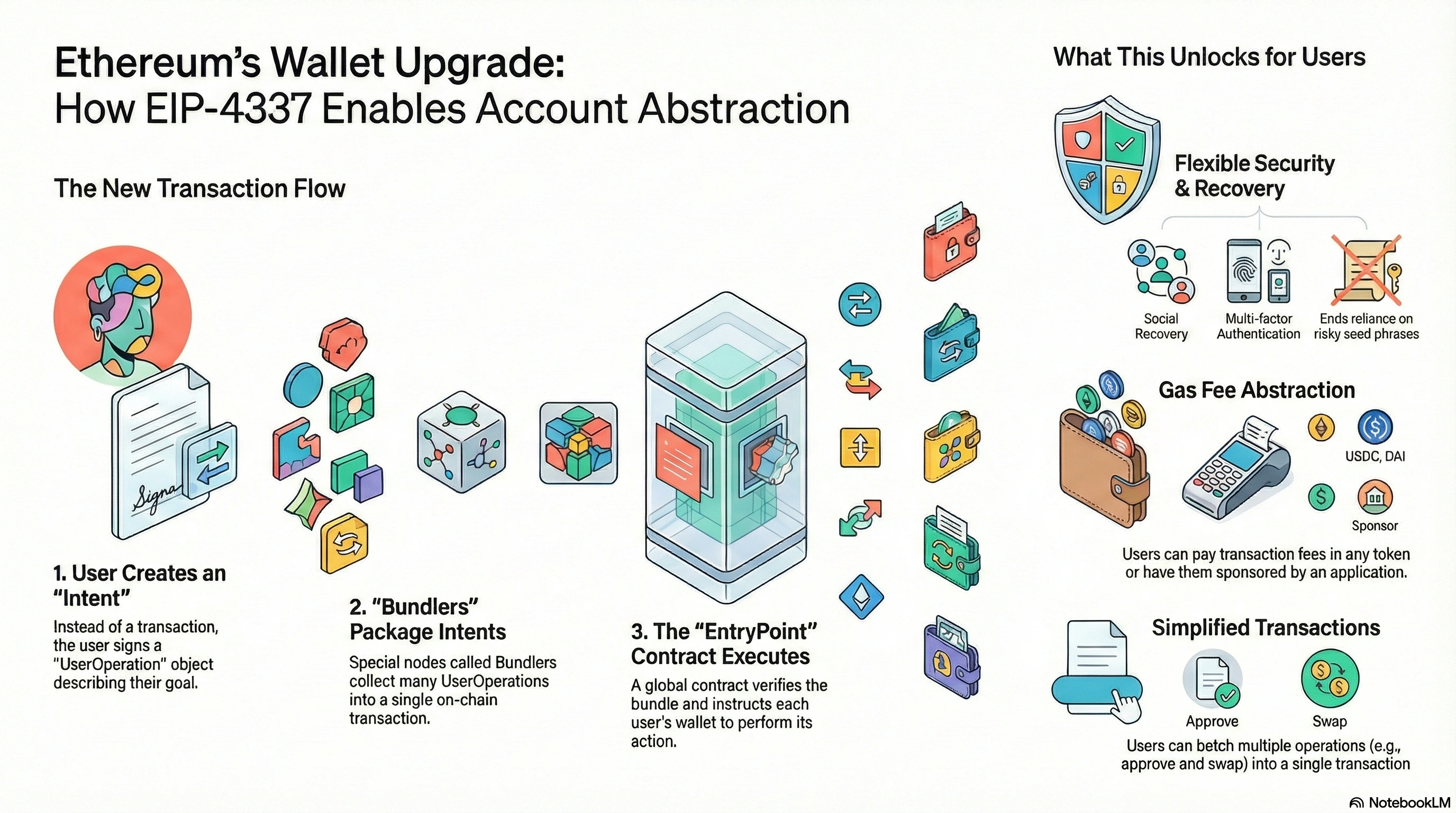
EIP-4337 is an Ethereum standard that enables account abstraction without requiring changes to the Ethereum consensus layer. It allows wallets to behave like smart contracts, unlocking features such as gas sponsorship, batch transactions, custom authentication, and social recovery. EIP-4337 achieves this through a new transaction flow built around UserOperations, bundlers, and a global EntryPoint contract. As of 2024–2025, EIP-4337 is widely adopted by wallet providers and infrastructure platforms, positioning it as the foundation for mainstream Ethereum UX.
Conceptual Background
The Problem with Traditional Ethereum Accounts
Ethereum historically supports two account types:
Externally Owned Accounts (EOAs): Controlled by private keys, used by most wallets.
Contract Accounts: Controlled by code, incapable of initiating transactions.
EOAs have rigid limitations:
Single private-key control
No native social recovery
Users must hold ETH to pay gas
One transaction per action
No programmable validation logic
These constraints create a poor user experience and hinder mass adoption.
What Is Account Abstraction?
Account abstraction is the idea of making user accounts programmable, so wallet logic can be defined in smart contracts instead of hard-coded protocol rules. This allows developers to customize how accounts validate signatures, pay gas, and execute transactions.
Earlier proposals (such as EIP-2938 and EIP-3074) required protocol-level changes. EIP-4337 achieves account abstraction entirely at the application layer, making it deployable today.
What Is EIP-4337?
EIP-4337 (ERC-4337) is an Ethereum standard that introduces account abstraction via smart contracts and an alternative mempool, without modifying Ethereum’s consensus rules.
Key entities introduced by EIP-4337:
UserOperation: A pseudo-transaction object
Bundler: A node that packages UserOperations
EntryPoint Contract: A singleton smart contract that validates and executes operations
Smart Contract Wallet: The user’s abstracted account
Paymaster: An optional contract that sponsors or customizes gas payment
EIP-4337 is supported across Ethereum and major Layer 2 networks.
Core Architecture of EIP-4337
Key Components Explained
UserOperation
A UserOperation is not an Ethereum transaction. It is a structured object containing:
Sender (smart contract wallet address)
Call data
Gas limits
Signature
Optional paymaster data
UserOperations are sent to a separate mempool monitored by bundlers.
Bundler
A bundler is a specialized actor that:
Collects UserOperations
Simulates them locally
Submits them in batches to the EntryPoint contract
Pays gas upfront
Bundlers are economically incentivized through gas reimbursement.
EntryPoint Contract
The EntryPoint is a globally deployed smart contract that:
Verifies UserOperations
Calls wallet validation logic
Executes the requested actions
Handles gas refunds and paymasters
All EIP-4337 wallets interact through this contract.
Smart Contract Wallet
The wallet is a programmable contract that defines:
Signature schemes (ECDSA, multisig, passkeys)
Recovery logic
Spending limits
Session keys
Examples include wallets built on Safe, Argent, and Biconomy.
Paymaster
A paymaster allows gas abstraction by:
Sponsoring gas for users
Accepting ERC-20 tokens instead of ETH
Enforcing conditional gas policies says
This enables onboarding without requiring ETH.
Step-by-Step Walkthrough: How EIP-4337 Works

Execution Flow
User signs a UserOperation using wallet-defined logic
Operation is sent to the ERC-4337 mempool
Bundler validates and batches operations
Bundler submits them to EntryPoint
EntryPoint calls
validateUserOpon the walletWallet logic approves or rejects
EntryPoint executes the transaction
Gas is reimbursed via wallet or paymaster
Code / JSON Snippets
Example UserOperation (Simplified JSON)
{
  "sender": "0xSmartWalletAddress",
  "nonce": "0x01",
  "callData": "0xabcdef",
  "callGasLimit": "100000",
  "verificationGasLimit": "150000",
  "maxFeePerGas": "30000000000",
  "signature": "0xSignatureData"
}
This structure enables flexible validation and gas logic.
Key Benefits of EIP-4337
Gas Abstraction
Users can:
Pay gas in ERC-20 tokens
Have gas fully sponsored
Onboard without ETH
Better Wallet UX
One-click onboarding
No seed phrase required
Web2-style login flows
Custom Security Models
Social recovery
Multisig by default
Hardware + passkey combinations
Batch Transactions
Approve + swap in one action
Reduced gas and friction
Safer Defaults
Spending limits
Session keys for dApps
Time-based permissions
Use Cases / Scenarios
Consumer Wallets
Smart wallets built on EIP-4337 provide seamless onboarding similar to traditional apps.
Enterprise and DAOs
Organizations benefit from programmable controls, multisig enforcement, and auditability.
Gaming and NFTs
Gas sponsorship and batched actions eliminate friction for in-game actions.
DeFi Automation
Automated strategies, recurring payments, and delegated execution become safer and cheaper.
Adoption and Ecosystem
EntryPoint is deployed across Ethereum and major L2s
Supported by the Ethereum Foundation
Integrated by infrastructure providers like Alchemy
Wallet adoption has been accelerating since late 2023
By 2024, millions of accounts were created using ERC-4337-compatible wallets.
Limitations / Considerations
Higher Gas Overhead
Validation logic increases gas cost compared to EOAs.
Bundler Centralization Risk
Early bundler markets may be concentrated, though permissionless participation is possible.
Contract Complexity
Smart wallets introduce more attack surface if poorly audited.
UX Depends on Infrastructure
Reliability depends on the bundler and paymaster availability.
Fixes and Best Practices
Use audited wallet frameworks
Deploy fallback paymasters
Monitor bundler redundancy
Implement strict validation logic
Limit upgradeability risks
FAQs
Is EIP-4337 live today?
Yes. It is fully deployed and usable without protocol upgrades.Does EIP-4337 replace EOAs?
No, but it provides a superior alternative for most users.Is ETH still required?
Not necessarily. Paymasters enable gasless or token-based transactions.Is EIP-4337 the final form of account abstraction?
It is a major milestone. Future protocol-level abstraction may build on it.
References
Ethereum Improvement Proposal 4337
Ethereum Foundation documentation
Wallet and infrastructure provider technical blogs
Conclusion
EIP-4337 fundamentally reshapes how users interact with Ethereum by making accounts programmable, flexible, and user-friendly. By delivering account abstraction without consensus changes, it bridges the gap between blockchain security and mainstream usability. As adoption grows across wallets, dApps, and Layer 2 networks, EIP-4337 is becoming the default foundation for the next generation of Ethereum experiences.
Join the conversation! Your thoughts help the community grow.