

Abstract / Overview
ERC-3643 is an Ethereum Improvement Proposal (EIP) and open-source token standard designed to enable permissioned, regulatory-compliant digital assets on Ethereum and other EVM chains. Unlike typical ERC-20 tokens, which are freely transferable between any address, ERC-3643 embeds compliance and identity verification directly into token logic. It represents a foundational framework for issuing, managing, and transferring real-world assets (RWAs) such as securities, funds, real estate, and other financial instruments while enforcing rules like Know Your Customer (KYC), Anti-Money Laundering (AML), and jurisdiction-based restrictions. (ERC3643)
Originally developed as the T-REX protocol (Token for Regulated EXchanges) by Tokeny and later formalized by the ERC-3643 Association, it remains a leading solution for regulated tokenization in the blockchain ecosystem today. (ERC3643)
Conceptual Background
The Problem ERC-3643 Solves
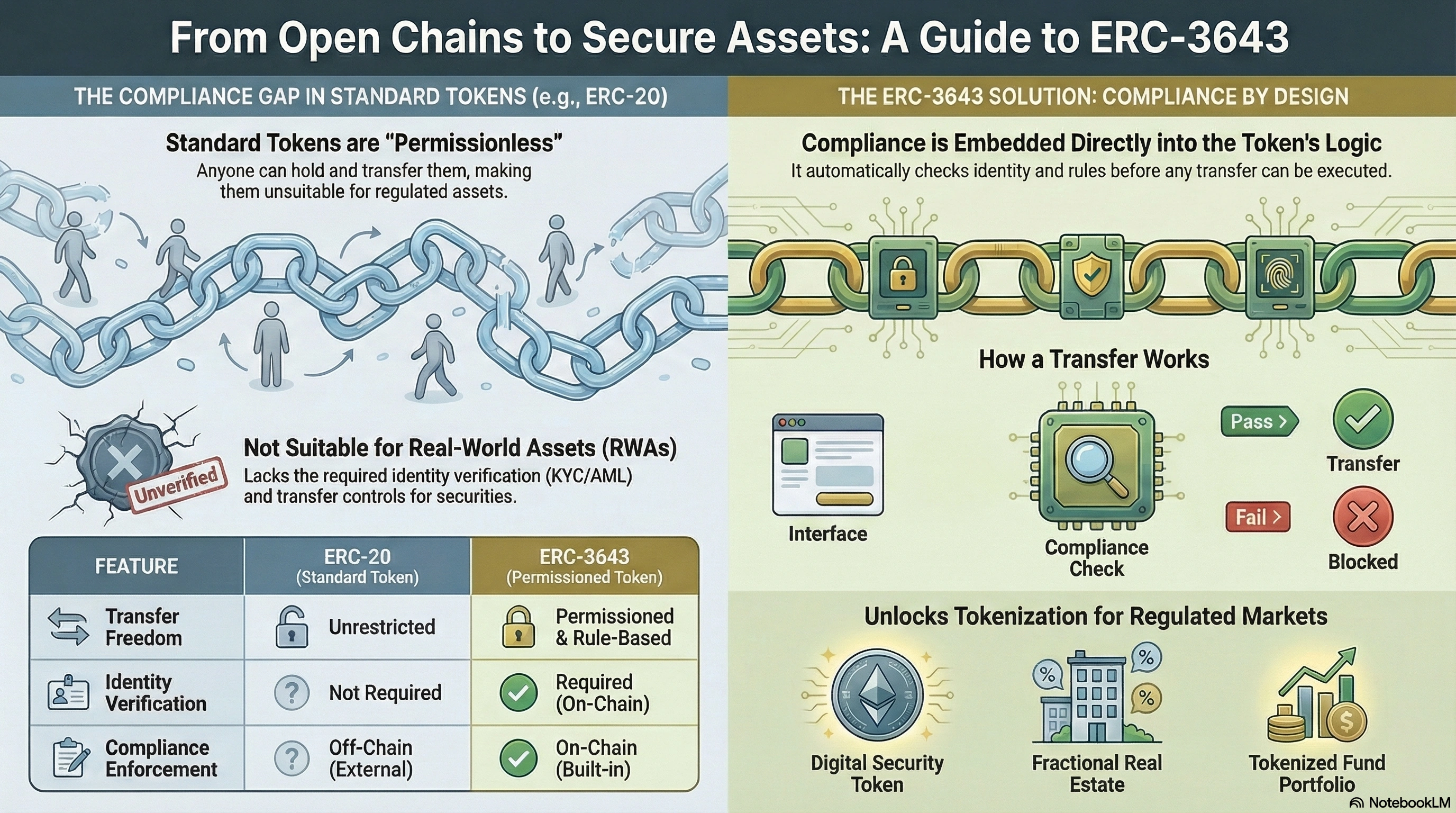
Standard blockchain tokens, such as ERC-20, prioritize decentralization and openness, allowing any wallet to receive or hold them. This design is unsuitable for regulated assets (e.g., securities) where:
Regulators require verified identities
Transfers must obey jurisdictional and investor-eligibility rules
Issuers retain some control over transferability and compliance
ERC-3643 addresses these gaps by embedding compliance into the token standard itself. (Quicknode)
Permissioned vs Permissionless Tokens
Permissionless (e.g., ERC-20):
Anyone can hold and transfer tokens.
Permissioned (ERC-3643):
Only verified, compliant participants may hold and transfer tokens. Contracts enforce compliance rules on every transaction. (ERC3643)
How ERC-3643 Works
Compliance-First Token Logic
At the core, an ERC-3643 token behaves like an ERC-20 token but extends it with:
On-chain identity integration (via systems like ONCHAINID)
Pre-transfer checks for regulatory eligibility
Conditional transfer functions that revert non-compliant transfers
Roles and permissions for issuers, agents, and compliance managers (Quicknode)
This architecture ensures that:
KYC/AML rules are applied automatically
Only authorized investors can hold or receive the token
Issuers maintain necessary legal controls over token distribution
Identity & Compliance
ERC-3643 integrates a decentralized identity framework (e.g., ONCHAINID) where each participating wallet is linked with verified identity data stored on the blockchain. Before any transfer, the token contract invokes identity and compliance modules to validate participants and enforce rules. (ERC3643)
Transfer Process (High Level)
Initiate transfer: A token holder requests a transfer.
Compliance check: The contract queries identity and rule modules (e.g., investor eligibility, jurisdiction).
Decision:
Pass: Transfer executes
Fail: Transfer reverts — non-compliant transfers are blocked.
Record: Transfer and identity metadata are logged for auditability. (Quicknode)
Interoperability
Despite added compliance, ERC-3643 tokens remain ERC-20 compatible, allowing integration with wallets, custodians, and platforms that understand standard token interfaces, albeit with compliance-aware handling. (ERC3643)
Core Features
Identity Management
Tokens are tied to verified on-chain identities, enabling compliance checks for each holder. (ERC3643)
Permissioned Transfers
Rules govern who can hold or transfer tokens based on compliance criteria. (Quicknode)
Compliance by Design
Regulatory rules (e.g., KYC, AML, accreditation) are enforced within the token logic. (store.aicerts.ai)
Interoperability
Tokens remain compatible with broader Ethereum tooling while enforcing compliance requirements. (ERC3643)
Upgradability
ERC-3643 frameworks often support proxy or modular upgrades to adapt to evolving legal or technical needs. (ERC3643)
Architecture & Component Breakdown
While implementations vary, a typical ERC-3643 system includes:
Token Contract: The core ERC-3643 token, building on ERC-20 with compliance integration. (Quicknode)
Identity Registry: Manages verified identities linked to wallets. (merklescience.com)
Compliance Modules: External contracts that enforce specific rules (e.g., KYC, jurisdiction). (GitHub)
Factory & Proxy Contracts: Facilitate deployment and upgradability. (ERC3643)
This modular setup enhances flexibility and future adaptability.
Use Cases & Scenarios
ERC-3643 enables a wide range of regulated tokenization applications:
Security Tokens & Capital Markets
Issuing shares, bonds, or other security tokens that must comply with securities laws. (Chainalysis)
Real Estate & Infrastructure
Fractional ownership of property, with compliance checks for investor eligibility. (kaleido.io)
Funds & Debt Instruments
Tokenized funds and loans with programmable compliance and transfer restrictions. (Rain Infotech)
Commodities & Loyalty Programs
Tokenization of goods (e.g., wines, watches) or brand loyalty tokens, where issuance must remain under control. (ERC3643)
Legal & Regulatory Considerations
ERC-3643 embeds legal compliance into smart contracts, aligning with regulatory standards globally. Tokens must enforce:
KYC verification
AML monitoring
Jurisdictional restrictions
Investor accreditation checks (store.aicerts.ai)
However, global regulatory fragmentation means token issuers must remain aware of shifting laws across regions.
ERC-3643 vs ERC-20
| Feature | ERC-20 | ERC-3643 |
|---|---|---|
| Transfer Freedom | Yes | No — permissioned |
| Compliance Enforcement | Off-chain | On-chain |
| Identity Verification | No | Yes |
| Regulatory Focus | No | Yes |
Developer & Ecosystem Resources
Official implementation repository: ERC-3643 smart contracts on GitHub — suite implementing the standard. (GitHub)
Documentation: Protocol overview, compliance modules, identity, and token factory details. (ERC3643)
DApp tools: Example decentralized applications to interact with ERC-3643 tokens. (GitHub)
Conclusion
ERC-3643 represents a major advancement for compliant tokenization on Ethereum and EVM chains. By integrating identity verification and compliance rules directly into token logic, it bridges the gap between blockchain flexibility and real-world regulatory requirements. Institutions, developers, and regulators can leverage this standard to issue and manage regulated digital assets with built-in compliance, unlocking new markets for tokenized securities, assets, and financial innovations.
References
ERC-3643 Official Site & Docs: ERC-3643 Permissioned Tokens overview. (ERC3643)
QuickNode: Fundamentals of ERC-3643 token standard. (Quicknode)
Tokeny Solutions & T-REX history and standard adoption. (Tokeny)
GitHub ERC-3643 implementation. (GitHub)
Legal & regulatory context of ERC-3643 tokens. (store.aicerts.ai)
Join the conversation! Your thoughts help the community grow.