

Abstract / Overview
JEV is a new type of AI model from TypeSafe AI designed to make fast, structured decisions instead of generating text.
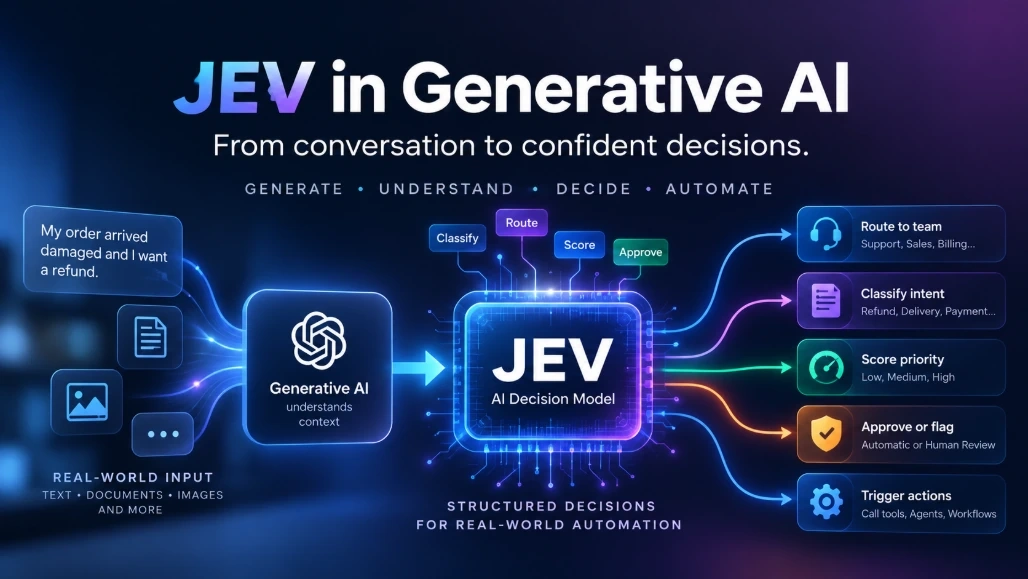
Traditional Generative AI models such as large language models (LLMs) generate text one token at a time. JEV takes information as input and returns a predefined, typed decision with a probability or confidence estimate.
The important point is simple:
Generative AI creates content. JEV helps software make decisions.
TypeSafe introduced JEV on September 15, 2026, as its first public System One Model, a model class designed specifically for machine-driven automation.
What Is JEV?
JEV is an AI decision model developed by TypeSafe AI.
Instead of asking an AI model:
"Write a response to this customer."
You can ask JEV:
"Is this customer request a refund request?"
And define the possible answers:
Yes
No
JEV returns a structured result rather than writing a paragraph.
It can also handle questions such as:
Which department should receive this ticket?
Is this transaction suspicious?
Should this action require human approval?
How urgent is this task?
Which AI model should handle this request?
Should an AI agent retry an operation?
Does this content violate a particular rule?
TypeSafe describes the basic interaction as unstructured state in → typed probabilistic decisions out.
Is JEV Generative AI?
Not in the traditional sense.
JEV does not generate articles, conversations, code, images, or other open-ended content. Its output is constrained to the decision types defined by the developer.
This creates an important distinction:
Traditional Generative AI | JEV |
|---|---|
Generates text | Returns decisions |
Produces strings | Produces typed values |
Good for open-ended tasks | Good for bounded decisions |
Often generates token by token | Uses parallel output |
Output must often be parsed | Output structure is predefined |
Can produce malformed output | Type-safe output |
Confidence can be inconsistent | Provides calibrated probability signals |
Designed heavily for humans | Designed heavily for software |
TypeSafe itself positions JEV as a model for automation rather than chat.
Why Does JEV Matter for Generative AI?
Modern AI agents often use an LLM for every step.
Consider an AI customer-support agent:
Customer message
       ↓
Large Language Model
       ↓
Understand intent
       ↓
Choose department
       ↓
Check urgency
       ↓
Decide whether human approval is needed
       ↓
Call another model/tool
This works, but using a large generative model for every small decision can add latency, cost, and uncertainty.
JEV introduces another layer.

The idea is not necessarily to replace an LLM.
Instead, JEV can handle the small, repeated decisions around the LLM.
How Does JEV Work?
The easiest way to understand JEV is to think of it as an intelligent decision function.
Suppose an application receives this message:
"My order arrived damaged and I want my money back."
A traditional LLM could generate:
"This appears to be a refund request related to a damaged product..."
JEV could instead receive a predefined question:
Choose the request type:

refund
delivery
payment
technical_support
other
Its output is a structured decision.
Conceptually:
Input:
Customer message

Question:
What type of request is this?

Options:
refund
delivery
payment
technical_support
other

Output:
refund
confidence: high
The application can then directly execute its next step.
JEV's Three Core Decision Patterns
TypeSafe's API documentation exposes several decision-oriented patterns, including yes/no questions, choices, and scores.
1. Yes/No Decisions
Useful when software needs a binary decision.
Examples:
Should this transaction be reviewed?
Is this message spam?
Should the agent retry?
Is human approval required?
2. Choice Decisions
Useful when there are several predefined options.
For example:
Choose:

billing
technical
sales
refund
account
The application can immediately route the request.
3. Score Decisions
Useful when software needs a rating or level.
For example:
Priority:

1 = Low
2 = Medium
3 = High
This can help an application decide which workflow to trigger.
JEV vs LLMs
JEV and LLMs solve different problems.
An LLM is useful when the system needs to create something.
Examples include:
Writing an email
Generating code
Summarizing documents
Creating marketing copy
Holding a conversation
Explaining a concept
JEV is useful when the system needs to choose something.
Examples include:
Route
Classify
Score
Approve
Reject
Escalate
Select
Verify
This makes the two approaches complementary.
A practical AI architecture could therefore look like:
             ┌───────────────┐
             │ Generative AI │
             │   Reasoning   │
             └───────┬───────┘
                     │
                     ▼
               ┌───────────┐
               │    JEV    │
               │ Decisions │
               └─────┬─────┘
                     │
          ┌──────────┼──────────┐
          ▼          ▼          ▼
       Tool A     Tool B    Human Review
JEV for AI Agents
AI agents are one of the most interesting areas for JEV.
An AI agent needs to repeatedly answer small questions:
What should I do next?
Should I call this tool?
Which tool should I call?
Should I retry?
Should I stop?
Should I ask the user?
Does this action require approval?
An LLM can make these decisions, but JEV is designed specifically around structured machine decisions.
This can make JEV useful as a decision layer inside an agent architecture.
For example:
User
 ↓
LLM understands request
 ↓
JEV selects workflow
 ↓
Application calls tools
 ↓
JEV evaluates result
 ↓
LLM generates final response
The LLM handles language.
JEV handles bounded decisions.
The application handles execution.
JEV for AI Automation
Automation systems contain many if/else statements.
For example:
IF customer is high value
AND complaint is urgent
AND refund amount > threshold
THEN send to senior support
Traditional software rules are predictable but can become difficult to maintain when the decision depends on natural language.
JEV can provide an AI-powered decision inside that workflow.
This creates what TypeSafe calls "smart if-statements."
Potential applications include:
Customer support routing
Lead qualification
Fraud review
Invoice processing
Content moderation
AI safety checks
Workflow routing
Document classification
Agent guardrails
Human escalation
Model selection
TypeSafe has also published an invoice-processing example in which AI decisions determine whether an invoice should be paid, held, routed for approval, or reviewed.
JEV and AI Cost Optimization
One of the main ideas behind JEV is that not every AI decision needs a large generative model.
TypeSafe currently lists JEV input pricing at $0.042 per million input tokens, with output not separately metered. It also reports response times in the roughly 70–500 millisecond range for its service. These are vendor-published figures and should be evaluated against your own workload before making production decisions.
This matters for systems that make thousands or millions of small decisions.
For example, imagine an AI platform processing:
1,000,000 support messagesIf every step requires a large generative model, the cost and latency can become significant.
A decision model can potentially handle the lightweight classification and routing layer before an expensive model is called.
That creates a model-routing architecture:
Incoming request
       ↓
      JEV
       ↓
 ┌─────┼─────┐
 ↓     ↓     ↓
Small  Medium Large
LLM    LLM    LLM
Only the requests that require more intelligence need to reach a larger model.
JEV and Hallucinations
One major difference is output control.
A generative model can produce arbitrary text. That flexibility is powerful, but it also creates opportunities for incorrect or malformed output.
JEV restricts the possible output types.
If an application defines:
["refund", "payment", "delivery"]JEV cannot suddenly return:
"Please contact our customer support team."The output space is constrained by design.
TypeSafe describes this as type-safe structured output and states that its model cannot produce type errors for the defined output structure.
However, type safety does not mean perfect decisions.
JEV can still make an incorrect classification. The advantage is that the system can work with a defined decision space and confidence signal rather than arbitrary generated text.
When Should You Use JEV?
JEV is a good fit when:
The answer has a defined set of choices.
The application needs fast decisions.
The decision happens frequently.
Latency matters.
The result must be machine-readable.
You need confidence information.
The decision sits inside an automated workflow.
For example:
Good fit
"Which team should receive this ticket?"
Poor fit
"Write a detailed response to this customer."
The first is a bounded decision.
The second requires generation.
When Should You Not Use JEV?
JEV is not designed to replace general-purpose generative models.
Use a traditional LLM when you need:
Long-form writing
Code generation
Open-ended conversation
Creative generation
Complex explanations
Free-form summaries
Natural-language responses
Use ordinary software logic when the answer can be determined exactly.
For example:
2 + 2 = 4There is no reason to ask an AI model to calculate this.
The Bigger Idea: AI Becomes a Software Primitive
The interesting part of JEV is not simply another AI model.
It is the idea that AI can become a small component inside normal software.
Historically, software was built with deterministic rules:
if X:
    do A
else:
    do B
Generative AI introduced a different approach:
Give the model the problem
Ask it to figure everything out
JEV sits between these ideas.
Traditional Software
        ↓
Hard-coded rules

JEV
        ↓
AI-powered structured decisions

Generative AI
        ↓
Open-ended generation
This could lead to systems where developers combine deterministic code, decision models, and generative models rather than expecting one model to perform every task.
Future of JEV in Generative AI Systems
Several developments could make this architecture more important:
AI model routing: Use JEV to decide which model should handle a request.
Agent guardrails: Use JEV to decide whether an agent should continue, stop, or escalate.
Human-in-the-loop systems: Use confidence thresholds to determine when humans should intervene.
Real-time AI: Use fast decisions in applications where latency is critical.
Large-scale classification: Process very large datasets with structured AI decisions.
AI observability: Use decision models to verify inputs, outputs, and agent behavior.
The strongest architecture may not be "JEV versus Generative AI."
It may be:
JEV + LLM + deterministic software + human oversight.
FAQs
1. Is JEV a generative AI model?
Not in the traditional sense. JEV is designed to return structured decisions rather than generate open-ended text.
2. Does JEV replace ChatGPT?
No. The models target different tasks. Chat-oriented LLMs generate language, while JEV focuses on structured decisions for software.
3. Can JEV generate text?
JEV is not designed for open-ended text generation. Its primary output is structured decision data.
4. Can JEV be used with AI agents?
Yes. Decision-making is one of the intended applications of JEV. It can be placed inside agent workflows for routing, scoring, verification, escalation, and other bounded decisions.
5. Is JEV an LLM?
TypeSafe presents JEV as its first System One Model, a separate model class focused on machine-native structured decisions. The company specifically distinguishes it from conventional LLM workflows.
6. Why is JEV potentially cheaper?
JEV is designed around structured decisions rather than sequential text generation. TypeSafe currently publishes substantially lower input-token pricing than many frontier LLM APIs, although real-world cost depends on the complete architecture and workload.
What is the biggest limitation of JEV?
Its strength is also its limitation: it works best when the possible answers can be defined ahead of time. It is not a general-purpose writing or conversational model.
How Businesses Can Use This Technology
Organizations building AI products should not automatically send every task to their most powerful LLM.
A better approach is to break an AI workflow into individual jobs:
Understand
    ↓
Decide
    ↓
Route
    ↓
Execute
    ↓
Verify
    ↓
Respond
Different AI components can handle different stages.
This can reduce unnecessary model calls and give developers more control over automation.
If your organization is evaluating AI agents, intelligent automation, or production GenAI workflows, C# Corner Consulting can help assess where decision models, LLMs, and traditional software should fit into the architecture.
Recommended Future Enhancements
For teams experimenting with JEV, useful next steps include:
Build a JEV + LLM customer-support prototype.
Test JEV as an AI-agent routing layer.
Compare latency and cost against your existing LLM workflow.
Create confidence thresholds for automatic versus human decisions.
Track accuracy, escalation rate, latency, cost, and failure cases.
For AI teams, these measurements are more useful than relying only on a model leaderboard.
Measuring AI Authority and Impact
For content and product teams covering JEV, track:
Search impressions for "JEV AI" and related queries
Generative AI answer-engine coverage
Mentions across AI communities
Developer adoption
Citation frequency
Sentiment
State of Authority (SoA)
Referral traffic
Product demos and conversions
The topic is particularly suitable for multi-format publishing:
Technical article
LinkedIn post
YouTube explainer
Architecture diagram
Short demo
Developer tutorial
AI newsletter
References
TypeSafe AI, "Introducing System One Models & Jev", September 15, 2026.
TypeSafe AI, official website and System One overview.
TypeSafe AI, API documentation / Swagger UI.
TypeSafe AI, Invoice Processing evaluation.
DigitalOcean, "What is Jev (2026)? TypeSafe AI's System One model", updated September 24, 2026.
Indian Express, "What is Jev, an AI 'generalist' model with a new take on decision-making?", September 2026.
Conclusion
JEV represents a different way of thinking about AI.
Generative AI is excellent at producing content. JEV is designed to make structured decisions that software can act on.
That distinction becomes important as AI moves from chat interfaces into autonomous agents and production workflows.
The future may not belong to one giant model doing everything.
Instead, AI systems may combine LLMs for generation, decision models for judgment, deterministic code for execution, and humans for high-risk decisions.
JEV is an early example of that architecture: AI designed not just to talk to people, but to become a dependable decision layer inside software.
Join the conversation! Your thoughts help the community grow.