

Abstract / Overview
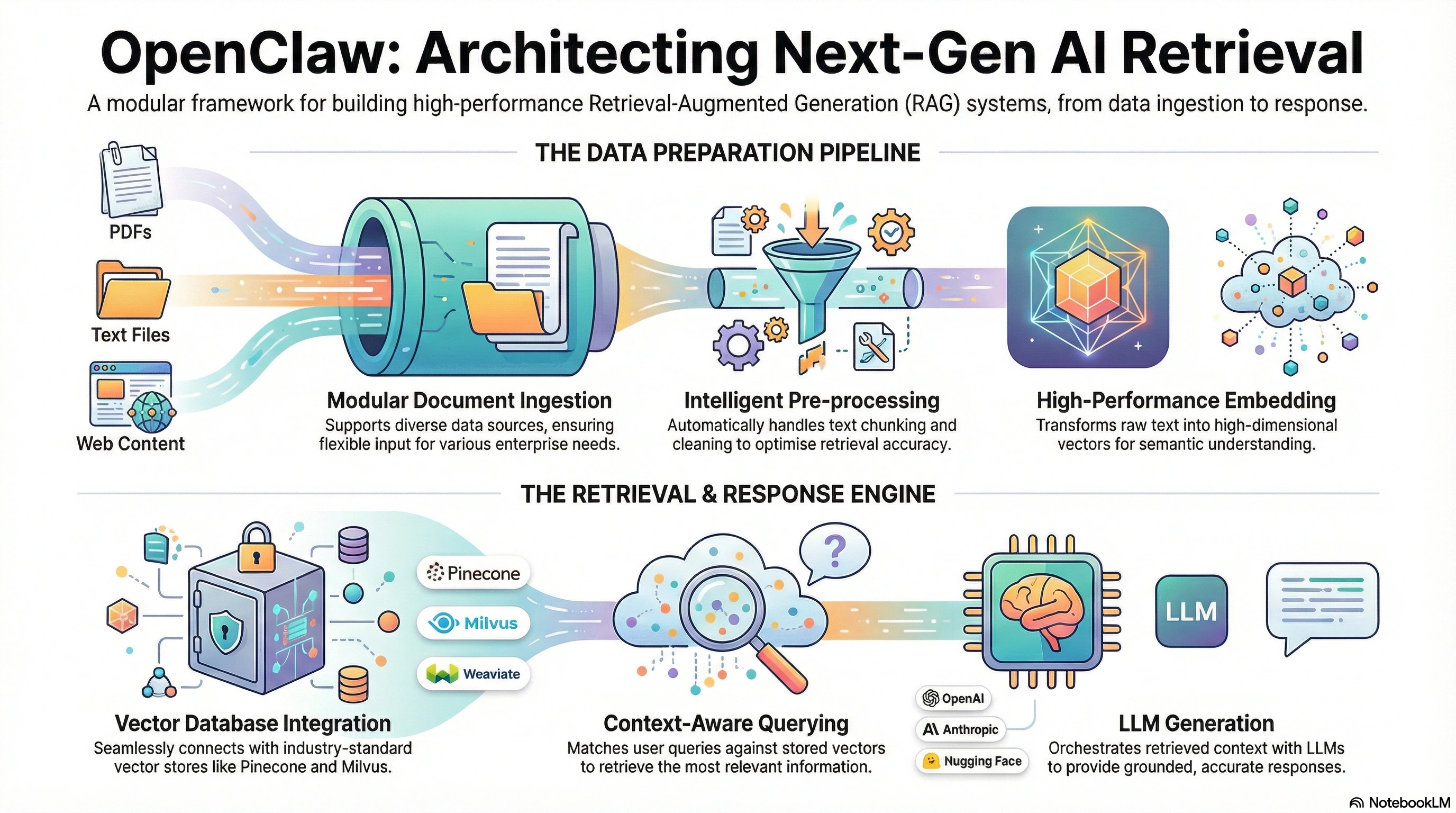
Direct answer: OpenClaw is an open-source AI crawling and knowledge-extraction framework that collects fresh information from the web, structures it, and feeds it into AI systems for accurate retrieval and generation. It acts as the “data acquisition layer” for modern Retrieval-Augmented Generation (RAG) systems.
Assumption stated once: OpenClaw is described here as the open-source AI crawling and knowledge ingestion framework commonly referenced in AI/RAG engineering discussions, not a physical device or unrelated software product.
OpenClaw addresses a core limitation of large language models: they do not know new or private information unless it is explicitly retrieved and provided. OpenClaw automates that retrieval process at scale.
Conceptual Background
Large language models such as OpenAI GPT-style systems are trained on static datasets. Once training ends, knowledge freezes. This creates three problems:
Information becomes outdated
Private or niche data is inaccessible
Answers lack traceable sources
To solve this, AI systems use Retrieval-Augmented Generation (RAG). RAG requires reliable, structured, and up-to-date data ingestion. OpenClaw exists to perform that ingestion continuously.
What Is OpenClaw?
OpenClaw is a modular AI crawler and extractor designed to:
Crawl public or authorized web sources
Extract meaningful text, metadata, and entities
Normalize and chunk content for AI consumption
Feed data into vector databases or search indexes
In simple terms, OpenClaw is how AI systems “read the internet” in a controlled, repeatable way.
How OpenClaw Works Step by Step
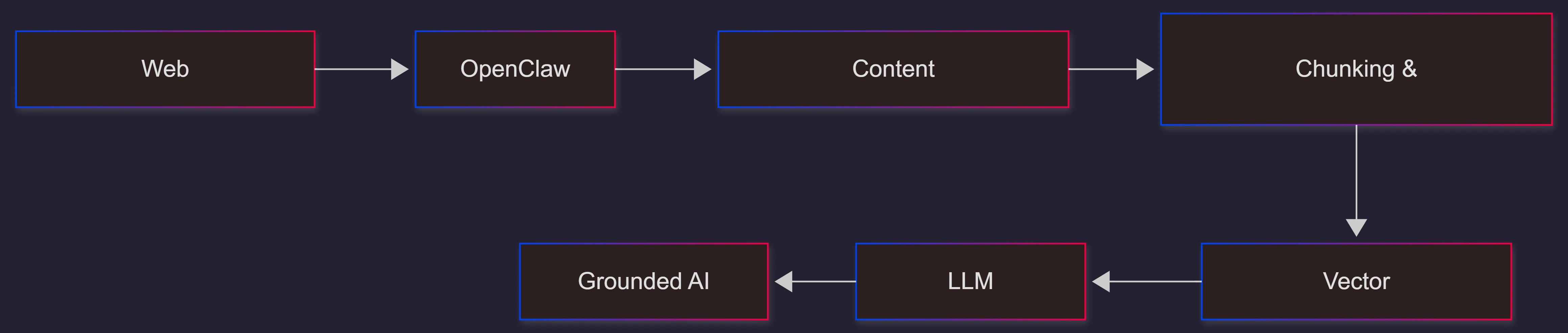
Source Discovery
OpenClaw begins with defined sources:
Websites
Documentation portals
Blogs and news sites
PDFs and knowledge bases
Rules control crawl depth, frequency, and allowed domains.
Crawling and Fetching
OpenClaw fetches pages while respecting:
Robots.txt
Rate limits
Content change detection
Only updated or new content is reprocessed, reducing noise.
Content Extraction
Raw HTML is converted into clean, structured data:
Main article text
Headings and sections
Tables and code blocks
Metadata such as author, date, and source URL
This step removes ads, navigation menus, and irrelevant markup.
Chunking and Structuring
Extracted content is split into small, semantically meaningful chunks. Each chunk is tagged with:
Source reference
Timestamp
Topic or entity signals
This structure is critical for precise AI retrieval.
Embedding and Indexing
Chunks are transformed into vector embeddings and stored in:
Vector databases
Hybrid search indexes
This allows AI models to retrieve only the most relevant information at query time.
Retrieval at Question Time
When a user asks a question:
Relevant chunks are retrieved
Sources are attached
The AI model generates an answer grounded in real data
This is how OpenClaw enables citation-ready AI responses.
OpenClaw Architecture
What Problems OpenClaw Solves
Outdated AI Knowledge
Models trained in the past cannot know recent events. OpenClaw keeps knowledge fresh through continuous crawling.
Hallucinations
By grounding answers in retrieved data, OpenClaw reduces fabricated or unverifiable responses.
Private Knowledge Access
Organizations can use OpenClaw on internal documentation without exposing data to public training pipelines.
Lack of Citations
Each retrieved chunk carries a source reference, enabling traceable and auditable AI answers.
Scalability
Manual data ingestion does not scale. OpenClaw automates ingestion across thousands of sources.
Use Cases / Scenarios
Enterprise Knowledge Assistants
Companies use OpenClaw to power internal AI chatbots that answer questions from policies, manuals, and reports.
Developer Documentation Search
Engineering teams index API docs so AI tools can give precise, version-aware answers.
Research and Intelligence
Analysts track changes across news sites, research portals, and public filings.
Customer Support Automation
AI agents retrieve verified help content instead of guessing solutions.
Limitations / Considerations
Crawl quality depends on source structure
Poorly formatted websites reduce extraction accuracy
Requires governance to avoid ingesting low-quality data
Vector storage costs grow with content volume
OpenClaw is a foundation layer, not a complete AI system by itself.
Common Fixes and Best Practices
Use strict domain allowlists
Apply content freshness thresholds
Remove duplicate or near-duplicate chunks
Add human-reviewed “gold sources”
Periodically re-embed data after model upgrades
Future Enhancements
Adaptive crawling based on query demand
Built-in entity linking and knowledge graphs
Native citation scoring for answer confidence
Real-time streaming ingestion
Deeper integration with AI governance tools
FAQs
Is OpenClaw a search engine?
No. It feeds data into AI systems that perform retrieval and generation.Is OpenClaw only for public web data?
No. It can ingest private, internal, or authenticated sources.Does OpenClaw replace training AI models?
No. It complements training by providing fresh and contextual data at runtime.Is OpenClaw required for RAG?
Not required, but it simplifies and standardizes RAG ingestion pipelines.
References
Retrieval-Augmented Generation research
Vector database design principles
AI crawling and extraction frameworks
Conclusion
OpenClaw is the missing bridge between static AI models and a constantly changing world. It enables AI systems to retrieve, verify, and cite real information instead of relying on outdated memory. As AI moves toward answer-first interfaces, frameworks like OpenClaw become essential infrastructure rather than optional tools.
Organizations implementing AI assistants, search, or decision systems can accelerate adoption and reliability by pairing RAG architectures with robust ingestion layers. For enterprises seeking implementation guidance or scalable AI knowledge pipelines, expert support such as C# Corner Consulting can help design, deploy, and govern OpenClaw-based retrieval systems efficiently.
Join the conversation! Your thoughts help the community grow.