

Introduction to Polygon
Polygon is a scaling solution known as a "layer two" or "sidechain" that operates in tandem with the Ethereum blockchain. This allows for rapid transactions and cost-effective fees. By leveraging the Polygon platform, blockchain projects can enhance their flexibility and scalability while retaining the security, interoperability, and structural benefits of the Ethereum blockchain. The native cryptocurrency of the Polygon network is MATIC, which is utilized to govern and secure the network, as well as pay for network transaction fees, staking, and other functions. It uses Proof of Stake (PoS) consensus mechanisms,
In PoS, validators are chosen to add new blocks to the blockchain based on the amount of cryptocurrency they hold and "stake" as collateral. It is a way to decide which user or users validate new blocks of transactions and earn a reward for doing so correctly.

Polygon Terminology
- Polygon: A Layer 2 scaling solution for Ethereum that aims to improve transaction speed and reduce gas fees.
- Side Chain: It is basically a chain that runs another blockchain alongside some other “main” blockchain. These two blockchains could then talk to each other in a special way that made it possible for assets to move between the two chains.
- Plasma Chains: It is basically a chain that runs another blockchain alongside some other “main” blockchain. However, unlike sidechains, the “root” of each plasma chain block is published to Ethereum. Block “roots” are basically little pieces of information that users can use to prove things about the contents of those blocks. For example, a user could use a block root to prove that they made a transaction in that specific block.
- POS: Stands for Proof of Stake, a consensus mechanism used in the Polygon network that allows validators to mine blocks based on the number of tokens they hold and stake.
- Bridges: A mechanism for transferring assets between different blockchains. The Polygon network has bridges that connect to Ethereum and other networks.
- Smart contracts: Self-executing contracts that are stored on the Polygon blockchain and automatically enforce the terms of the contract when certain conditions are met.
- Gas fees: The cost of making a transaction on the Polygon blockchain, paid in units of Ether (ETH).
- Decentralized applications (dApps): Applications that run on a blockchain and are decentralized, meaning that they are not controlled by a single entity.
- Polygon SDK: A set of tools and libraries that developers can use to build and deploy decentralized applications on the Polygon network.
- Polygon PoS Chain: A blockchain within the Polygon network that uses a proof-of-stake consensus mechanism.
- Polygon EVM: An Ethereum Virtual Machine (EVM) compatible execution environment that runs on the Polygon network.
- Polygon Scan: A blockchain explorer for the Polygon network that allows users to view transactions, addresses, and blocks on the blockchain.
What is MATIC?
MATIC is the proprietary cryptocurrency of Polygon, represented as an ERC-20 token that operates on the Ethereum blockchain. Its purpose is to pay fees on the Polygon network, as well as for staking and to govern and secure the network and its transaction fees. Unlike several other cryptocurrencies with no supply limit, the supply of MATIC is finite, with roughly $7.4 billion in circulation. The total number of coins in circulation will never surpass 10 billion.
How does Polygon work?
Polygon is multi-chain ecosystem of interconnected blockchain Layer-2 scaling solutions for Ethereum. It works by providing a network of interconnected blockchains called "Polygon chains," which operate on top of Ethereum. These chains support various consensus mechanisms(Polygon uses a proof-of-stake consensus mechanism) and can interact with each other through Polygon's inter-chain communication protocols. Polygon achieves fast and cheap transactions by utilizing off-chain processing through a modified version of the Plasma framework, as well as other scaling solutions such as Optimistic Rollups and ZK Rollups. This reduces the load on the Ethereum mainnet, resulting in faster and more efficient transaction processing. Developers can deploy smart contracts and dApps on Polygon using Ethereum-compatible tools and frameworks, such as Web3.js and Truffle. Polygon also supports popular Ethereum standards such as ERC-20 and ERC-721 tokens.
Available components of polygon
Polygon is a multi-chain scaling solution that offers several components to facilitate the development and deployment of decentralized applications (dApps) on its network. Some of the available components of Polygon includes
- Polygon SDK: This is a software development kit that allows developers to create their own customized blockchain networks on top of the Polygon network.
- Polygon POS Chain: This is a proof-of-stake (PoS) blockchain that is compatible with the Ethereum Virtual Machine (EVM). It is used for executing smart contracts and deploying decentralized applications.
- Polygon Plasma Chains: These are a set of sidechains that are designed to improve the scalability and speed of transactions on the Polygon network. They operate using a plasma architecture, which allows for faster transaction processing times.
- Polygon Bridge: This is a bridge that connects the Polygon network with other blockchains, such as Ethereum and Binance Smart Chain. It enables the transfer of assets and data across different blockchain networks.
- Polygon Gas Station Network: This is a decentralized solution for gas price optimization on the Polygon network. It provides real-time gas prices and enables users to pay for transactions using stablecoins, reducing the impact of gas price volatility. Overall, these components work together to provide a fast, secure, and scalable infrastructure for decentralized applications on the Polygon network.
How to build on the Polygon network?
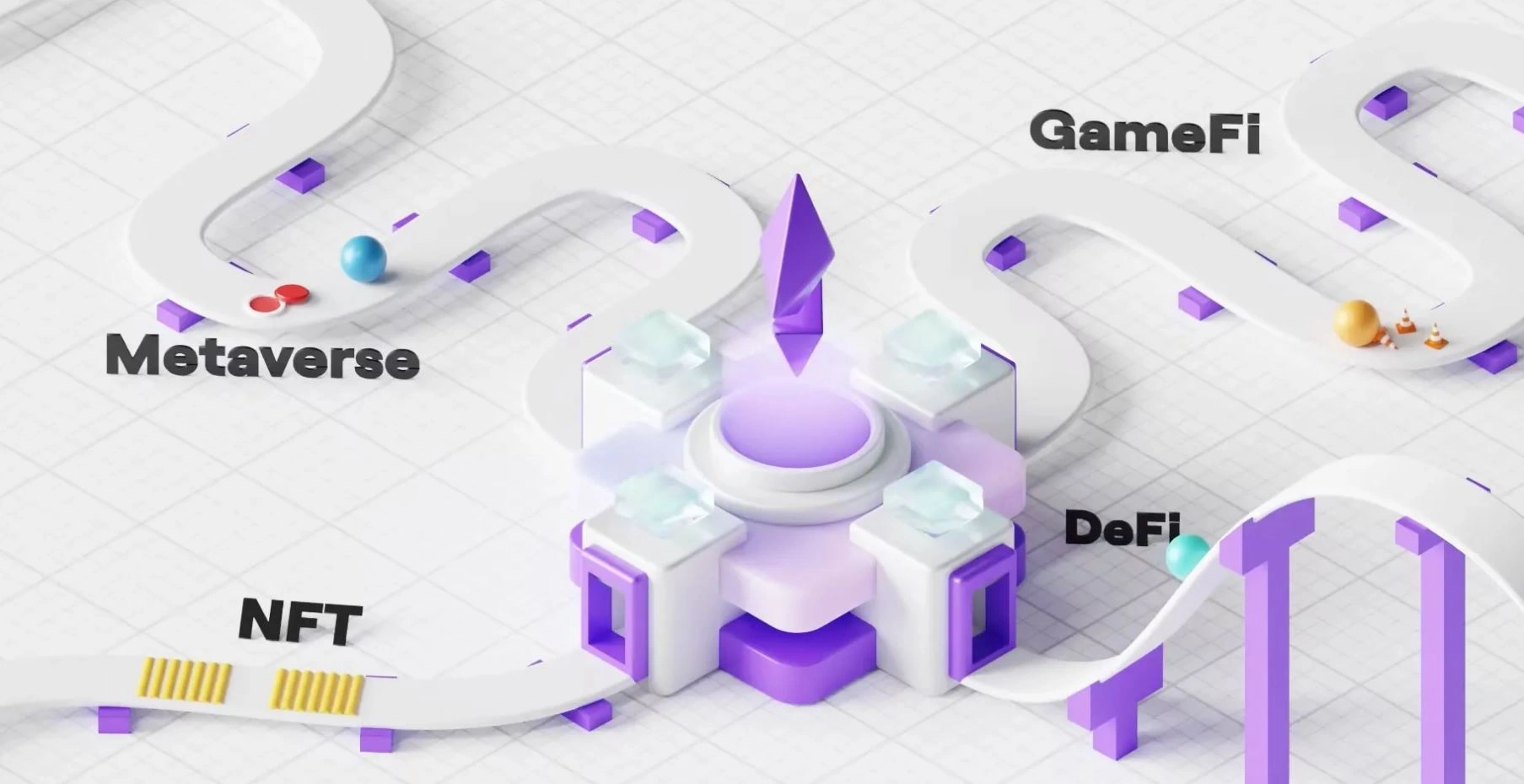
Source - https://polygon.technology/
You can adhere to the general methods listed below to expand the Polygon network.
- Selecting a development environment: On the Polygon network, you can build using a variety of programming languages, frameworks, and tools, including Solidity, Remix, Truffle, Hardhat, and others. Pick the option that best suits your requirements and level of skill.
- Create a development environment: Install the required tools, including a testing framework, a local node, and a wallet that is compatible with Polygon. Use your development environment to create and test your smart contracts before deploying them. For writing, compiling, and debugging Solidity code, you can use the Remix IDE.
- Deploy your smart contracts: After testing them, you may add your smart contracts to the Polygon network. To deploy your contracts, you can use a variety of deployment tools like Remix, Truffle, and Hardhat.
- Interact with your smart contracts: Using web3.js, ethers.js, or other tools; you may communicate with your smart contracts after you have deployed them. Your contracts can be integrated with other dApps or platforms, or you can create a frontend application that lets users interact with them.
- Test and iterate: To find and address any problems, thoroughly test your dApp. To enhance the user interface and functionality, iterate on your smart contracts and front end as necessary.
Remember to follow best practices when building on the Polygon network, such as testing thoroughly, optimizing gas usage, and securing your smart contracts against attacks.
Advantages of Polygon
Polygon blockchain has several advantages over other blockchain networks. Some of them are,
- Scalability: Polygon is designed to be a layer 2 solution for Ethereum, So it can handle a large number of transactions per second (TPS). It can also scale to meet the needs of high-traffic decentralized applications.
- Faster Transactions: Transactions on the Polygon blockchain are processed more quickly than on other blockchain networks, So users can send and receive funds faster.
- Low transaction fees: Transactions on Polygon are cheaper than on other blockchain networks, which makes it more affordable for users to make transactions.
- Easy to Use: Polygon has an easy-to-use interface that makes it simple for users to navigate the platform, even if users are not familiar with blockchain technology.
- Secure: The Polygon blockchain is secure and uses a consensus algorithm that prevents fraudulent activities and provides more security.
- Interoperable: Polygon is compatible with other blockchain networks, which makes it easier for users to transfer funds between different networks.
- Supportive Community: Polygon has a supportive community of developers and users who provide resources and support to each other, So it makes it easier for users to learn and navigate.
Disadvantages of polygon
Despite those several advantages, such as faster transaction speeds and lower fees, there are also some disadvantages to using a Polygon blockchain.
- Limited decentralization: Polygon relies on a set of validators to process transactions, and the network is not as decentralized as other blockchains like Bitcoin or Ethereum. This can make it vulnerable to centralization and censorship.
- Security risks: While Polygon is built on Ethereum, it has its own security model and can be susceptible to different kinds of attacks. For example, if a hacker gains control of the majority of validators on the network, they could potentially manipulate transactions or steal funds.
- Governance concerns: The governance structure of Polygon is not as decentralized as other blockchains.
- The majority of decision: making power rests with a small group of stakeholders, which can lead to centralization and conflicts of interest.
- Ethereum dependent: It is not known how the transition to Ethereum 2.0 will affect the development of the Polygon network also there are high competition among other scaling solutions. For example, Polkadot has made significant progress in creating multi-chain solutions that are compatible with all blockchains.
Conclusion
In conclusion, the Polygon blockchain is a Layer-2 scaling solution for Ethereum that aims to improve transaction speed and reduce gas fees. It offers a multi-chain ecosystem of interconnected blockchains that support various consensus mechanisms which help to interact with each other through Polygon's inter-chain communication protocols. Developers can deploy smart contracts and dApps on Polygon using Ethereum-compatible tools and frameworks. Polygon has its own cryptocurrency, called MATIC, which is used used to govern and secure the Polygon network and to pay network transaction fees, staking, and more.
FAQ's
Question - What is Polygon, and how does it work?
Answer - Polygon is a Layer 2 scaling solution for Ethereum that aims to improve the speed, scalability, and cost-effectiveness of the Ethereum network. Polygon achieves this by providing a framework for building and connecting Ethereum-compatible blockchain networks, known as "Polygon chains" or "Polygon sidechains". These sidechains are connected to the Ethereum mainnet, allowing users to transfer assets and data between the mainnet and the sidechains. By offloading a significant portion of transactions from the mainnet to sidechains, Polygon reduces network congestion and gas fees on Ethereum, making it more accessible and usable for developers and users.
Question - What is the purpose of the MATIC cryptocurrency?
Answer - MATIC is the native cryptocurrency of the Polygon network, used for various functions such as paying transaction fees, participating in network governance, and staking to secure the network. As more users and applications adopt the Polygon network, the demand for MATIC is expected to increase, potentially leading to price appreciation.
Question - What is the difference between sidechains and plasma chains on the Polygon network?
Answer - Sidechains and plasma chains are both types of Polygon chains, but they differ in their architecture and purpose. Sidechains are independent blockchain networks that are interoperable with the Ethereum mainnet, allowing users to transfer assets and data between them. Plasma chains, on the other hand, are a specific type of sidechain that use a hierarchical architecture to improve scalability and reduce gas fees. They allow for faster and cheaper transactions by aggregating multiple transactions into a single transaction on the Ethereum mainnet.
Question - How does the Proof of Stake consensus mechanism work on Polygon?
Answer - Polygon uses a Proof of Stake (PoS) consensus mechanism, which allows users to stake their MATIC tokens to become validators and help secure the network. Validators are responsible for validating transactions, creating new blocks, and maintaining the integrity of the network. Validators who successfully validate transactions are rewarded with transaction fees and block rewards, while those who behave maliciously or negligently can be penalized by losing their stake.
Question - What is the Polygon SDK, and how is it used?
Answer - The Polygon SDK (Software Development Kit) is a set of tools and frameworks that allow developers to build and deploy Ethereum-compatible blockchain networks on the Polygon network. It includes various components such as smart contract templates, APIs, and a consensus mechanism that can be customized and configured to meet the specific needs of the application.
Question - What are gas fees on the Polygon network, and how are they paid?
Answer - Gas fees on the Polygon network are paid in MATIC, the native cryptocurrency of the network. Gas fees are used to incentivize validators to process transactions and maintain the security of the network. Users who want to send a transaction on the Polygon network must pay a certain amount of MATIC as a gas fee, which is determined by the complexity of the transaction and the level of network congestion.
Question - What is the role of bridges in the Polygon network?
Answer - Bridges are a critical component of the Polygon network, as they enable interoperability between the Ethereum mainnet and Polygon sidechains. Bridges allow users to transfer assets and data between different networks, enabling decentralized applications to take advantage of the strengths and features of each network.
Question - What types of applications can be built on the Polygon network?
Answer - The Polygon network is designed to support a wide range of decentralized applications, including but not limited to decentralized finance (DeFi), non-fungible tokens (NFTs), gaming, and social media. The network's scalability and low gas fees make it an attractive platform for developers looking to build high-performance and cost-effective applications.
Join the conversation! Your thoughts help the community grow.