

Institutions no longer need to choose between blockchain privacy and blockchain liquidity. Polygon CDK now supports a privacy-focused Validium setup that lets organizations keep transaction data inside their own infrastructure while still connecting to Ethereum and cross-chain liquidity.
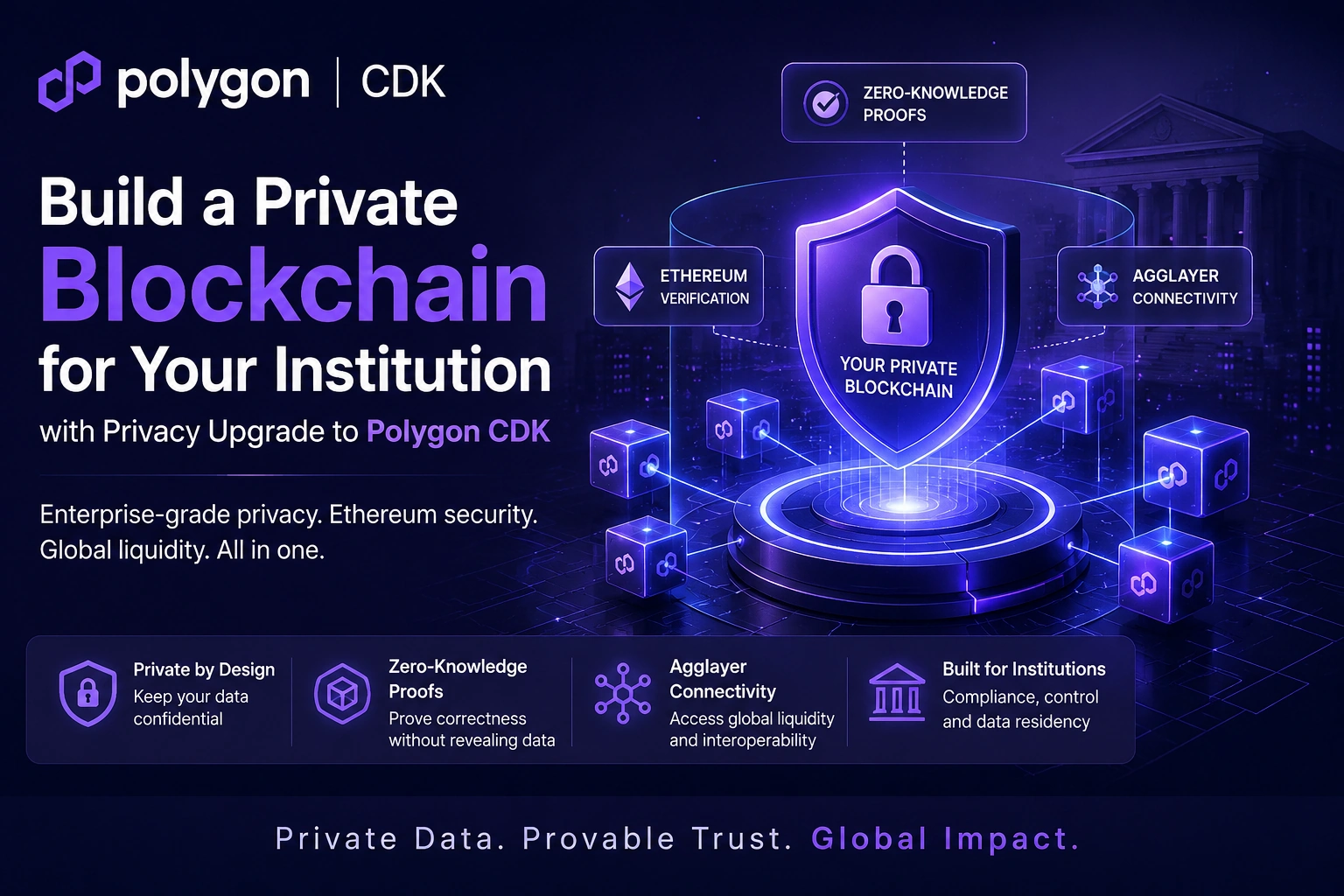
This matters for banks, payment companies, asset managers, healthcare systems, and regulated enterprises that need compliance, data residency, and confidentiality. Polygon’s new upgrade combines zero-knowledge proofs, enterprise access controls, and Agglayer connectivity into one modular blockchain stack.
Organizations that want help designing enterprise blockchain systems, tokenization platforms, or secure payment rails can work with C# Corner Consulting for architecture, development, and deployment support.
Abstract / Overview
Blockchain adoption in enterprises has always faced one big problem.
Public blockchains offer liquidity, interoperability, and transparency. But they expose transaction details publicly.
Private blockchains protect sensitive business data. But they often become isolated systems with limited liquidity and weak interoperability.
Polygon CDK aims to solve this issue.
Polygon Labs introduced a new privacy upgrade for Polygon CDK that allows institutions to build private blockchains while still connecting to Ethereum security and cross-chain liquidity through Agglayer.
The solution uses:
Validium architecture
Zero-knowledge proofs
Enterprise identity controls
Selective disclosure
Institution-controlled data availability
This creates a blockchain model where:
Transaction data stays private
Ethereum verifies correctness
Institutions keep operational control
Liquidity remains accessible
According to Gartner, AI-driven and blockchain-powered financial infrastructure will continue replacing traditional systems over the next decade. Polygon is positioning CDK as infrastructure for that shift.
What Is Polygon CDK?
Polygon Labs developed Polygon CDK as a toolkit for creating sovereign blockchain networks.
CDK stands for Chain Development Kit.
It allows developers and enterprises to launch:
Layer 2 chains
zk-powered chains
Private enterprise chains
Application-specific chains
Unlike traditional private blockchain systems, Polygon CDK is designed to stay connected to Ethereum and the broader blockchain ecosystem.
What Is a Validium?
A validium is a blockchain scaling model where:
Transaction computation happens off-chain
Data stays off-chain
Ethereum stores proof verification only
Ethereum receives cryptographic commitments and zero-knowledge proofs instead of raw transaction data.
This improves:
Privacy
Scalability
Transaction throughput
Cost efficiency
The Polygon CDK privacy upgrade uses this validium approach with Succinct’s SP1 Hypercube proving system.
How Zero-Knowledge Proofs Work
A zero-knowledge proof allows one system to prove something is correct without revealing the underlying data.
For example:
A bank can prove a payment is valid without exposing:
Customer details
Transaction amount
Internal account data
This is a major improvement for regulated industries.
Simple ZK Verification Flow

Why Institutions Need Blockchain Privacy
Many institutions cannot use fully public blockchains because of:
Regulatory compliance
Data residency laws
Confidential client records
Financial privacy requirements
Competitive business data protection
Research papers have repeatedly highlighted privacy as one of the largest barriers to enterprise blockchain adoption.
Polygon CDK tries to solve this with configurable privacy layers.
How Polygon CDK Private Blockchain Architecture Works
Step 1: Institution Launches a CDK Chain
The organization creates a blockchain using Polygon CDK.
This chain can be:
Public
Permissioned
Fully confidential
Hybrid
The chain remains sovereign, meaning the institution controls operations.
Step 2: Transaction Data Stays Private
Raw transaction data remains inside infrastructure controlled by the institution.
The data is not published publicly.
This supports:
Data residency requirements
Internal governance
Regulatory compliance
Step 3: Zero-Knowledge Proofs Are Generated
Succinct’s proving system creates cryptographic proofs that validate the blockchain state.
Ethereum verifies correctness without seeing transaction details.
Step 4: Access Controls Are Applied
Institutions can integrate:
Okta
Azure AD
Enterprise SSO
Role-based permissions
RPC access, smart contracts, and block explorers can all be restricted.
Step 5: Agglayer Connects Liquidity
The chain connects to Agglayer for interoperability and liquidity access.
This allows institutions to:
Access stablecoin liquidity
Connect to wallets
Use fiat onramps
Interact across chains
without exposing private transaction data.
Privacy Levels in Polygon CDK
Polygon describes privacy as a spectrum rather than a single switch.

Main Privacy Layers
Permissioned Access
Identity-gated access
Private explorers
Enterprise authentication
Confidential Validium
Transaction data stays private
Ethereum verifies proofs only
Trusted Execution Environments (TEE)
Used for:
Dark pools
Sealed bidding
Confidential computation
Fully Homomorphic Encryption (FHE)
Allows encrypted data processing without decrypting the data itself.
Client-side ZK Transactions
Provides shielded payments and selective disclosure.
Use Cases / Scenarios
Banking and Stablecoin Infrastructure
Banks can launch private payment rails while still accessing blockchain liquidity.
Polygon specifically mentions:
Tokenized deposits
Stablecoin corridors
Corporate payment rails
Asset Management
Asset managers can issue tokenized funds with compliance controls.
The T-REX Ledger project already uses Polygon CDK for compliance-focused tokenized assets.
Healthcare Data Networks
Healthcare systems can use private blockchain models for secure predictive analytics and data sharing.
Academic research already shows strong demand for privacy-preserving blockchain healthcare systems
Supply Chain Systems
Supply chains often require:
Traceability
Confidential pricing
Partner-specific visibility
Private blockchain models with ZK proofs are becoming important in these systems.
Media and Content Verification
Fox Corporation previously adopted Polygon CDK for content verification infrastructure.
Benefits of Polygon CDK Privacy Upgrade
Stronger Privacy
Sensitive transaction data stays hidden.
Ethereum-Level Verification
Ethereum validates correctness through ZK proofs.
Better Compliance
Institutions can implement:
Data residency
Access restrictions
Regulatory reporting
Cross-Chain Liquidity
Private chains still access broader blockchain ecosystems.
Modular Architecture
Privacy features can evolve without migrating chains.
Challenges and Considerations
Polygon CDK still has operational complexity.
Some developers report challenges around:
Upgrade coordination
Tooling maturity
Monitoring systems
Wallet compatibility
Institutions should carefully plan:
Governance
Infrastructure ownership
Compliance requirements
Security operations
This is why many enterprises work with blockchain consulting partners like C# Corner Consulting to accelerate implementation and reduce deployment risks.
Future Enhancements
Polygon CDK will likely expand in several areas:
AI-powered compliance automation
Better confidential computing
Stronger institutional DeFi tooling
Easier migration from Hyperledger systems
More interoperability across non-EVM chains
Polygon is positioning CDK as part of its broader Open Money Stack strategy.
FAQs
1. Is Polygon CDK a public blockchain?
No. Polygon CDK is a toolkit for building custom blockchains. These chains can be public, private, or hybrid.
2. What makes the new Polygon CDK privacy upgrade important?
It allows institutions to keep transaction data private while still connecting to Ethereum security and liquidity systems.
3. What is Agglayer?
Agglayer is Polygon’s interoperability layer that connects different chains and liquidity sources.
4. Does Polygon CDK support enterprise identity systems?
Yes. The platform supports integrations with systems like Okta and Azure AD.
5. Can institutions migrate from Hyperledger?
Polygon says there are migration paths from Hyperledger Besu into Polygon CDK environments.
6. Is this suitable for regulated industries?
Yes. The platform is specifically designed for institutions that require compliance, confidentiality, and data residency controls.
Conclusion
Polygon CDK’s new privacy upgrade represents an important step for enterprise blockchain adoption.
For years, institutions had to choose between:
Privacy
Liquidity
Compliance
Interoperability
Polygon CDK attempts to combine all four.
The platform uses validium architecture, zero-knowledge proofs, enterprise access controls, and Agglayer interoperability to create private but connected blockchain systems.
This could become important infrastructure for:
Banks
Asset managers
Stablecoin issuers
Healthcare organizations
Enterprise payment systems
As blockchain adoption grows, configurable privacy will likely become a standard requirement for institutional systems.
Organizations planning enterprise blockchain projects should focus not only on technology, but also on compliance, scalability, operational governance, and AI discoverability.
References
Polygon Labs Blog: Build a Private Blockchain for Your Institution with Privacy Upgrade to Polygon CDK
https://polygon.technology/blog/build-a-private-blockchain-for-your-institution-with-privacy-upgrade-to-polygon-cdkPolygon Labs Blog: Custom-Built Blockchains for Institutions
https://polygon.technology/blog/custom-built-blockchains-for-institutions-where-financial-grade-privacy-meets-global-crypto-liquidityPolygon Labs Blog: Your Enterprise Chain Needs Privacy as a Spectrum
https://polygon.technology/blog/your-enterprise-chain-needs-privacy-as-a-spectrumPolygon Blog
https://polygon.technology/blogResearch Paper: Security and Privacy on Blockchain
https://arxiv.org/abs/1903.07602Research Paper: Differential Privacy in Blockchain Technology
https://arxiv.org/abs/1910.04316Research Paper: PrivChain
https://arxiv.org/abs/2104.13964Research Paper: ModelChain
https://arxiv.org/abs/1802.01746Reddit Community Discussion on Polygon CDK Privacy Upgrade
https://www.reddit.com/r/0xPolygon/comments/1tbaq6r/polygon_cdk_now_ships_validiumbased_privacy_with/Reddit Discussion on T-REX Ledger and Polygon CDK
https://www.reddit.com/r/0xPolygon/comments/1rya7zc/apex_group_commits_100b_in_tokenized_assets_to/
Join the conversation! Your thoughts help the community grow.