

Introduction
TF-IDF stands for Term Frequency-Inverse Document Frequency. It is a numerical representation used in natural language processing and information retrieval to determine the importance of a word or term in a document relative to a collection of documents (corpus). TF-IDF is a key concept in text mining and plays a crucial role in various applications, such as document search, information retrieval, and text classification.
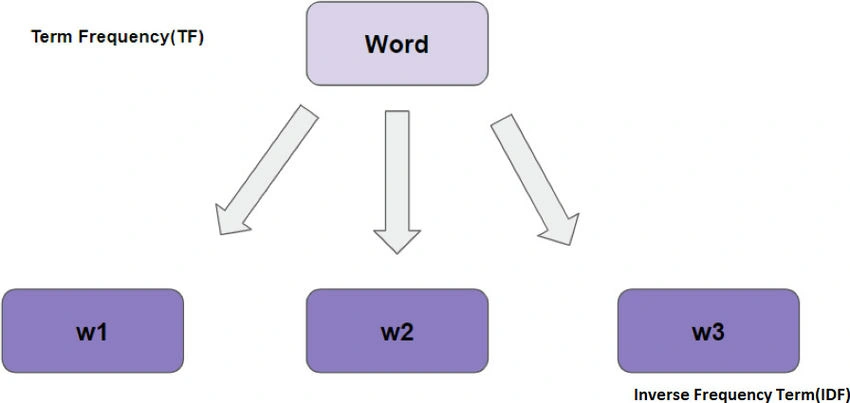
What is TF-IDF, and why it's important?
The importance of TF-IDF lies in its ability to identify and extract key terms from a collection of documents. This helps in various natural language processing tasks, such as keyword extraction, document ranking, and content-based recommendation systems. TF-IDF aids in highlighting the most relevant and distinctive terms, which is valuable in understanding the content of a document and comparing it with other documents in the corpus.TF-IDF is used to quantify the relevance of terms in a document relative to a larger corpus of documents. Let's break down the key components.
- Term Frequency (TF): TF measures how frequently a term (word) appears in a document. It is calculated by counting the number of times a term occurs in a document and dividing it by the total number of terms in that document. The idea is that words appearing more often are more relevant to the document's content.

- Inverse Document Frequency (IDF): IDF quantifies how unique or rare a term is across a collection of documents (corpus). It helps to identify words that are specific to certain documents but not common across the entire corpus. IDF is calculated as the logarithm of the total number of documents divided by the number of documents containing the term.

- TF-IDF Score: The TF-IDF score for a term in a document is obtained by multiplying its TF and IDF values. It gives us a measure of how important a term is in a particular document relative to its importance across the entire corpus.

How TF-IDF Vectorization Works?
TF-IDF vectorization converts a collection of documents into a matrix where each row represents a document, and each column represents a unique term. The values in the matrix are the TF-IDF scores for each term in each document. Here's a step-by-step overview of the TF-IDF vectorization process.
- Tokenization: The first step is to tokenize the text documents, which involves breaking them down into individual words or terms. This can also include removing punctuation and stop words (common words like "the," "and," "in," etc.).
- Calculating TF: For each document, calculate the TF values for all the terms. This results in a TF matrix where each row corresponds to a document, and each column corresponds to a term.
- Calculating IDF: Calculate the IDF values for all unique terms across the entire corpus. This results in an IDF vector.
- Calculating TF-IDF: Multiply the TF matrix by the IDF vector element-wise to obtain the TF-IDF matrix. Each element in this matrix represents the TF-IDF score for a specific term in a specific document.
- Normalization: Optionally, you can normalize the TF-IDF matrix to ensure that the values are on the same scale. Common techniques include L2 normalization (Euclidean normalization) or cosine similarity normalization.
Here I am Providing a Python program that demonstrates TF-IDF vectorization using the popular library scikit-learn. Before running this program, make sure you have scikit-learn installed. You can install it using pip if you haven't already.
pip install scikit-learn
Now, let's create a simple program.
Example
from sklearn.feature_extraction.text import TfidfVectorizer

# Sample documents
documents = [
    "This is the first document.",
    "This document is the second document.",
    "And this is the third one.",
    "Is this the first document?"
]

# Create a TF-IDF vectorizer with optional preprocessing steps
tfidf_vectorizer = TfidfVectorizer(stop_words='english')

# Fit and transform the documents
tfidf_matrix = tfidf_vectorizer.fit_transform(documents)

# Get the feature names (terms)
terms = tfidf_vectorizer.get_feature_names_out()

# Print the TF-IDF matrix
print("TF-IDF Matrix:")
print(tfidf_matrix.toarray())

# Print the feature names
print("\nFeature Names (Terms):")
print(terms)
Explanation
- Imports the TfidfVectorizer from scikit-learn.
- Defines a list of sample documents.
- Creates a TfidfVectorizer object, specifying that English stop words (common words like "the," "and," "in," etc.) should be removed.
- Fits and transforms the documents using the vectorizer, resulting in a TF-IDF matrix.
- Retrieves the feature names (terms) from the vectorizer.
- Prints the TF-IDF matrix and the feature names.
Let's talk more about this code.
from sklearn.feature_extraction.text import TfidfVectorizer is used to Decode the input into a string of Unicode symbols.
There are a lot of functions in this library includes.
| Function | Description |
| build_analyzer() | Return a callable to process input data. |
| build_preprocessor() | Return a function to preprocess the text before tokenization. |
| build_tokenizer() | Return a function that splits a string into a sequence of tokens. |
| decode(doc) | Decode the input into a string of Unicode symbols. |
| Learn vocabulary and idf from the training set. | Learn vocabulary and idf from the training set. |
| fit_transform(raw_documents[,y]) | Learn vocabulary and idf, return document-term matrix. |
| get_feature_names_out([input_features]) | Get output feature names for transformation. |
| get_metadata_routing() | Get metadata routing of this object. |
| get_params([deep]) | Get parameters for this estimator. |
| get_stop_words() | Build or fetch the effective stop words list. |
| inverse_transform(X) | Return terms per document with nonzero entries in X. |
| set_fit_request(*[,raw_documents]) | Request metadata passed to the fit method. |
| set_params(**params) | Set the parameters of this estimator. |
| set_transform_request(*[,raw_documents]) | Request metadata passed to the transform method. |
| transform(raw_documents) | Transform documents to the document-term matrix. |
Applications of TF-IDF Vectorization
TF-IDF vectorization is widely used in various natural language processing (NLP) and text mining applications, including.
- Information Retrieval: TF-IDF helps search engines rank documents based on their relevance to user queries.
- Text Classification: It's used to classify documents into predefined categories or topics.
- Keyword Extraction: TF-IDF can identify important keywords in a document.
- Document Similarity: It can measure the similarity between documents, aiding in clustering and recommendation systems.
- Sentiment Analysis: TF-IDF can be used to identify significant terms related to positive or negative sentiments.
Conclusion
TF-IDF vectorization is a powerful technique for converting text data into a numerical format suitable for various machine-learning tasks. It helps quantify the importance of terms within documents and across a corpus. By understanding TF-IDF, you can leverage its capabilities to extract valuable insights from textual data, whether it's for information retrieval, text classification, or any other NLP-related task. Mastering TF-IDF is a fundamental step towards effective text analysis and natural language understanding.
FAQ's
Q. What is the purpose of TF-IDF?
A. TF-IDF is commonly used in information retrieval and text mining to determine the relevance of terms in documents. It helps in identifying keywords and ranking documents based on their similarity to a query.
Q. Is TF-IDF a feature extraction technique?
A. Yes, TF-IDF is often used as a feature extraction technique in natural language processing (NLP) and machine learning tasks to represent text data numerically.
Q. Are there variations of TF-IDF?
A. Yes, there are variations and enhancements of TF-IDF, such as Term Frequency-Inverse Document Frequency with Smooth (S-TF-IDF) and sublinear TF-IDF, which aim to address some of its limitations.
Join the conversation! Your thoughts help the community grow.