

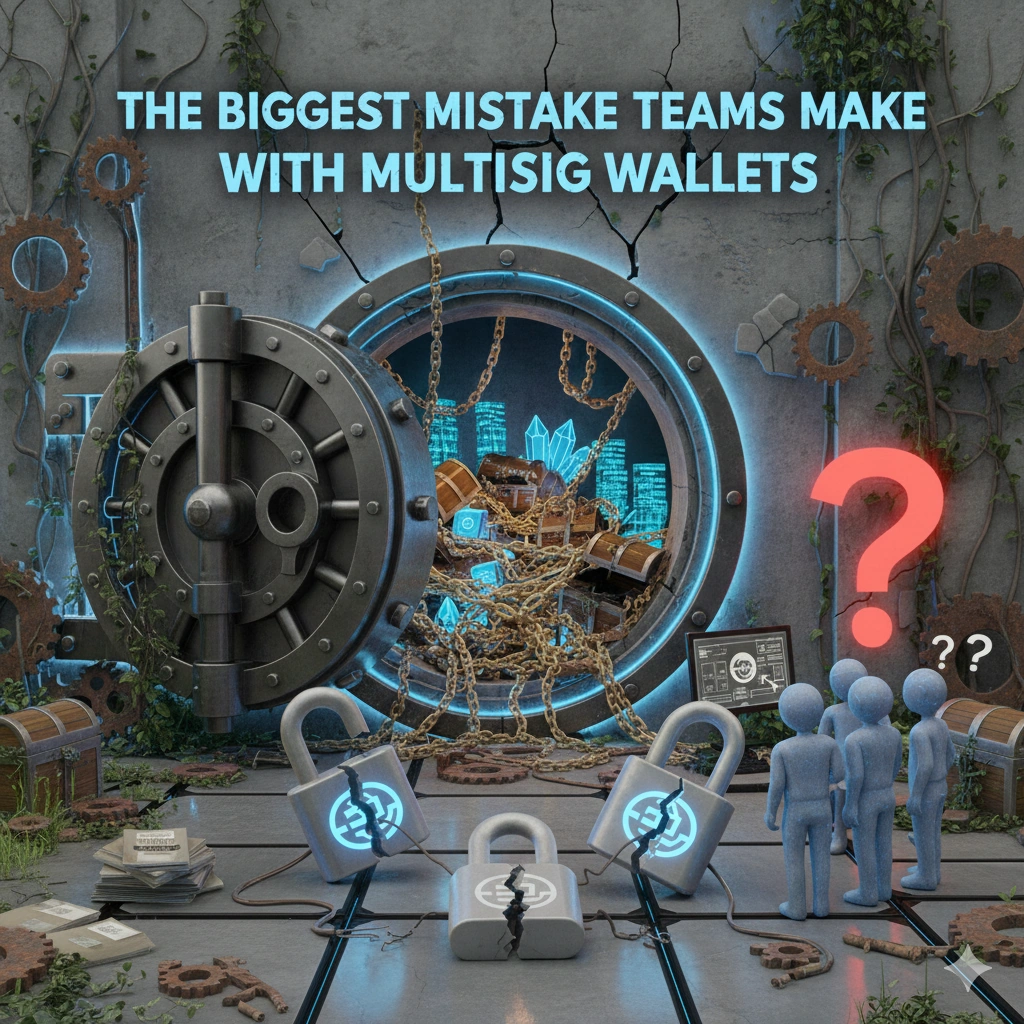
Multisig wallets are widely considered the gold standard for managing crypto treasuries. DAOs use them. Foundations rely on them. Companies moving real money through blockchain infrastructure almost always end up there. And yet, despite all of that, multisig related losses still happen with uncomfortable regularity.
The reason is not faulty code. The reason is misuse.
The single biggest mistake teams make with multisig wallets is assuming that simply having a multisig automatically makes them secure. That assumption creates a false sense of safety, and false safety is more dangerous than no safety at all.
A multisig wallet is not a shield. It is a governance system. If that system is poorly designed, it does exactly what it is told to do, even when the outcome is disastrous.
Mistaking multisig for key security
One of the most common and costly misunderstandings is believing that multisig protects private keys. It does not.
Multisig protects decisions, not keys.
If every signer uses a browser wallet on a personal laptop, the multisig contract will happily accept approvals from compromised devices. From the blockchain’s point of view, valid signatures are valid signatures. It does not know whether those signatures came from a careful human or a piece of malware.
This is how real treasuries have been drained while technically following multisig rules. Attackers did not break the multisig. They collected enough signatures by compromising signers.
This is why experienced teams treat hardware wallets as non negotiable for primary signers. Offline keys reduce the risk of silent compromise. They force explicit confirmation. They introduce friction where friction is healthy.
Multisig without hardware wallets is shared risk, not reduced risk.
Choosing thresholds that look clean but fail in reality
Another major mistake is picking approval thresholds based on symmetry instead of resilience.
Two of two multisigs are a classic example. They look elegant. Both parties must agree. No one can act alone. On paper, it feels secure. In practice, it is fragile.
If one signer loses access, goes offline, leaves the company, or simply refuses to cooperate, the wallet is frozen. Funds cannot move. Signers cannot be changed. The multisig becomes a locked vault with no recovery path.
This is not a rare edge case. It happens during team breakups, legal disputes, travel emergencies, and lost devices. A multisig that cannot survive one signer failing is not designed for real world conditions.
This is why two of three and three of five setups are far more common among mature teams. They allow progress without unanimity while still preventing unilateral action. Thresholds should be chosen based on failure tolerance, not aesthetics.
Treating multisig as a checkbox instead of a system
Many teams set up multisig once and never revisit it. There is no documentation. No clear ownership model. No process for what happens when signers change roles or leave.
This is a governance failure, not a technical one.
Multisig wallets are living systems. Teams evolve. Advisors rotate. Responsibilities shift. Devices get replaced. A multisig that does not adapt becomes increasingly risky over time.
Signer rotation should be expected. Recovery scenarios should be discussed before they are needed. Backup plans should exist and be understood by more than one person.
When none of this is planned, multisig becomes brittle. The first unexpected event turns into a crisis.
Allowing convenience to override security
Convenience is the quiet enemy of good multisig design.
Teams start with good intentions. Hardware wallets for everyone. Strong thresholds. Clear separation of duties. Over time, friction creeps in. Someone wants faster approvals. Someone signs from a hot wallet just this once. Someone adds a software wallet signer for emergencies and never removes it.
Each shortcut feels small. The combined effect is not.
Eventually, the multisig can be executed without any hardware wallet involvement. At that point, the strongest layer of protection has been bypassed, often without anyone explicitly deciding to do so.
Good multisig setups make unsafe actions hard, not easy.
Assuming multisig replaces operational discipline
Multisig does not fix sloppy processes. It exposes them.
No backups for recovery phrases. No clear rule on who proposes transactions. No review process for large transfers. No separation between proposal and approval. These are operational failures, not contract failures.
Multisig amplifies whatever governance model you put into it. If your internal processes are weak, multisig will faithfully enforce weak decisions with cryptographic certainty.
The teams that use multisig well treat it as one layer in a broader security and governance strategy, not as a replacement for thinking.
What strong multisig design actually looks like
Well designed multisig setups share a few characteristics. They assume people will make mistakes. They assume devices will be lost. They assume relationships will change. They assume someone will eventually disagree.
And they continue to function anyway.
They use hardware wallets for primary signers. They choose thresholds that tolerate failure. They document recovery paths. They regularly review signer lists. They treat multisig as part of governance, not just custody.
Platforms like Safe provide the tooling, but the responsibility for design still sits with the team.
The real takeaway
Most multisig failures are not caused by attackers outsmarting cryptography. They are caused by teams misunderstanding what multisig actually does.
Multisig does not make bad decisions safe. It makes decisions deliberate.
If your multisig cannot tolerate one signer failing, one device being lost, or one person acting irrationally, it is not protecting your treasury. It is only delaying the moment of failure.
Security is not about checking the multisig box. It is about designing systems that survive stress, mistakes, and change.
Multisig works best when it is treated as governance infrastructure, not just a wallet.
Join the conversation! Your thoughts help the community grow.