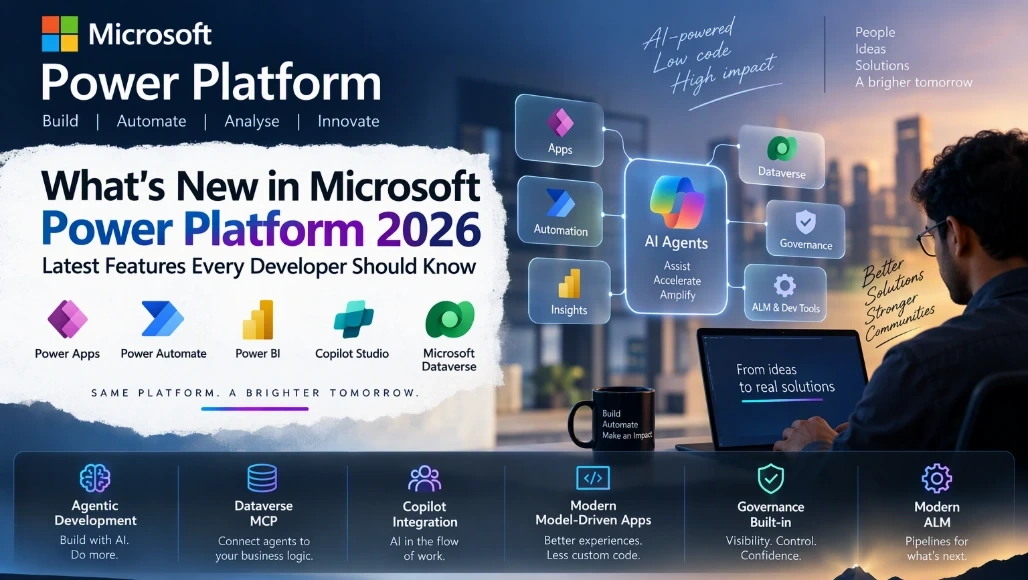
Microsoft Power Platform continues to evolve rapidly, with AI and agent-based development becoming central to the platform. In 2026, Microsoft has introduced significant improvements across Power Apps, Microsoft Dataverse, Copilot experiences, developer tooling, application lifecycle management, and governance.
Another important change is how Microsoft communicates new features. Power Platform is moving away from the traditional twice-yearly release wave model toward an always-on roadmap. Starting in September 2026, Power Platform, Dataverse, Dynamics 365, Microsoft 365, and Copilot roadmap information is being brought together in the AI at Work roadmap.
In this article, let us explore some of the most interesting Power Platform developments that developers, makers, architects, and administrators should know about.
1. From Release Waves to an Always-On Roadmap
Traditionally, Power Platform features were organized into Release Wave 1 and Release Wave 2.
Microsoft is retiring this approach.
Instead of waiting for the next release-wave announcement, capabilities will now be published continuously once Microsoft is ready to disclose them. Roadmap features progress through statuses such as In Development, Rolling Out, and Launched.
The new roadmap also provides useful functionality such as:
Product-based filtering
CSV export
RSS subscriptions
Feature IDs
Advanced filtering
Shareable roadmap links
Microsoft has also confirmed that the old Release Planner is being retired by November 15, 2026, with the AI at Work roadmap becoming the source of truth for public roadmap information.
Why does this matter?
For Power Platform developers and administrators, checking the roadmap can become part of regular platform governance rather than something performed only twice a year.
2. Dataverse MCP Server Is Becoming More Powerful
One of the most interesting areas for developers is the expansion of Model Context Protocol, or MCP, integration with Dataverse.
Microsoft announced support for Dataverse Custom APIs through the Dataverse MCP Server in October 2026. This allows agents to work with existing custom business logic exposed through Dataverse Custom APIs.
This is particularly interesting if you already build Custom APIs and plug-ins.
For example, imagine that you already have a Dataverse Custom API named:
ap_SubmitApprovalRequest
which contains validated server-side business logic.
Instead of duplicating that logic inside an AI solution, an agent could potentially interact with the capability exposed through Dataverse MCP.
Conceptually:
AI Agent -> Dataverse MCP Server -> Custom API -> Plug-in Logic -> Dataverse
This represents an important architectural direction because organizations can reuse governed Dataverse business logic when building agent experiences.
3. Power Apps and Agentic Authoring
Power Apps is also moving beyond the traditional maker experience.
Microsoft announced a preview of agentic authoring in Canvas Studio using a GitHub account, while the canvas authoring agent plugin had already reached general availability.
The direction is important.
Instead of AI simply suggesting a formula, developers can increasingly work with coding agents as collaborators during application development.
For example, a developer might describe a requirement such as:
Create a screen that displays active accounts, supports searching by account name, and opens the selected account details.
Agent-based development can help move from the requirement toward the implementation while the maker remains responsible for reviewing and validating the result.
4. Microsoft 365 Copilot Chat Inside Model-Driven Apps
Another major improvement introduced during 2026 is the availability of Microsoft 365 Copilot chat within model-driven Power Apps.
Microsoft introduced this capability in public preview, allowing users to work with Copilot without leaving the business application. Users can reason over app data and connect information from documents and communications while remaining within the model-driven app experience.
That means the future model-driven app experience can become more like:
Business Application + Dataverse + Copilot + Agents
rather than requiring users to constantly switch between separate applications.
For enterprise implementations, this could be particularly useful in scenarios such as:
Customer service
Healthcare
Case management
Sales
Employee management
Service requests
5. Power Apps MCP and Human-Agent Collaboration
Microsoft also introduced the Power Apps MCP Server and an enhanced agent feed in public preview.
One of the initial scenarios focuses on data entry. Agents can interpret unstructured information, map it to forms, and help create records while allowing users to review the action.
This is an important concept.
Consider an incoming description:
Contoso Ltd contacted support because their subscription stopped working after the latest renewal.
Instead of requiring someone to manually extract every field, an agent could identify information relevant to the Dataverse form and prepare the record for review.
Microsoft has also described closed-loop learning for agents connected to the Power Apps MCP server, where user corrections can persist as structured memory and influence subsequent runs.
6. More Developer Capabilities for Power Apps Code Apps
Power Apps is increasingly combining low-code capabilities with conventional software development practices.
During 2026, Microsoft highlighted functionality including using the CLI to discover, create, and wire connectors in code apps.
Microsoft's own Power CAT team also released a sample release planner code app built using technologies including:
Power Apps code apps
React
Custom connectors
The application demonstrates search, filtering, cards, calendars, and timelines for Microsoft roadmap information.
This is an interesting development for professional developers because Power Platform development increasingly spans both low-code experiences and established development technologies.
7. Modern Model-Driven App Improvements
Model-driven apps also received several usability improvements during the 2026 feature cycle.
Some capabilities documented by Microsoft include:
Modern appearance across model-driven apps
Enhanced row summaries
Multi-value grid column filtering
Table-scoped global search
Streamlined navigation experiences
For developers, these improvements can reduce the need to build custom components for common user-experience requirements.
Before creating custom JavaScript, PCF controls, or web resources, it is worth checking whether the platform now provides the required functionality natively.
8. Power Platform Governance Is Becoming More Native
Governance is another area receiving significant attention.
Microsoft's current guidance encourages organizations to use the Power Platform admin center as the main destination for platform governance.
Capabilities such as:
Inventory
Usage
Monitor
Actions
Licensing
provide administrators with native visibility into Power Platform resources and usage. Microsoft also states that the Center of Excellence Starter Kit is no longer actively maintained, with many of its historical governance capabilities now available natively.
This is an important consideration for organizations that have depended heavily on the CoE Starter Kit.
The question should increasingly become:
Do we still need to build or maintain this governance capability ourselves, or does the Power Platform admin center provide it natively?
9. ALM Continues Moving Toward Native Power Platform Pipelines
Another significant architectural change concerns Application Lifecycle Management.
Microsoft states that the ALM Accelerator is deprecated, with no new features being added. Microsoft recommends Pipelines in Power Platform for ALM automation across Power Platform and Dynamics 365.
Developers should therefore become comfortable with:
This reinforces a broader trend: capabilities that previously required additional accelerator solutions are increasingly becoming native platform features.
10. New Power Platform Architecture Patterns
The Power Platform and Copilot Studio Architecture Center has also expanded significantly.
Recent 2026 reference architectures cover topics including:
Transactional Outbox pattern with Dataverse
React web resources with Dataverse Custom APIs
Dataverse virtual tables connected to centralized data warehouses
Dataverse Git integration and Power Platform Pipelines
Microsoft Fabric integration
Intelligent document processing
Multi-agent solutions
This is particularly useful for developers and architects because it shows that the Power Platform conversation is no longer limited to building canvas apps and flows.
Modern Power Platform architecture can involve:
Power Apps + Dataverse + Custom APIs + Azure + Fabric + Copilot Studio + Agents + Source Control + Pipelines
What Does This Mean for Power Platform Developers?
Looking at these updates together, I see several areas worth focusing on.
1. Learn Dataverse beyond basic CRUD
Understand:
Custom APIs
Plug-ins
Web API
Dataverse SDK
Security
Virtual tables
MCP capabilities
2. Understand agent-based development
Developers should start exploring how Copilot Studio, MCP servers, Dataverse, Power Apps, and coding agents can work together.
3. Strengthen ALM skills
Power Platform development increasingly expects proper lifecycle management using:
Solutions → Git → PAC CLI → Pipelines → Target Environments
4. Prefer native governance capabilities
Before building custom governance applications, check what is already available through the Power Platform admin center.
5. Follow the roadmap continuously
The traditional habit of checking Release Wave 1 and Release Wave 2 is changing. Developers should follow the new continuous roadmap and product announcements instead.
Conclusion
2026 represents an important shift for Microsoft Power Platform.
Power Platform is evolving from a primarily low-code development platform into a broader enterprise application and agent platform combining low-code development, professional development, AI agents, Dataverse, MCP, governance, and modern ALM practices.
For me, some of the most interesting areas to watch are Dataverse MCP, Custom API integration with agents, agentic Power Apps development, native governance, and developer-focused Power Apps capabilities.
As Power Platform developers, we should not look at Copilot and agents as replacements for traditional development. Instead, they are becoming additional capabilities that can work alongside existing Dataverse solutions, plug-ins, Custom APIs, Power Automate flows, and enterprise architecture.
And perhaps the biggest change is not an individual feature at all. It is the development model itself:
Power Platform is moving from low-code development toward AI-assisted, agent-driven, governed enterprise application development.


Join the conversation! Your thoughts help the community grow.