

Introduction
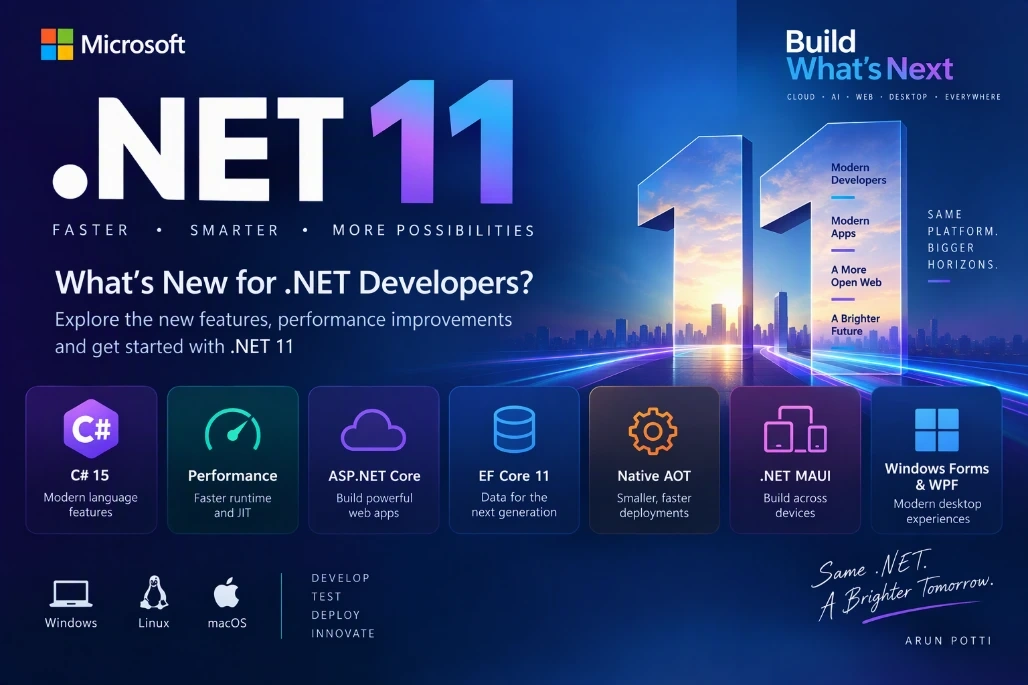
Microsoft has officially released.NET 11, bringing another major set of improvements to the .NET ecosystem.
.NET 11 was released on November 10, 2026, and is available for Windows, Linux, and macOS. The release includes improvements across the .NET Runtime, SDK, libraries, ASP.NET Core, Blazor, Entity Framework Core, .NET MAUI, Windows Forms, WPF, and the C# language.
For developers, .NET 11 continues Microsoft's focus on:
Better application performance
Improved developer productivity
Runtime efficiency
Modern cloud-native development
Native AOT
ASP.NET Core improvements
C# language enhancements
AI and modern application scenarios
In this article, let's explore some of the important features of .NET 11 and see how developers can get started.
.NET 11 at a Glance
The official .NET 11 downloads provide:
.NET SDK 11.0.100
.NET Runtime 11.0.0
ASP.NET Core Runtime 11.0.0
.NET Desktop Runtime 11.0.0
C# 15
F# 11
Visual Basic 17.13
It is also supported by Visual Studio 2026 version 18.12.
1. C# 15
One of the most interesting reasons for C# developers to explore .NET 11 is C# 15.
When your project targets:
XML
<TargetFramework>net11.0</TargetFramework>
C# 15 becomes the default C# language version.
This means developers can take advantage of the latest language improvements while targeting .NET 11.
For example, newer language capabilities can reduce boilerplate and make domain models easier to express while retaining compile-time type checking.
2. Runtime Async Improvements
One of the significant runtime areas being developed in .NET 11 is Runtime Async.
Traditionally, the C# compiler transforms an async method into a state machine.
For example:
C#
public async Task<string> GetDataAsync()
{
await Task.Delay(1000);
return "Hello from .NET 11";
}
Runtime Async moves more of the implementation of asynchronous methods into the runtime.
In .NET 11, Microsoft reports improvements including cleaner stack traces, reduced overhead, improved await paths, tiered compilation, and reduced warm-up allocations.
For developers building APIs and backend services with heavy asynchronous workloads, these improvements are particularly interesting.
3. JIT Performance Improvements
Performance continues to be an important area of investment in .NET 11.
The Just-In-Time compiler includes improvements involving:
Bounds-check elimination
Devirtualization
Redundant branch elimination
Switch-expression folding
Constant folding for
SequenceEqualHardware intrinsic improvements
.NET 11 additionally introduces new Arm SVE2 intrinsics and improvements to hardware-intrinsic cost modelling.
Many of these enhancements require little or no application-code change.
That is one of the nice things about runtime optimization: upgrading your framework can allow existing code to benefit from improvements made underneath it.
4. Native AOT Improvements
Native Ahead-of-Time compilation continues to evolve in .NET 11.
Native AOT compiles .NET applications directly into native machine code rather than depending entirely on JIT compilation at runtime.
Conceptually:
C# Code
↓
.NET Compilation
↓
Native AOT
↓
Native Executable
This approach can be attractive for workloads where startup time, deployment characteristics, and runtime overhead are important.
In .NET 11, Native AOT includes faster interface dispatch using a shared dispatch helper, which can reduce binary size at interface call sites and improve throughput for interface-heavy workloads.
5. ASP.NET Core Improvements
.NET 11 also brings improvements across ASP.NET Core.
For example, work leading into .NET 11 included support for OpenAPI 3.2, Web Worker project templates, native OpenTelemetry tracing, Blazor enhancements, and performance improvements.
This makes .NET 11 particularly relevant for developers building:
REST APIs
Microservices
Cloud-native applications
Blazor applications
Backend services
6. Entity Framework Core Improvements
Entity Framework Core continues evolving alongside .NET 11.
Join the conversation! Your thoughts help the community grow.