

Introduction
In the early days of Generative AI, "prompt engineering" was the silver bullet. If an LLM gave a wrong answer, we tweaked the prompt. We added "Think step-by-step," we defined roles like "You are a senior tax consultant," and we demanded specific output formats. For many tasks, this worked wonders. However, as enterprises move from playful chatbots to mission-critical systems like Tax Management Intelligence, relying solely on prompt engineering becomes a dangerous bottleneck. Tax management is a high-stakes domain. A hallucinated tax rate or a missed compliance deadline can result in severe financial penalties and legal repercussions. In this context, accuracy is not a feature; it is a requirement. When a tax AI fails, simply rewriting the prompt is often insufficient. The failure might stem from missing data (retrieval), inadequate reasoning capabilities (model), or poor architectural flow (state management).
This article explores the critical tipping point where prompt engineering stops helping and deeper architectural changes become necessary. We will build a complete, end-to-end Proof of Concept (POC) for a Tax Management Intelligence Copilot using LangGraph, RAG, and Multi-Agent Systems. This POC will demonstrate how to diagnose failures, implement robust retrieval, manage state across complex workflows, and decide when to upgrade your model or knowledge base instead of just your prompts.
Disclaimer: This POC is for educational purposes only. It uses synthetic tax data and does not constitute professional tax advice.
Understanding Prompt Engineering in Tax Management
Prompt engineering involves crafting inputs to guide an LLM toward desired outputs. In tax management, this might look like: "You are a tax expert. Answer the following question based ONLY on the provided context. Cite your sources."
This is effective for:
Formatting outputs (e.g., JSON vs. Markdown).
Setting tone (professional, cautious).
Basic instruction following.
When Prompt Engineering Stops Helping
There comes a point where no amount of prompt tweaking can fix the underlying issue. This happens when the problem is not how the model answers, but what it knows or how it finds information.
Example A — Prompt Engineering Can Help
Issue: The model provides a verbose, unstructured answer. Fix: Update prompt to: "Provide a bulleted list of 3 key considerations. Keep each point under 2 sentences." Result: Better format, same accuracy.
Example B — Retrieval Change Is Necessary
Issue: User asks about "Section 194A TDS rates." The system retrieves documents about "Section 194C" because the embedding model confused the semantic similarity of section numbers. Why Prompt Fails: You cannot prompt the model to know what it wasn't given. Fix: Improve chunking, use metadata filtering (section_id: 194A), or switch to a hybrid search (BM25 + Vector).
Example C — Model Change Is Necessary
Issue: The system retrieves the correct 50-page tax circular. The user asks to compare clauses 4.1 and 4.2 across three different years. The small LLM loses track of the context or fails to perform the logical comparison. Why Prompt Fails: The model lacks the reasoning depth or context window capacity. Fix: Upgrade to a larger model with better reasoning capabilities (e.g., GPT-4o, Claude 3.5 Sonnet) or use a specialized reasoning model.
Example D — Knowledge Base Change Is Necessary
Issue: User asks about a new tax amendment passed yesterday. The system says, "I don't have information on this." Why Prompt/Retrieval Fails: The document doesn't exist in the vector store. Fix: Update the ingestion pipeline to fetch real-time regulatory updates.
Diagnostic Decision Framework
When a tax AI fails, use this framework:
Failure Type | Symptoms | Diagnostic Question | Solution |
|---|---|---|---|
Prompt | Good info, bad format/tone | Did it get the facts right but look wrong? | Refine instructions, few-shot examples. |
Retrieval | Wrong/Hallucinated facts | Did it retrieve irrelevant docs? | Improve embeddings, chunking, metadata, reranking. |
Model | Logical errors, ignored context | Did it get the right docs but reason poorly? | Upgrade LLM, increase context window, use CoT. |
Knowledge | "I don't know" / Outdated | Is the info missing from the DB? | Update ingestion pipeline, add sources. |
Real-Time Enterprise Tax Management Use Case
Scenario: A tax analyst at a mid-sized bank needs to review a corporate client's cross-border transaction. Query: "A corporate customer has received interest income from a foreign subsidiary and is planning a dividend repatriation. Based on current Indian tax laws, what are the TDS implications, and what forms are required?"
System Goals:
Identify jurisdiction (India) and tax type (TDS, International Tax).
Retrieve relevant sections of the Income Tax Act and DTAA (Double Taxation Avoidance Agreement).
Analyze the transaction against retrieved rules.
Flag missing information (e.g., residency status, treaty benefits).
Provide a cited, compliant response.
Enterprise Multi-Agent Architecture
We use LangGraph to orchestrate specialized agents. This allows us to separate concerns: retrieval, analysis, compliance, and response generation.
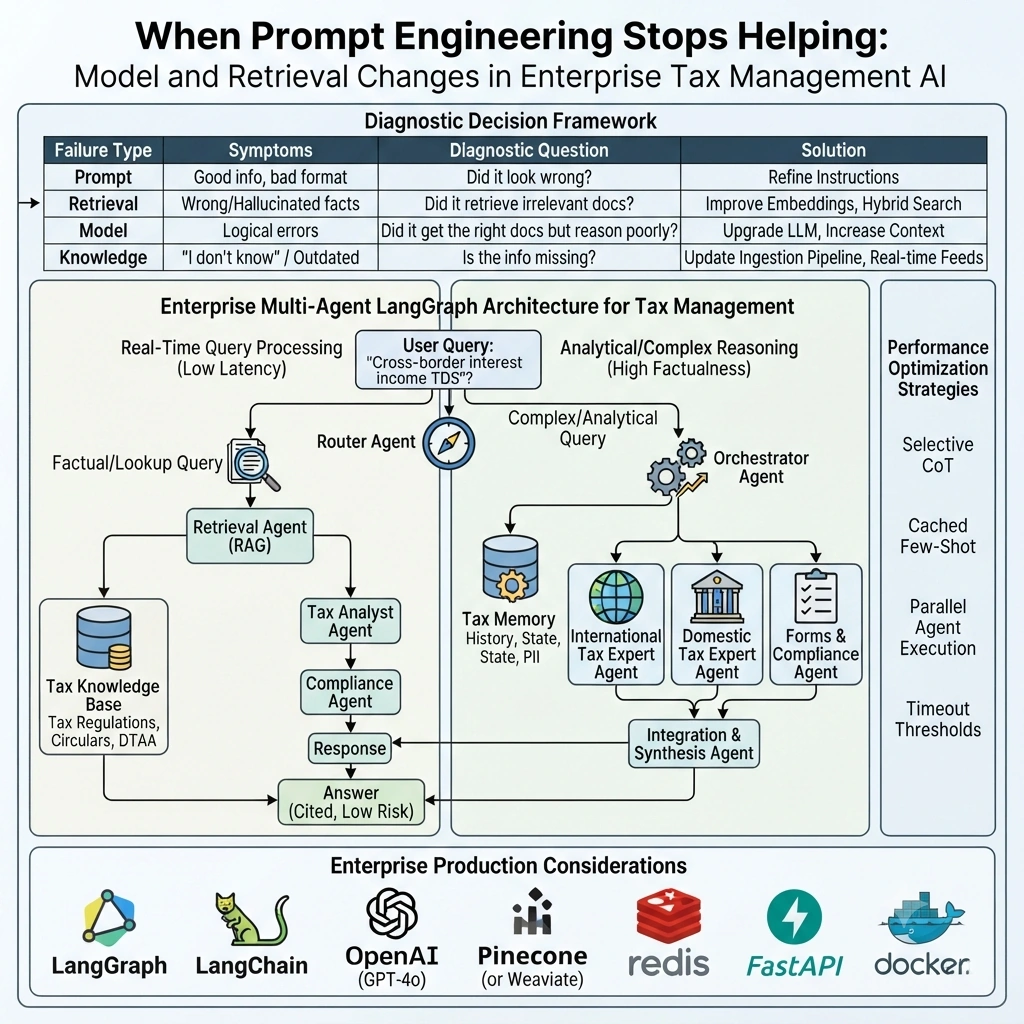
Agent Responsibilities
Intake Agent: Extracts entities (jurisdiction, tax year, entity type).
Classifier Agent: Determines if the query is factual, analytical, or requires human review.
Retrieval Agent: Queries the vector store with metadata filters.
Tax Analyst Agent: Reads retrieved docs and drafts an answer.
Compliance Agent: Checks for hallucinations and unsupported claims.
Response Agent: Formats the final output with citations.
Project Folder Structure
tax-management-ai/
│
├── backend/
│   ├── app/
│   │   ├── main.py
│   │   ├── config.py
│   │   ├── models/
│   │   │   ├── state.py
│   │   │   └── schemas.py
│   │   ├── agents/
│   │   │   ├── intake_agent.py
│   │   │   ├── classifier_agent.py
│   │   │   ├── retrieval_agent.py
│   │   │   ├── tax_analyst_agent.py
│   │   │   ├── compliance_agent.py
│   │   │   └── response_agent.py
│   │   ├── graph/
│   │   │   └── tax_graph.py
│   │   ├── rag/
│   │   │   ├── ingest.py
│   │   │   ├── retriever.py
│   │   │   └── embeddings.py
│   │   ├── memory/
│   │   │   └── checkpoint.py
│   │   └── data/
│   │       └── tax_policies/
│   ├── requirements.txt
│   └── .env.example
│
├── frontend/
│   ├── src/
│   │   ├── App.jsx
│   │   ├── components/
│   │   │   ├── ChatWindow.jsx
│   │   │   ├── SourcePanel.jsx
│   │   │   └── ReviewPanel.jsx
│   │   └── main.jsx
│   ├── package.json
│   └── index.html
│
└── README.md
Backend Implementation
1. Configuration (backend/app/config.py)
import os
from dotenv import load_dotenv

load_dotenv()

class Settings:
    OPENAI_API_KEY = os.getenv("OPENAI_API_KEY")
    MODEL_NAME = os.getenv("MODEL_NAME", "gpt-4o-mini")
    EMBEDDING_MODEL = os.getenv("EMBEDDING_MODEL", "all-MiniLM-L6-v2")
    CHROMA_PATH = os.getenv("CHROMA_PATH", "./chroma_db")
    DATABASE_URL = os.getenv("DATABASE_URL", "sqlite:///./tax_memory.db")

settings = Settings()
2. State Definition (backend/app/models/state.py)
LangGraph requires a typed state to pass data between nodes.
from typing import TypedDict, List, Optional, Annotated
from langgraph.graph import add_messages

class TaxState(TypedDict):
    messages: Annotated[list, add_messages]
    conversation_id: str
    user_query: str
    intent: Optional[str]
    jurisdiction: Optional[str]
    retrieved_documents: List[dict]
    analysis_draft: Optional[str]
    compliance_issues: List[str]
    final_response: Optional[str]
    citations: List[dict]
    needs_human_review: bool
    error: Optional[str]
3. RAG Ingestion (backend/app/rag/ingest.py)
We create synthetic tax documents for the POC.
from langchain_core.documents import Document
from langchain_text_splitters import RecursiveCharacterTextSplitter
from langchain_community.vectorstores import Chroma
from langchain_community.embeddings import HuggingFaceEmbeddings
import uuid

def create_synthetic_data():
    return [
        Document(
            page_content="Under Section 195 of the Income Tax Act, any person responsible for paying to a non-resident any sum chargeable under this Act shall deduct tax at source. The rate is determined by the Finance Act or DTAA.",
            metadata={"source": "Income Tax Act", "section": "195", "jurisdiction": "India", "type": "TDS"}
        ),
        Document(
            page_content="Form 15CA and 15CB are required for remittances to non-residents. Form 15CB is a certificate from a Chartered Accountant verifying the tax deduction.",
            metadata={"source": "RBI Guidelines", "section": "Remittance", "jurisdiction": "India", "type": "Compliance"}
        ),
        Document(
            page_content="Interest income received from a foreign subsidiary may be exempt under DTAA if the beneficial owner holds more than 10% equity. Refer to Article 11 of the India-US DTAA.",
            metadata={"source": "DTAA Guide", "section": "Article 11", "jurisdiction": "India-US", "type": "Exemption"}
        )
    ]

def ingest_documents():
    docs = create_synthetic_data()
    splitter = RecursiveCharacterTextSplitter(chunk_size=500, chunk_overlap=50)
    split_docs = splitter.split_documents(docs)

    embeddings = HuggingFaceEmbeddings(model_name="all-MiniLM-L6-v2")
    vector_store = Chroma.from_documents(
        documents=split_docs,
        embedding=embeddings,
        persist_directory="./chroma_db"
    )
    print("Documents ingested successfully.")
    return vector_store
4. Agents Implementation
Intake Agent (backend/app/agents/intake_agent.py)
from langchain_core.prompts import ChatPromptTemplate
from langchain_openai import ChatOpenAI
from app.config import settings

llm = ChatOpenAI(model=settings.MODEL_NAME, temperature=0)

intake_prompt = ChatPromptTemplate.from_template("""
Extract the jurisdiction and tax domain from the following query.
Query: {query}
Return JSON: {{"jurisdiction": "string", "domain": "string"}}
""")

def intake_node(state):
    chain = intake_prompt | llm
    response = chain.invoke({"query": state["user_query"]})
    # In production, use structured output parsing
    state["jurisdiction"] = "India" # Simplified for POC
    state["intent"] = "tax_inquiry"
    return state
Retrieval Agent (backend/app/agents/retrieval_agent.py)
from langchain_community.vectorstores import Chroma
from langchain_community.embeddings import HuggingFaceEmbeddings

def retrieval_node(state):
    embeddings = HuggingFaceEmbeddings(model_name="all-MiniLM-L6-v2")
    vector_store = Chroma(persist_directory="./chroma_db", embedding_function=embeddings)

    # Metadata filtering for better precision
    docs = vector_store.similarity_search(
        state["user_query"],
        k=3,
        filter={"jurisdiction": state.get("jurisdiction", "India")}
    )

    state["retrieved_documents"] = [
        {"content": d.page_content, "metadata": d.metadata} for d in docs
    ]
    return state
Tax Analyst Agent (backend/app/agents/tax_analyst_agent.py)
from langchain_core.prompts import ChatPromptTemplate
from langchain_openai import ChatOpenAI
from app.config import settings

llm = ChatOpenAI(model=settings.MODEL_NAME, temperature=0)

analyst_prompt = ChatPromptTemplate.from_template("""
You are a Senior Tax Analyst. Answer the user's question based ONLY on the provided context.
If the context is insufficient, state what information is missing.
Cite your sources using [Source Name].

Context:
{context}

Question: {question}

Answer:
""")

def analyst_node(state):
    context = "\n\n".join([doc["content"] for doc in state["retrieved_documents"]])
    chain = analyst_prompt | llm
    response = chain.invoke({
        "context": context,
        "question": state["user_query"]
    })
    state["analysis_draft"] = response.content
    return state
Compliance Agent (backend/app/agents/compliance_agent.py)
from langchain_core.prompts import ChatPromptTemplate
from langchain_openai import ChatOpenAI
from app.config import settings

llm = ChatOpenAI(model=settings.MODEL_NAME, temperature=0)

compliance_prompt = ChatPromptTemplate.from_template("""
Review the following tax advice for potential hallucinations or unsupported claims.
Does the answer cite specific sections or documents from the context?
If yes, return "PASS". If no, return "FAIL" and list the issues.

Answer: {answer}
Context: {context}
""")

def compliance_node(state):
    context = "\n\n".join([doc["content"] for doc in state["retrieved_documents"]])
    chain = compliance_prompt | llm
    response = chain.invoke({
        "answer": state["analysis_draft"],
        "context": context
    })

    if "FAIL" in response.content:
        state["needs_human_review"] = True
        state["compliance_issues"] = [response.content]
    else:
        state["needs_human_review"] = False

    return state
Response Agent (backend/app/agents/response_agent.py)
def response_node(state):
    if state["needs_human_review"]:
        state["final_response"] = "⚠️ This response requires human review due to compliance checks. Please consult a tax professional."
    else:
        state["final_response"] = state["analysis_draft"]

    # Extract citations for UI
    state["citations"] = state["retrieved_documents"]
    return state
5. LangGraph Workflow (backend/app/graph/tax_graph.py)
from langgraph.graph import StateGraph, END
from app.models.state import TaxState
from app.agents.intake_agent import intake_node
from app.agents.retrieval_agent import retrieval_node
from app.agents.tax_analyst_agent import analyst_node
from app.agents.compliance_agent import compliance_node
from app.agents.response_agent import response_node
from langgraph.checkpoint.sqlite import SqliteSaver

def build_graph():
    workflow = StateGraph(TaxState)

    workflow.add_node("intake", intake_node)
    workflow.add_node("retrieve", retrieval_node)
    workflow.add_node("analyze", analyst_node)
    workflow.add_node("compliance", compliance_node)
    workflow.add_node("respond", response_node)

    workflow.set_entry_point("intake")
    workflow.add_edge("intake", "retrieve")
    workflow.add_edge("retrieve", "analyze")
    workflow.add_edge("analyze", "compliance")
    workflow.add_edge("compliance", "respond")
    workflow.add_edge("respond", END)

    memory = SqliteSaver.from_conn_string(":memory:")
    app = workflow.compile(checkpointer=memory)
    return app

tax_app = build_graph()
6. FastAPI Endpoints (backend/app/main.py)
from fastapi import FastAPI, HTTPException
from pydantic import BaseModel
from app.graph.tax_graph import tax_app
from app.rag.ingest import ingest_documents
import uuid

app = FastAPI(title="Tax Management AI")

class ChatRequest(BaseModel):
    message: str
    conversation_id: str = None

@app.post("/api/tax/chat")
async def chat(request: ChatRequest):
    conv_id = request.conversation_id or str(uuid.uuid4())

    config = {"configurable": {"thread_id": conv_id}}

    try:
        result = tax_app.invoke(
            {"messages": [{"role": "user", "content": request.message}], "user_query": request.message},
            config=config
        )
        return {
            "conversation_id": conv_id,
            "response": result["final_response"],
            "citations": result["citations"],
            "needs_review": result["needs_human_review"]
        }
    except Exception as e:
        raise HTTPException(status_code=500, detail=str(e))

@app.post("/api/tax/ingest")
async def ingest():
    try:
        ingest_documents()
        return {"status": "success"}
    except Exception as e:
        raise HTTPException(status_code=500, detail=str(e))
Frontend Implementation frontend/src/App.jsx
import React, { useState } from 'react';
import './App.css';

function App() {
  const [input, setInput] = useState('');
  const [messages, setMessages] = useState([]);
  const [loading, setLoading] = useState(false);
  const [convId, setConvId] = useState(null);

  const sendMessage = async () => {
    if (!input.trim()) return;

    const userMsg = { role: 'user', content: input };
    setMessages([...messages, userMsg]);
    setInput('');
    setLoading(true);

    try {
      const res = await fetch('http://localhost:8000/api/tax/chat', {
        method: 'POST',
        headers: { 'Content-Type': 'application/json' },
        body: JSON.stringify({ message: input, conversation_id: convId }),
      });
      const data = await res.json();

      setConvId(data.conversation_id);
      setMessages(prev => [...prev, {
        role: 'assistant',
        content: data.response,
        citations: data.citations,
        review: data.needs_review
      }]);
    } catch (err) {
      console.error(err);
    } finally {
      setLoading(false);
    }
  };

  return (
    <div className="app-container">
      <h1>Tax Management Copilot</h1>
      <div className="chat-window">
        {messages.map((msg, idx) => (
          <div key={idx} className={`message ${msg.role}`}>
            <p>{msg.content}</p>
            {msg.citations && msg.citations.length > 0 && (
              <div className="citations">
                <strong>Sources:</strong>
                <ul>
                  {msg.citations.map((cite, i) => (
                    <li key={i}>{cite.metadata.source} - {cite.metadata.section}</li>
                  ))}
                </ul>
              </div>
            )}
            {msg.review && <div className="warning">⚠️ Requires Human Review</div>}
          </div>
        ))}
        {loading && <div className="loading">Analyzing tax regulations...</div>}
      </div>
      <div className="input-area">
        <input
          value={input}
          onChange={(e) => setInput(e.target.value)}
          placeholder="Ask about TDS, GST, or compliance..."
        />
        <button onClick={sendMessage} disabled={loading}>Send</button>
      </div>
    </div>
  );
}

export default App;
Running the Application
Backend:
cd backend
pip install -r requirements.txt
python -m uvicorn app.main:app --reload
Ingest Data:
curl -X POST http://localhost:8000/api/tax/ingestFrontend:
cd frontend
npm install
npm run dev
Real-Time POC Demonstration
User: "A corporate customer has received interest income from a foreign subsidiary. What are the TDS implications?"
Intake Agent: Identifies jurisdiction as "India" (default) and domain as "International Tax".
Retrieval Agent: Fetches documents on Section 195 and DTAA Article 11.
Analyst Agent: Drafts response: "Under Section 195, TDS is applicable. However, if the subsidiary is in a treaty country, reduced rates may apply per DTAA."
Compliance Agent: Checks if citations are present. Finds references to Section 195. Passes.
Response Agent: Returns formatted answer with citations.
Follow-up: "What forms are required?"
State Management: LangGraph retains the previous context. The system knows we are discussing the same transaction.
Retrieval: Fetches Form 15CA/15CB docs.
Response: "You need Form 15CA and a CA certificate in Form 15CB."
Evaluation Framework
To determine if prompt engineering is enough, measure:
Retrieval Precision@K: Are the top 3 documents relevant? If < 80%, improve embeddings/chunking.
Faithfulness: Does the answer contain facts not in the context? If yes, improve the compliance agent or model.
Latency: If CoT prompting adds > 2 seconds, consider a faster model or parallel agent execution.
Enterprise Production Considerations
Security: Implement OAuth2/JWT for API access. Encrypt PII in the database.
Scalability: Move from SQLite to PostgreSQL with pgvector. Use Redis for session state.
Observability: Integrate LangSmith to trace agent steps and debug failures.
Governance: Version control your tax documents. Implement a human-in-the-loop approval workflow for high-risk answers.
Limitations
This POC uses synthetic data. Real tax law is complex and jurisdiction-specific.
The LLM may still hallucinate if the retrieval fails silently.
Not a substitute for professional tax advice.
Conclusion
Prompt engineering is a powerful tool, but it is not a panacea. In enterprise tax management, the cost of error is too high to rely on prompts alone. By building a multi-agent system with LangGraph, we can isolate failures: if retrieval is poor, we fix the vector store; if reasoning is weak, we upgrade the model; if compliance is risky, we add guardrails. This architectural approach ensures that our AI copilot is not just smart, but also safe, accurate, and auditable. The next step is to integrate real-time regulatory feeds and rigorous evaluation pipelines to evolve this POC into a production-grade platform.
Join the conversation! Your thoughts help the community grow.