Why AI-Agentic Penetration Testing May Be Preferred Over Breach and Attack Simulation in 2027
A practical, evidence-led guide to the differences, business value, limitations and future of continuous security validation
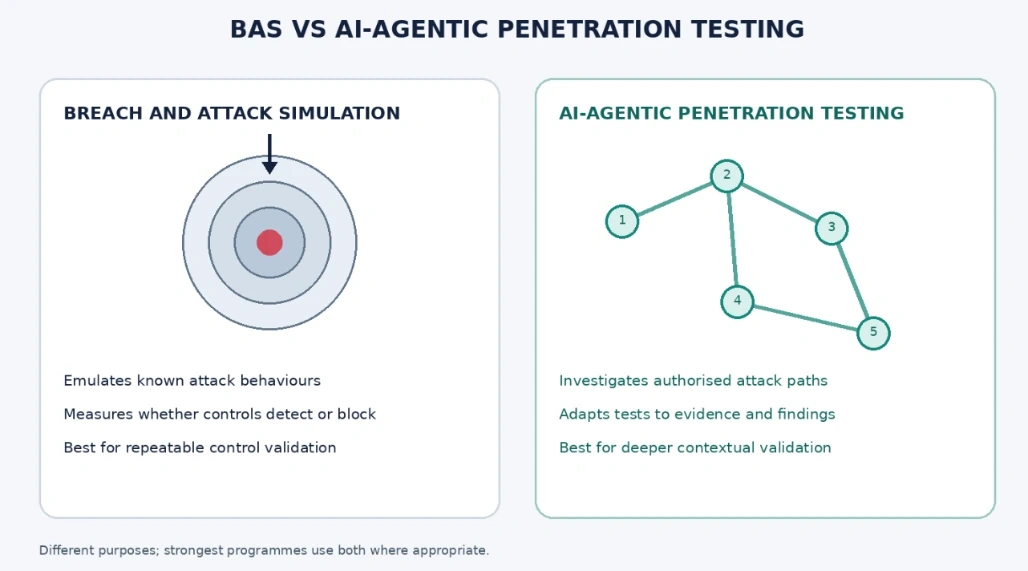
Figure 1. BAS validates control behaviour; agentic penetration testing aims to investigate contextual attack paths. Capabilities vary by product and implementation.
By 2027, security leaders are likely to ask a more demanding question than “Did our controls detect the test?” They will also ask, “Can an attacker combine weaknesses across identities, cloud services, applications and data to reach something that matters?” Breach and Attack Simulation (BAS) remains useful for repeatable, safe and measurable checks of defensive controls. AI-agentic penetration testing can add value by planning and adapting a sequence of authorised tests, following evidence, and validating whether individual weaknesses form a meaningful attack path. The strongest strategy is not to declare BAS obsolete. It is to use BAS for broad, repeatable control validation and agentic testing for deeper, contextual investigation—with human oversight and explicit guardrails.
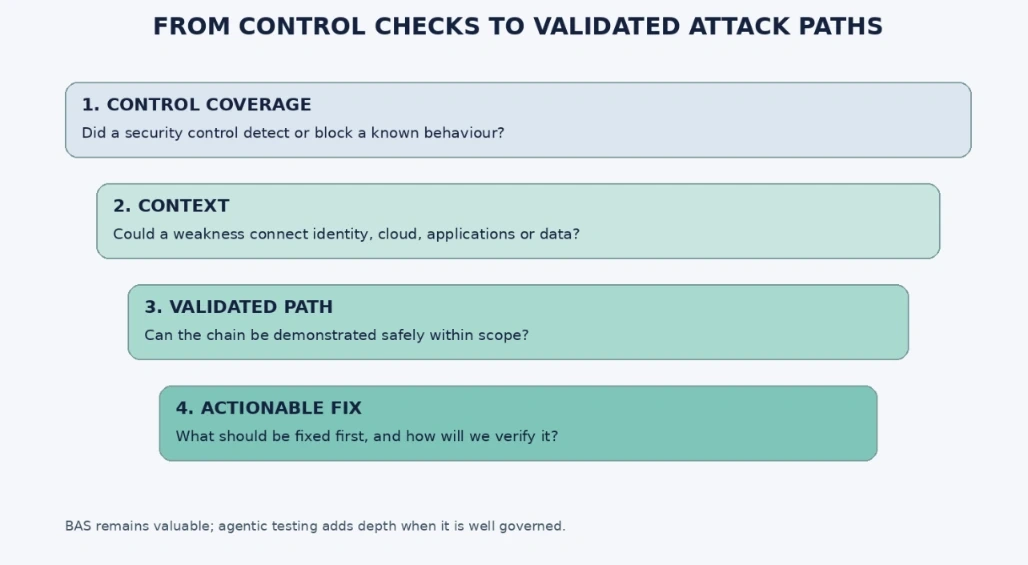
1. The 2027 shift: from checking controls to understanding attack pathsCybersecurity environments are increasingly connected. An exposed service may be low risk in isolation, while a misconfigured identity, weak application permission or cloud trust relationship can turn it into a route toward sensitive data. Traditional security testing methods each see part of the picture. BAS typically executes curated attack behaviours to measure whether controls prevent, detect or respond as expected. Penetration testing investigates exploitable weaknesses and impact within a defined scope. Agentic AI introduces a way to coordinate parts of that investigative process: an AI agent can reason over collected evidence, choose from permitted next steps, and adjust its plan when results change.
This does not mean an agent is automatically more accurate than an experienced tester. The term “agentic” is meaningful only when the system can pursue a goal through multiple steps, use tools within constraints, react to results and maintain a traceable decision process. A product that simply runs a fixed script with an AI label is still largely automation.
2. What is Breach and Attack Simulation (BAS)?BAS platforms emulate selected attacker techniques and scenarios to test the effectiveness of security controls. Depending on the platform and configuration, tests may cover endpoint detection and response, email security, network controls, identity controls, cloud controls or security operations workflows.
Typical BAS strengths include:
Repeatability: run the same scenario after a policy, agent, rule or configuration change.
Coverage measurement: identify which simulated techniques were detected, blocked, alerted on or missed.
Operational safety: use curated simulations designed to avoid destructive impact.
Trend reporting: compare results over time and communicate control performance.
Continuous assurance: schedule tests more frequently than traditional point-in-time assessments.
BAS is particularly useful when a team needs consistent answers about control effectiveness. However, a simulation result alone does not always prove that a complete, multi-step route to a business asset is exploitable. That depends on the scenario, integrations, telemetry and the product’s scope.
3. What is AI-agentic penetration testing?AI-agentic penetration testing uses AI agents to plan, execute and adapt a sequence of authorised security tests within a defined rules-of-engagement framework. A mature implementation may combine asset discovery, attack-surface mapping, hypothesis generation, tool execution, evidence collection, risk ranking and retesting. The agent should not be treated as an unrestricted autonomous attacker: scope controls, permission boundaries, rate limits, logging, approval gates and stop conditions are essential.
A credible agentic workflow should be able to:
Use context from the environment rather than relying only on a fixed list of scenarios.
Form and revise hypotheses as evidence is collected.
Connect findings across systems where the authorised scope and integrations permit it.
Validate impact with the least intrusive proof possible.
Explain the evidence behind a finding and preserve a reproducible audit trail.
Escalate uncertain, sensitive or potentially disruptive actions to a human operator.
4. BAS vs AI-agentic penetration testing: complete comparisonDimension | Breach and Attack Simulation (BAS) | AI-agentic penetration testing |
Primary question | Did a security control detect, block or respond to a simulated behaviour? | Can weaknesses be chained into a meaningful, in-scope attack path? |
Core approach | Runs curated or configured simulations and measures outcomes. | Plans and adapts a multi-step investigation based on evidence and permitted tools. |
Test logic | Often scenario-driven and repeatable; breadth depends on the scenario library. | Potentially dynamic: next action can change based on discoveries and results. |
Context awareness | Varies; typically strongest within configured control and telemetry integrations. | Can correlate identity, application, cloud and network context when data and permissions are available. |
Attack-path validation | May simulate steps, but may not prove end-to-end exploitability in every deployment. | Designed to investigate and validate plausible paths; actual depth varies by product. |
Control effectiveness | Core strength: measure detection, prevention and response coverage. | Can test controls during a broader investigation, but may not provide BAS-style coverage metrics. |
Repeatability | Usually strong for recurring baseline tests and regression checks. | Can be repeatable with saved plans, versions and guardrails; adaptive paths may vary. |
Breadth of routine checks | Often strong for large libraries of known techniques and scheduled runs. | Breadth depends on agent skills, tools, model quality, integrations and safe execution limits. |
Novel combinations | Limited to the scenarios and logic configured or supported. | May discover combinations not explicitly scripted, if reasoning and tool access are effective. |
Proof of impact | Often reports whether a simulated action triggered a control. | May collect evidence that a chain reaches a defined asset or privilege boundary, where safely possible. |
False positives | Can produce clear results for deterministic tests; configuration and telemetry still matter. | Requires careful evidence verification; model reasoning can introduce errors or unsupported conclusions. |
False negatives | Can miss behaviours outside the selected scenarios or integrations. | Can miss paths because of incomplete context, tool limits, model errors or conservative guardrails. |
Safety profile | Usually designed around controlled simulations; risk depends on test configuration. | Requires strict permissions, action boundaries, approvals, rate limits and rollback/stop mechanisms. |
Human oversight | Operators select scenarios, configure tests and interpret results. | Humans define scope and policy, supervise sensitive actions and validate conclusions. |
Output | Control coverage, technique results, detections, gaps and trends. | Evidence-backed findings, attack paths, impact hypotheses, remediation priorities and retest results. |
Best-fit use case | Continuous control validation and repeatable assurance. | Deeper investigation of contextual weaknesses and end-to-end exposure. |
Operational fit | SOC engineering, detection engineering, security assurance and compliance reporting. | Red teams, penetration testers, exposure management and security engineering. |
Buying consideration | Scenario coverage, integrations, safety, reporting and repeatability. | Quality of reasoning, tool transparency, exploit verification, guardrails, auditability and human control. |
Not a substitute for | Full-scope penetration testing, architecture review or threat modelling in every case. | Expert human judgment, formal authorisation, specialist testing and well-designed BAS control checks. |
Best combined value | Provides recurring baseline and control-level measurement. | Investigates the contextual paths behind high-priority gaps and helps verify remediation. |
Important qualification: capabilities vary widely between vendors. This table describes common approaches and intended strengths, not a guarantee that every BAS or agentic-testing product behaves this way.
5. Why agentic testing may gain preference in 20275.1 It can investigate chains, not just isolated signals
A single misconfiguration rarely tells the whole story. An agentic workflow can attempt to connect an exposed application, a weak identity boundary and an over-permissioned cloud role—only where each test is authorised and safe. The resulting evidence may help teams prioritise the chain that creates the greatest business exposure, rather than treating every finding as an independent ticket.
5.2 It can adapt when the environment changes
When a test discovers that a path is blocked, a well-designed agent may explore another permitted route or stop and report why the hypothesis failed. This adaptive loop can be more useful than rerunning a fixed scenario when the goal is investigation. The benefit depends on the quality of reasoning, tools, data and boundaries—not simply on using a large language model.
5.3 It can make findings more actionable
A control alert tells the team what happened in a test. A validated attack path can add context: which prerequisite enabled the next step, what business asset was at risk, what evidence supports the conclusion and which remediation would break the chain. This can help security teams rank remediation by practical exposure, while avoiding claims of impact that the evidence does not support.
5.4 It may help reduce manual investigation effort
Agents can automate parts of repetitive reconnaissance, hypothesis testing, evidence collation and retesting. This may free skilled testers to focus on complex decisions and unusual cases. Organisations should measure actual time saved, analyst review effort, false-positive rate and coverage before assuming a productivity gain.
5.5 It aligns with continuous exposure validation
Security changes constantly: new cloud assets appear, permissions drift, applications ship and identity relationships evolve. Agentic testing can complement continuous exposure management by investigating the most consequential changes, while BAS repeatedly measures whether defensive controls still work.
 6. Example: the same weakness, two different questions
Imagine a company has a cloud-hosted customer portal, single sign-on, several service identities and a sensitive reporting database.
What BAS might answer
A configured simulation attempts a known behaviour associated with credential misuse or suspicious endpoint activity. The BAS platform records whether the relevant controls blocked it, detected it or raised the expected alert. The result helps the team tune detection and response.
What agentic penetration testing might investigate
Within a signed scope, the agent maps the portal and permitted identity context, identifies a potential access-control weakness, tests whether that weakness exposes a service identity, and checks whether the identity has an unintended route to the reporting database. It stops if the next step is out of scope or could cause disruption, and records evidence for human review.
The key difference is not that one is “AI” and the other is not. It is the question being answered: control performance versus contextual exploitability. In this example, BAS can show whether controls detect a behaviour; agentic testing may help determine whether the weakness connects to a material business asset.
7. Governed agentic pentesting flowchart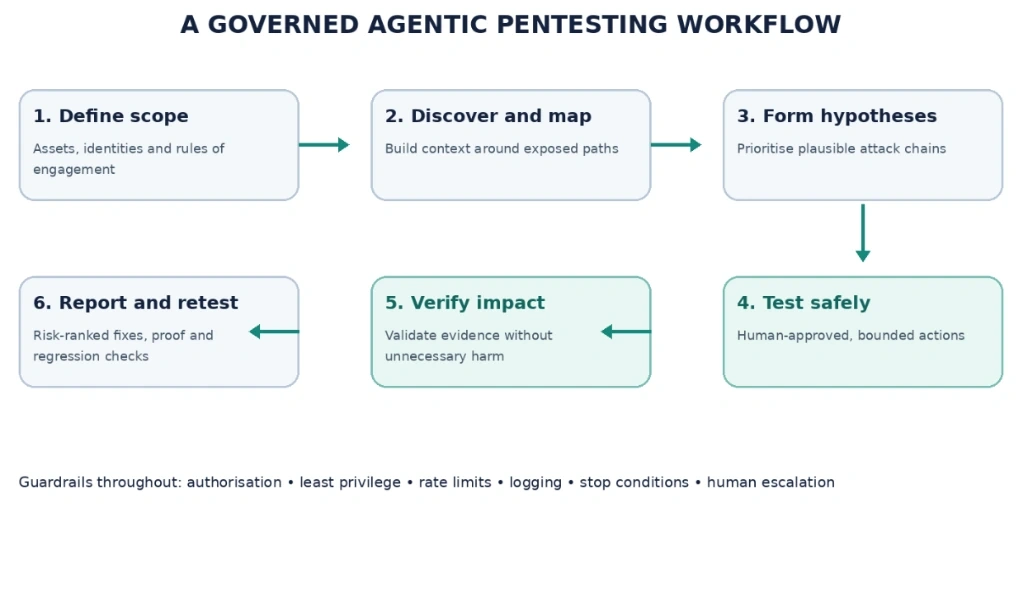
Figure 3. A safe operating model for agentic penetration testing. Authorisation, logging and stop conditions should apply throughout the workflow.
8. The value for CISOs, security teams and the businessStakeholder | Potential business value |
For the CISO | More context for risk decisions; clearer evidence linking technical weaknesses to business assets; a way to focus remediation on validated paths. |
For SOC and detection engineering | BAS remains the repeatable measurement layer; agentic testing can provide additional scenarios and context to investigate gaps. |
For red teams and penetration testers | Automation can accelerate selected tasks while experts govern scope, validate evidence and handle complex edge cases. |
For cloud and application teams | Potentially clearer dependencies between misconfigurations, identity permissions, application flaws and sensitive data. |
For audit and assurance | Traceable scope, test logs, evidence, approvals and retest records can support assurance. They do not automatically prove regulatory compliance. |
For finance and operations | A risk-based view may help avoid treating every finding equally; actual cost savings should be measured, not assumed. |
9. Limitations and risks: agentic does not mean infallibleHallucinated or weakly supported findings: every important claim needs evidence and human validation.
Unsafe actions: tool access must be limited; destructive actions, persistence, data exfiltration and out-of-scope activity should be prohibited unless explicitly authorised under a carefully controlled engagement.
Incomplete visibility: missing credentials, telemetry, APIs or integrations can make paths invisible.
Model and tool drift: updates may change results, so versions, prompts/policies and test conditions should be recorded.
Prompt injection and untrusted content: data encountered during testing must not be allowed to override the rules of engagement.
Compliance and privacy: define data handling, retention, residency, access control and audit requirements before testing.
Overclaiming autonomy: a product should disclose which steps are autonomous, which are scripted, and where human approval is required.
A responsible programme treats the agent as a constrained testing system—not as an independent authority. Use written authorisation, explicit asset scope, least privilege, non-production validation where possible, emergency stop controls, and an accountable human owner.
10. A practical adoption model for 2027Keep BAS for repeatable control checks. Establish a baseline for the controls that matter most and schedule regression tests after meaningful changes.
Pilot agentic testing on a narrow, well-understood scope. Choose a non-critical environment or an explicitly approved set of assets.
Set success metrics before the pilot. Examples: percentage of findings supported by reproducible evidence, time to validate a high-risk path, analyst review time, false-positive rate, out-of-scope action count (target: zero), and remediation retest success.
Require transparent evidence. Every high-severity finding should include the path, prerequisites, proof, limitations and remediation logic.
Keep humans in the loop for sensitive actions. Define approval gates for privilege changes, production-impacting tests, access to regulated data and ambiguous outcomes.
Integrate findings into existing workflows. Route verified issues to ticketing, vulnerability management, cloud security and detection engineering processes.
Review quarterly. Compare the cost and coverage of BAS and agentic testing against actual outcomes, not vendor claims.
11. How to evaluate an agentic pentesting platformDoes it demonstrate multi-step planning and adaptation, or mainly execute prewritten playbooks?
Can it show the evidence behind each conclusion and reproduce the test?
Can it enforce scope, identity permissions, rate limits, approval gates and stop conditions technically?
How does it prevent untrusted page content or prompt injection from changing its instructions?
Which environments are genuinely supported: external attack surface, web applications, APIs, identity, cloud, endpoints, containers or internal networks?
Can it avoid destructive activity and protect sensitive data by design?
Can findings be exported to the organisation’s ticketing, SIEM, exposure-management and reporting systems?
What are the measured false-positive and false-negative rates for the organisation’s use cases?
Can the vendor explain model/tool versions, audit logs, data retention, hosting, data residency and access controls?
What requires human approval, and what actions can the system take without one?
12. The strongest strategy is BAS + agentic testingIt is tempting to frame new security technology as a replacement for everything that came before it. That is usually the wrong decision framework. BAS and AI-agentic penetration testing address overlapping but different needs. BAS is well suited to recurring, standardised checks of defensive control behaviour. Agentic testing is promising for contextual investigation and the validation of multi-step paths. Together, they can create a more complete validation cycle.
A practical operating rhythm could look like this: BAS runs continuously or on a schedule to check control coverage; exposure and configuration tools surface changes; agentic testing investigates selected high-risk paths; human testers review material findings; remediation teams fix root causes; BAS and targeted retesting verify the improvement.
13. Conclusion: what security leaders should expect in 2027The likely shift in 2027 is not from BAS to agentic pentesting as a simple either-or choice. It is from isolated security checks toward evidence-backed understanding of exposure. As agentic systems mature, organisations may increasingly prefer them for questions that require contextual reasoning, adaptive test planning and multi-step attack-path validation. BAS will continue to matter wherever repeatability, control coverage and consistent regression testing are priorities.
The winning approach is therefore straightforward: keep measuring whether your controls work, and add governed agentic testing to investigate whether weaknesses can combine into real business risk. Buy based on verified capabilities, evidence quality, safety and outcomes not on the word “agentic” in a product description.


Join the conversation! Your thoughts help the community grow.