

The Hidden Problem Developers Are Discovering with Claude
Developers love Claude for its reasoning, architecture analysis, large context handling, and repository understanding. As a matter of fact, many developers are building full fledged complex data driven applications using Claude Code. And now with Claude Design, Claude becomes a go to tool for many founders and creative business owners who can quickly design websites and apps.
However, many developers eventually encounter the same painful realization:
Claude can consume a massive number of tokens.
For individual developers, this may simply feel expensive. For startups and enterprises running AI workflows at scale, token costs can quickly become a serious operational concern.
Teams are increasingly asking:
Why does Claude consume so many tokens?
Why are costs suddenly exploding?
Why are large repositories expensive?
How can we reduce AI usage costs?
How should we structure prompts?
How should repositories be optimized for AI systems?
These are no longer small developer questions. They are becoming architectural questions. As AI native software development grows, token optimization is rapidly becoming an entirely new engineering discipline.
What Are Tokens?
Before understanding why Claude consumes so many tokens, it is important to understand what tokens actually are.
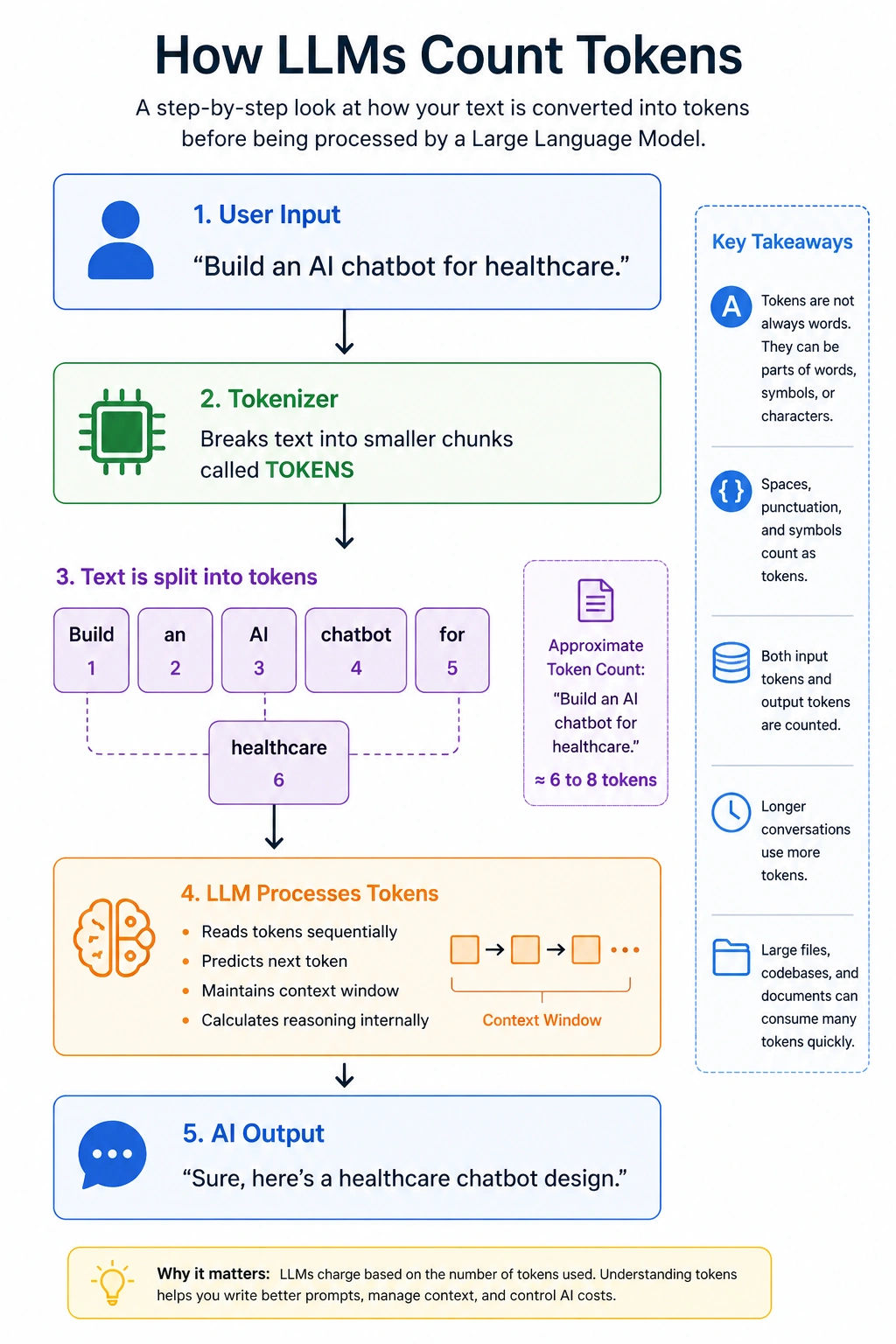
AI systems do not process text exactly the way humans read language. Instead, they break text into smaller units called tokens.
A token may represent:
Part of a word
A full word
Symbols
Spaces
Code syntax
Numbers
JSON structures
For example:
“Build an authentication API”
may become multiple tokens internally.
Code consumes tokens especially quickly because programming syntax contains:
Symbols
Indentation
File structures
Imports
Variables
Configuration data
Large repositories can easily generate enormous token counts.
Important Things About Tokens
1. Tokens Are NOT Words
One word can become multiple tokens.
Example:
"AuthenticationService"may become:
"Authentication"
"Service"
or even smaller chunks.
Code consumes tokens much faster than plain English.
2. Spaces and Symbols Count Too
These all consume tokens:
{ } ( ) [ ] ; : < >That’s why codebases become expensive quickly.
3. Input + Output Both Count
If you send:
50,000 input tokens
and receive 10,000 output tokens
Total usage becomes:
60,000 tokens4. Conversation History Also Counts
LLMs often resend previous context internally.
Long chats dramatically increase token usage.
5. Large Repositories Explode Token Counts
Sending:
logs
configs
APIs
dependencies
multiple files
can quickly exceed hundreds of thousands of tokens.
Simple Token Example
Sentence:
"The quick brown fox jumps over the lazy dog"

Possible Tokens:
["The", " quick", " brown", " fox", " jumps",
 " over", " the", " lazy", " dog"]

≈ 9 tokens
Why This Matters for AI Costs
LLMs charge based on:
Input tokens
Output tokens
Context size
Reasoning complexity
This is why:
Large prompts
AI agents
Repository analysis
Long memory systems
can become expensive very quickly.
Here is a diagram that shows how LLMs count tokens.
Why Claude Consumes More Tokens Than Expected
The biggest reason Claude consumes large numbers of tokens is simple:
Claude is designed to understand large contexts. That is one of its biggest strengths.
Claude can process:
Large repositories
Multiple files
Long conversations
Large documents
Technical architectures
Complex workflows
However, context is expensive. Every additional piece of information sent to Claude increases token usage.
Developers often accidentally send:
Entire repositories
Large logs
Repeated prompts
Duplicate instructions
Huge documentation files
Long conversation histories
This dramatically increases costs.
The Real Cost Explosion Happens in AI Native Development
Traditional software tools usually process only small amounts of information at a time. AI native systems work differently.
Modern AI workflows increasingly involve:
Multi file analysis
Repository indexing
Long memory systems
AI agents
Workflow orchestration
Retrieval systems
Persistent context
Technical planning
Every layer adds more tokens. This becomes especially expensive when teams run:
Autonomous coding agents
AI powered customer support
AI document analysis
Multi agent systems
Enterprise workflows
Continuous AI pipelines
The result is that AI infrastructure costs can scale rapidly without optimization.
Why Large Context Windows Create Bigger Costs
One of Claude’s biggest advantages is its large context window.
That allows Claude to:
Understand large repositories
Analyze architecture
Maintain long conversations
Process multiple documents
Retain technical context
But large context windows also encourage developers to send more information than necessary. Many developers mistakenly assume:
“More context always produces better results.”
That is not always true.
Excessive context often creates:
Higher costs
Slower responses
More noise
Lower focus
Reduced reasoning quality
Context engineering is becoming critically important.
The Biggest Token Mistakes Developers Make
1. Sending Entire Repositories
One of the most common mistakes is sending massive codebases unnecessarily.
Developers often paste:
Entire projects
Full directories
Large logs
Huge configuration files
even when Claude only needs a small portion. This can generate enormous token consumption.
2. Repeating Instructions Constantly
Many prompts repeatedly include:
Coding standards
Architecture instructions
Team rules
Style preferences
This duplication adds unnecessary costs.
3. Long Chat Histories
Developers frequently keep extremely long conversations alive. Every previous interaction may continue consuming tokens because Claude maintains conversational context. Over time, this becomes expensive.
4. Poor Prompt Structure
Messy prompts often force AI systems to process unnecessary information. Unclear prompts may also require multiple retries, increasing usage further.
5. Sending Large Generated Outputs Back Into Context
One overlooked issue is repeatedly feeding AI generated outputs back into future prompts. This creates compounding token growth over time.
Why Claude.md Files Matter
One of the most important emerging practices in AI native development is the use of Claude.md files.
Claude.md files help centralize:
Coding conventions
Repository rules
Architectural standards
Team expectations
Workflow guidelines
Instead of repeating these instructions constantly, developers can maintain structured reusable context. This significantly improves:
Consistency
Prompt quality
Token efficiency
Repository understanding
Claude.md files are quickly becoming a major best practice in AI assisted engineering.
How to Reduce Claude Token Costs
1. Use Smaller Contexts
Do not send entire repositories unless absolutely necessary.
Instead:
Send only relevant files
Use modular prompts
Limit unnecessary logs
Focus context around specific tasks
Smaller focused prompts often produce better results.
2. Use Retrieval Instead of Massive Prompts
Modern AI systems increasingly use retrieval architectures.
Instead of sending everything into context:
Store documents in vector databases
Retrieve only relevant sections
Dynamically inject needed information
This dramatically reduces token usage. This approach is commonly known as Retrieval Augmented Generation (RAG).
3. Summarize Long Conversations
Long conversations accumulate token costs rapidly. Instead of preserving entire histories:
Summarize previous discussions
Compress context
Retain only critical decisions
Store memory separately
This significantly reduces usage.
4. Build Better Repository Structure
AI systems perform better with organized repositories. Well structured systems reduce unnecessary context overhead.
Helpful practices include:
Modular architecture
Clear naming conventions
Service separation
Smaller focused files
Better documentation
AI native architecture is becoming increasingly important.
5. Optimize Claude.md Files
Well designed Claude.md files can reduce repetitive prompting dramatically. A good Claude.md should include:
Coding standards
Repository structure
Architectural principles
Workflow expectations
Team conventions
But avoid excessive detail. Large Claude.md files themselves can become token heavy.
6. Use Specialized AI Workflows
Not every task requires the most advanced model or largest context. Many workflows can use:
Smaller models
Shorter prompts
Specialized agents
Lightweight reasoning systems
This is becoming a major AI cost optimization strategy.
Context Engineering Is Becoming a New Discipline
One of the most important emerging concepts in AI development is context engineering. Context engineering focuses on:
What information AI receives
When information is injected
How memory is structured
How workflows maintain reasoning
How agents coordinate information
This may become one of the most important software engineering disciplines of the AI era. The companies that master context engineering may gain enormous productivity advantages.
AI Agents Can Increase Token Costs Dramatically
AI agents introduce another major challenge.
AI agents often:
Think step by step
Maintain memory
Use tools repeatedly
Analyze repositories continuously
Generate internal reasoning
Coordinate workflows
This creates compounding token usage. Without optimization, autonomous systems can become extremely expensive at scale. Future AI architectures will require careful orchestration and governance.
Enterprise AI Costs Are Becoming a Strategic Concern
Large organizations are increasingly deploying AI across:
Engineering
Customer support
Operations
Analytics
Security
Internal productivity
As usage grows, token costs become operational infrastructure costs similar to:
Cloud hosting
GPU usage
Database scaling
Storage systems
AI optimization is becoming a business level concern, not just a developer concern.
Why This Problem Will Get Bigger
AI systems are becoming more autonomous. Future systems may involve:
Persistent memory
Continuous agents
Autonomous workflows
AI operating systems
Multi agent orchestration
Long running reasoning systems
This means token optimization will become even more important over time. The future winners in AI may not simply have the smartest models. They may instead build the most efficient AI infrastructure.
The Future of AI Development
The rise of token optimization signals something much larger. Software engineering itself is evolving. Developers are no longer simply writing software. They are increasingly orchestrating intelligent systems. Future engineering workflows may focus heavily on:
Context design
AI orchestration
Agent management
Memory systems
Retrieval architectures
Governance
AI observability
This represents a major shift in software development.
Final Thoughts
Claude’s large token usage is not a flaw. It is often the direct result of its strongest capability:
deep contextual reasoning.
However, developers and enterprises must learn how to manage AI systems efficiently. The future of AI native development will require:
Smarter prompts
Better context management
Retrieval systems
Memory optimization
Efficient workflows
AI governance
The developers and organizations that master these practices early may gain a significant competitive advantage in the AI era.
Here are some tips: Stop Burning Your AI Tokens: Top 25 Ways To Reduce LLM Token Costs
Build AI Native Systems with Mindcracker and C# Corner
Organizations worldwide are rapidly adopting AI powered engineering workflows. If your company is exploring:
AI agents
Enterprise AI systems
Conversational AI
AI native architecture
Context engineering
Retrieval systems
Blockchain platforms
Cloud modernization
the teams at Mindcracker and C# Corner can help design and build scalable intelligent AI platforms optimized for performance, governance, and cost efficiency.
From AI architecture to enterprise modernization, we help organizations build the next generation of intelligent software systems.
Join the conversation! Your thoughts help the community grow.