

As Agentic AI transitions from experimental proof-of-concepts to mission-critical production systems, the choice of orchestration framework dictates the success or failure of the deployment. While frameworks like AutoGen and CrewAI have democratized multi-agent development, LangGraph has emerged as the definitive standard for complex, stateful, and highly regulated workflows.
This article provides an end-to-end comparative analysis of these three leading frameworks and details exactly why LangGraph is the superior architectural choice for a high-stakes, low-latency use case: Real-Time Financial Fraud Detection.
The Agentic Landscape: A Head-to-Head Comparison
To understand why a specific framework is chosen, we must first dissect the philosophical and architectural differences between the top contenders.
| Feature | LangGraph | AutoGen | CrewAI |
|---|---|---|---|
| Core Paradigm | Stateful, graph-based orchestration (Nodes & Edges) | Conversational, multi-agent chat and autonomous problem-solving | Role-playing, task-oriented, hierarchical team collaboration |
| Control Flow | Highly deterministic, supports cyclic graphs and explicit state transitions | Emergent, dynamic, conversation-driven (can be unpredictable) | Sequential or hierarchical, optimized for linear task completion |
| State Management | First-class citizen (StateGraph, typed schemas, persistent memory) | Implicit (via chat history) or custom memory mechanisms | Shared task output and agent memory, but less granular than LangGraph |
| Human-in-the-Loop (HITL) | Native, granular breakpoints and approval workflows | Possible, but requires custom conversational scaffolding | Supported via task delegation, but less seamless for real-time interruption |
| Best Use Case | Production systems requiring auditability, strict state control, and complex branching (e.g., Finance, Healthcare) | Brainstorming, complex coding tasks, open-ended research, and dynamic negotiation | Content generation, marketing workflows, and well-defined sequential research tasks |
| Learning Curve | Moderate to Steep (requires understanding graph theory and state schemas) | Moderate (requires managing conversational dynamics and termination conditions) | Low (highly abstracted, intuitive API for defining roles and tasks) |
The Deep Dive
CrewAI excels at making AI feel like a managed workforce. Its strength lies in its simplicity and role-based abstraction. However, this abstraction becomes a liability when you need fine-grained control over execution paths, error handling, or state mutation.
AutoGen (backed by Microsoft) is a powerhouse for emergent, conversational problem-solving. It allows agents to debate and iterate autonomously. Yet, this "emergent" nature makes it notoriously difficult to bound, audit, and guarantee deterministic outcomes—fatal flaws in regulated industries.
LangGraph, built as an extension of LangChain, treats workflows as directed graphs with cycles. It forces the developer to explicitly define the State (the data schema passed between nodes) and the Edges (the logic dictating the next step). This explicitness is not a limitation; it is the foundation of production-grade reliability.
The Crucible: Why Fraud Detection is a Unique Beast
Fraud detection is not a simple "prompt and response" task. It is a high-stakes, real-time decisioning engine with strict non-negotiable requirements:
Determinism & Auditability: Every decision (Approve, Decline, Flag) must be traceable. Regulators require exact knowledge of why a transaction was flagged, which agents were invoked, and what data they saw.
Stateful Context: A fraud check isn't isolated. It requires aggregating the current transaction payload, the user's historical behavior, device fingerprinting, and real-time ML model scores into a unified, evolving state.
Human-in-the-Loop (HITL): Edge cases (e.g., a high-value transaction from a new device for a VIP client) cannot be auto-declined. The system must pause, alert a human analyst, ingest their decision, and resume the workflow seamlessly.
Latency Constraints: The entire agentic workflow must execute in milliseconds to seconds. Overhead from unstructured conversational handoffs is unacceptable.
Cyclic Error Handling: If an external API (e.g., a credit bureau check) times out, the system must retry with exponential backoff or route to a fallback agent, requiring cyclic graph capabilities.
Why LangGraph is the Ultimate Choice for Fraud Detection
Given the constraints above, LangGraph is not just a good choice; it is the only choice among the three that natively satisfies all production requirements. Here is the architectural breakdown of why:
1. First-Class State Management (StateGraph)
In fraud detection, data integrity is paramount. LangGraph allows you to define a Pydantic or TypedDict State schema. As the transaction flows through the graph, each node (e.g., VelocityCheckNode, LLMAnomalyNode) explicitly updates specific keys in the state.
Insight: This prevents the "telephone game" data loss common in CrewAI or AutoGen, where context is passed via unstructured chat history. You know exactly what data the final decision node received.
2. Native Human-in-the-Loop (HITL) via Breakpoints
LangGraph’s interrupt functionality is a game-changer. You can configure the graph to automatically pause execution before a FinalDecisionNode if the fraud_score is between 0.4 and 0.7 (the "gray area").
Insight: The system persists the state to a database (e.g., PostgreSQL via LangGraph Checkpointer), waits for a human analyst to review the UI, and then resumes the exact same graph execution with the analyst's input injected into the state. AutoGen and CrewAI require cumbersome, custom-built polling mechanisms to achieve this.
3. Deterministic Routing and Cyclic Flows
Fraud workflows are rarely linear. If a geolocation check fails, you might want to trigger a secondary SMS verification agent. LangGraph’s conditional edges allow for precise, code-based routing:
def route_transaction(state: FraudState):
    if state.fraud_score > 0.8:
        return "decline"
    elif state.fraud_score > 0.5:
        return "human_review"
    else:
        return "approve"
Furthermore, if an external tool fails, LangGraph can loop back to a retry node, a pattern that is clunky to implement in task-oriented frameworks like CrewAI.
4. Superior Observability and Compliance
Because LangGraph executes as a series of discrete, named nodes with explicit state mutations, it integrates flawlessly with tracing tools like LangSmith. Every step of the fraud decision is logged, timestamped, and versioned. When a customer disputes a charge, the compliance team can pull the exact graph execution trace, satisfying regulatory audit requirements.
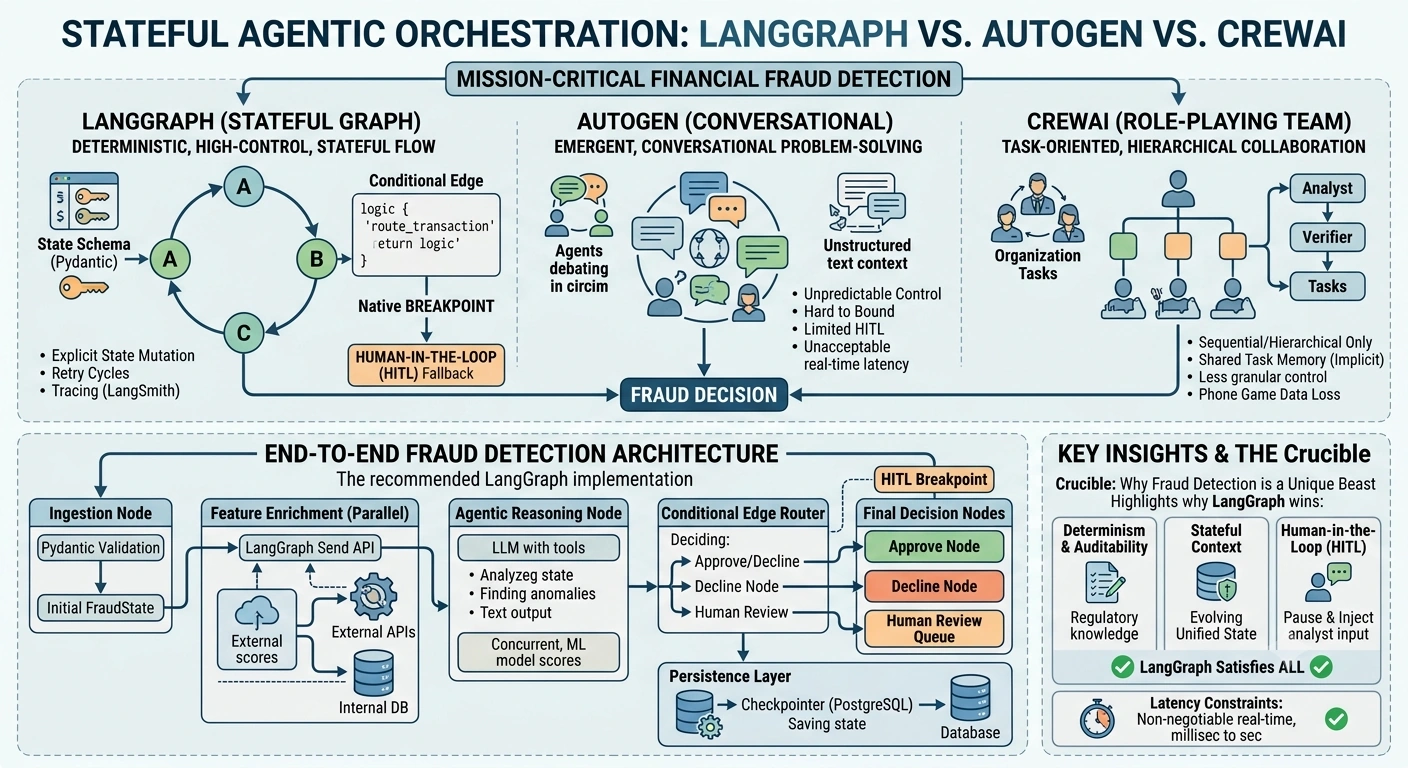
End-to-End Architecture: The LangGraph Fraud Detection System
Here is how a production-ready fraud detection system is structured using LangGraph:
Ingestion Node: Receives the transaction payload. Validates it against a Pydantic schema. Initializes the
FraudState.Feature Enrichment Node (Parallel Execution): Uses LangGraph’s
SendAPI to concurrently query:User historical velocity (Database)
Device reputation score (External API)
Traditional ML model score (Internal Microservice)
Agentic Reasoning Node: An LLM agent equipped with tools to analyze the enriched state. It looks for semantic anomalies (e.g., "Transaction is for a luxury watch, but user's historical bio indicates a student, and device is a newly registered emulator").
Conditional Edge Router: Evaluates the combined ML score and LLM reasoning.
Score < 0.3: Route to Approve Node.
Score > 0.8: Route to Decline Node.
Score 0.3 - 0.8: Trigger
interrupt, route to Human Review Queue.
Persistence Layer: LangGraph Checkpointer saves the state at every step to PostgreSQL, ensuring no data is lost if the pod crashes mid-execution.
The choice between LangGraph, AutoGen, and CrewAI is not about which framework is "better" in a vacuum; it is about aligning the framework's philosophy with the problem's constraints.
Choose CrewAI when you need to rapidly prototype a marketing content pipeline or a sequential research assistant where elegance and speed of development trump strict control.
Choose AutoGen when you are building an open-ended coding assistant or a brainstorming engine where emergent, multi-agent debate yields creative solutions.
Choose LangGraph when you are building mission-critical, stateful, and regulated systems.
In financial fraud detection, the cost of a false negative is direct financial loss, and the cost of a false positive is severe reputational damage and regulatory scrutiny. LangGraph’s explicit state management, deterministic routing, and native human-in-the-loop capabilities provide the guardrails necessary to deploy Agentic AI with confidence. It transforms the LLM from a chaotic black box into a reliable, auditable, and highly orchestrated component of the enterprise stack.
Join the conversation! Your thoughts help the community grow.