

Introduction
Building software is relatively simple during the early stages of an application lifecycle. With a smaller user base, limited data, and low traffic, most applications perform adequately without major architectural concerns.
However, as applications grow, organizations often begin experiencing:
Performance bottlenecks
Slow API response times
Infrastructure complexity
Rising operational costs
Deployment challenges
Scalability limitations
At this stage, architecture design and framework capabilities become important factors.
Modern enterprise applications are expected to handle:
High traffic loads
Concurrent user requests
Large datasets
Real-time processing
Cloud-native deployments
Faster release cycles
Unfortunately, many systems are not initially designed with scalability in mind.
Common Reasons Systems Break at Scale
Inefficient Resource Usage
Applications that consume excessive CPU or memory resources can become unstable under heavy traffic conditions.
Common causes include:
Blocking operations
Inefficient database queries
Poor caching strategies
Excessive object allocations
Synchronous processing
These issues often become significant bottlenecks as traffic increases.
Monolithic Architectures
Traditional monolithic applications can become difficult to maintain and deploy as systems grow.
Challenges commonly include:
Large codebases
Tight coupling between modules
Slower deployment cycles
Single points of failure
Difficult horizontal scaling
A small change may require redeploying the entire application.
Slow API Performance
As request volumes increase, APIs can become slower due to:
Database contention
Serialization overhead
Poor indexing
Thread blocking
Excessive network calls
Without optimization, APIs may struggle under concurrent workloads.
Limited Cloud Readiness
Many legacy systems were not designed for distributed environments.
As organizations move toward:
Docker
Kubernetes
Microservices
Distributed systems
older applications may face deployment and scaling challenges.
How .NET 10 Helps Modern Applications Scale Better
.NET 10 includes several enhancements related to performance optimization, asynchronous processing, cloud-native development, and modern API design.
Runtime and Performance Improvements
Microsoft continues improving the .NET runtime, garbage collection, and JIT compilation.
These optimizations help:
Reduce memory consumption
Improve execution speed
Increase request throughput
Improve application responsiveness
Applications handling large workloads can benefit from these runtime-level improvements.
Better Async Processing
Efficient asynchronous programming is critical for scalable systems.
Using async APIs helps reduce thread blocking and improves application throughput.
app.MapGet("/products", async (AppDbContext db) =>
{
    return await db.Products
        .AsNoTracking()
        .ToListAsync();
});
Benefits include:
Better thread utilization
Improved API responsiveness
Higher concurrent request handling
Reduced server resource consumption
Improved Minimal APIs
Minimal APIs continue to simplify lightweight API development.
app.MapPost("/orders", async (Order order, AppDbContext db) =>
{
    db.Orders.Add(order);
    await db.SaveChangesAsync();

    return Results.Created($"/orders/{order.Id}", order);
});
This approach reduces boilerplate code while keeping APIs lightweight and efficient.
Native AOT Enhancements
Native Ahead-of-Time (AOT) compilation helps improve application startup performance.
Benefits include:
Faster startup time
Reduced memory usage
Smaller container images
This is especially useful for:
Microservices
Serverless applications
Cloud-native APIs
Containerized workloads
Better Cloud-Native Support
Modern systems increasingly rely on:
Docker
Kubernetes
Distributed services
Observability platforms
.NET 10 improves integration with distributed and containerized environments.
This helps simplify:
Cloud deployment
Service orchestration
Container scaling
Monitoring and diagnostics
Improved Data Access Performance
Efficient database access becomes critical in large-scale applications.
Using optimized Entity Framework Core queries can significantly improve performance.
var products = await db.Products
    .AsNoTracking()
    .Where(x => x.IsActive)
    .Take(100)
    .ToListAsync();
Using AsNoTracking() reduces unnecessary Entity Framework tracking overhead for read-only operations.
Caching for Better Scalability
Caching is one of the most effective ways to reduce database load.
Example using in-memory caching:
builder.Services.AddMemoryCache();

app.MapGet("/categories", async (
    IMemoryCache cache,
    AppDbContext db) =>
{
    if (!cache.TryGetValue("categories", out List<Category> categories))
    {
        categories = await db.Categories
            .AsNoTracking()
            .ToListAsync();

        cache.Set("categories", categories,
            TimeSpan.FromMinutes(10));
    }

    return categories;
});
Benefits:
Reduced database calls
Faster response times
Improved scalability
Better overall throughput
Background Processing
Long-running operations should not block API requests.
Examples include:
Email sending
File processing
Report generation
Notification processing
Using background services helps improve responsiveness.
public class WorkerService : BackgroundService
{
    protected override async Task ExecuteAsync(CancellationToken stoppingToken)
    {
        while (!stoppingToken.IsCancellationRequested)
        {
            Console.WriteLine("Background task running...");

            await Task.Delay(5000, stoppingToken);
        }
    }
}
Rate Limiting Support
Protecting APIs from excessive traffic is important for scalable applications.
.NET provides built-in rate limiting middleware.
builder.Services.AddRateLimiter(options =>
{
    options.AddFixedWindowLimiter("api", config =>
    {
        config.PermitLimit = 100;
        config.Window = TimeSpan.FromMinutes(1);
    });
});
Benefits include:
Protection against traffic spikes
Improved API stability
Reduced server overload
Better resource management
Real Business Benefits
Applications designed with scalable architecture patterns can help organizations achieve:
Faster response times
Better scalability
Easier deployments
Improved reliability
Reduced infrastructure pressure
Better resource utilization
These improvements become increasingly important as applications and user traffic grow.
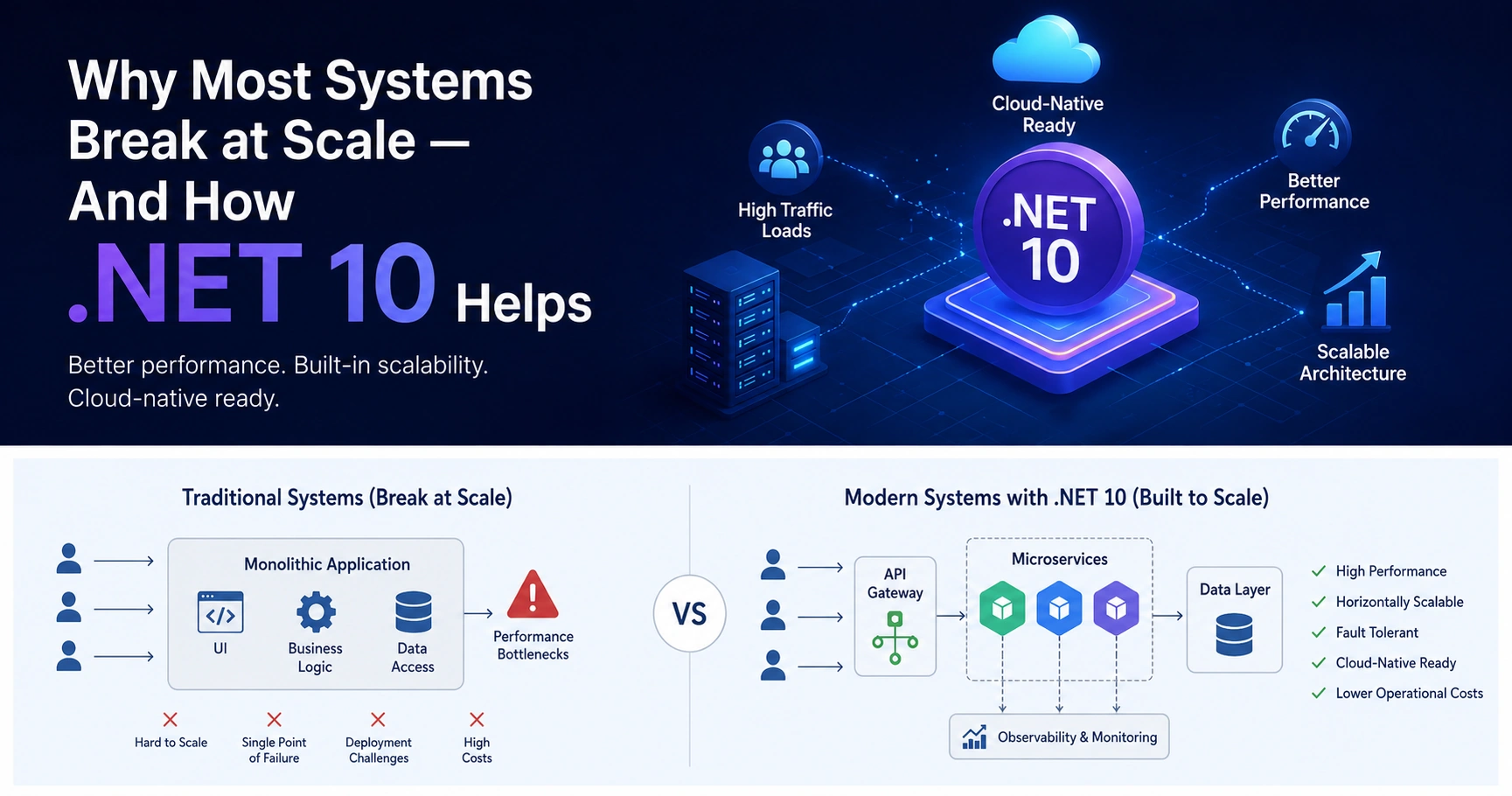
Modern Architecture Comparison
Traditional systems often struggle with:
Tight coupling
Deployment complexity
Performance bottlenecks
Limited scalability
Modern distributed architectures improve:
Horizontal scalability
Fault tolerance
Independent deployments
Cloud-native readiness
Monitoring and observability
The attached architecture illustration demonstrates the transition from traditional monolithic systems toward scalable cloud-native architectures using .NET 10.
Final Thoughts
Scalability challenges rarely appear during the early stages of application development. They typically emerge as systems grow, traffic increases, and workloads become more demanding.
Choosing scalable architectural patterns and modern frameworks early can help reduce future technical debt.
.NET 10 introduces several improvements related to performance, asynchronous processing, cloud-native development, and modern API design, making it a practical framework option for building scalable modern applications.
Join the conversation! Your thoughts help the community grow.