
Introduction
For decades, startups have followed a predictable path: raise venture capital, scale quickly, and aim for an exit through acquisition or IPO. While this model created giants like Google and Facebook, it also left ownership and control concentrated in the hands of a few investors, not the community that helped them grow.
Enter tokenized economies, blockchain-powered ecosystems where tokens replace equity, and communities replace venture capitalists. This new model has the potential to disrupt the very idea of a startup, making growth more democratic, sustainable, and community-owned.
One of the strongest examples of this shift is the Sharp Economy, powered by the Sharp Token.
Traditional Startups: The VC-Driven Model
Traditional startups typically follow this cycle.
- Seed Funding: Founders pitch to investors, trade equity for capital.
- Scaling: Use funds for growth, often prioritizing speed over sustainability.
- Exit Pressure: Investors push for an acquisition or IPO to unlock profits.
- Ownership Gap: Users and communities create value but get no stake.
The result is that wealth and decision-making are concentrated in investors’ hands, while genuine contributors, users, and early adopters are left with little.
Tokenized Economies: A New Model for Growth
Instead of relying on VC funding, tokenized economies use tokens to distribute value, ownership, and decision-making to their participants.
Key characteristics
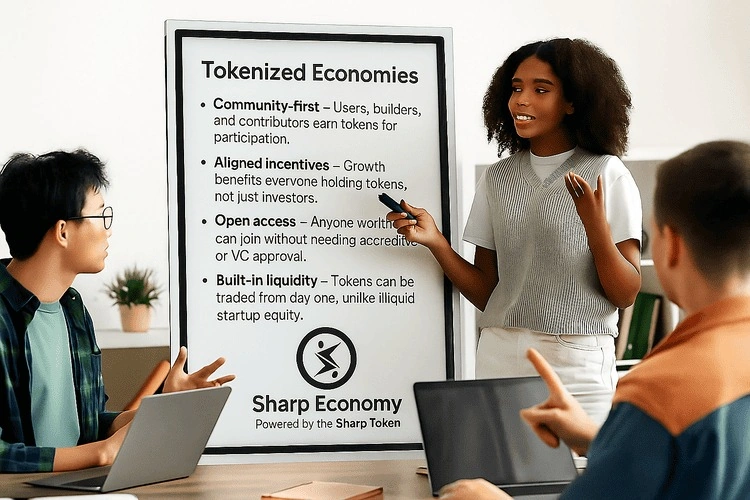
- Community-first: Users, builders, and contributors earn tokens for participation.
- Aligned incentives: Growth benefits everyone holding tokens, not just investors.
- Open access: Anyone worldwide can join without needing accreditation or VC approval.
- Built-in liquidity: Tokens can be traded from day one, unlike illiquid startup equity.
Startup vs. Tokenized Economy
| Feature | Traditional Startup | Tokenized Economy |
|---|---|---|
| Ownership | Concentrated in VCs & founders | Distributed among the community |
| Funding | Venture capital rounds | Token issuance & community buy-in |
| Liquidity | Illiquid equity until exit | Tradable tokens from the start |
| Growth Driver | Investor pressure | Community participation |
| Exit | IPO or acquisition | Ongoing ecosystem value |
| Example | Uber, Airbnb | Sharp Economy, DAO ecosystems |
The Sharp Economy
The Sharp Economy demonstrates how tokenized economies can succeed where startups fall short:
- Ownership for all: Instead of equity locked with VCs, Sharp Token distributes ownership to the community.
- Sustainable growth: The ecosystem grows with user adoption, not exit pressure.
- Utility-driven token: Sharp Token isn’t just speculation; it powers coordination, participation, and governance within the Sharp Economy.
- Accessible to anyone: No barriers like accredited investor status; anyone can join and benefit.
In other words, the Sharp Economy is not just a project, it’s a living economy, owned by those who contribute to it.
Why Tokenized Economies Could Replace Startups?
- Fairer Ownership Models: Users and contributors finally share in the upside.
- Global Participation: Token economies scale beyond borders from day one.
- Aligned Growth: Communities benefit directly when ecosystems thrive.
- No Exit Pressure: Economies can keep evolving, instead of racing toward IPOs.
- More substantial Network Effects: Every new participant adds both value and ownership, creating compounding growth.
Real-World Signals of the Shift
- DAOs (Decentralized Autonomous Organizations) already operate like tokenized cooperatives.
- Web3 gaming economies reward players with in-game tokens that hold real value.
- Community tokens are forming local and digital micro-economies without needing startup capital.
The Sharp Economy fits directly into this movement, showing how tokenized economies can be more resilient, fair, and future-proof than the VC-driven startup model.
Conclusion
Startups as we know them may not disappear overnight, but the writing is on the wall: tokenized economies are emerging as the next-generation model of growth and ownership.
Where traditional startups concentrate wealth, tokenized economies like the Sharp Economy distribute it. Where startups chase exits, tokenized economies build sustainable ecosystems.
In the end, the future may not belong to startups; it may belong to communities running their own tokenized economies.
Join the conversation! Your thoughts help the community grow.