

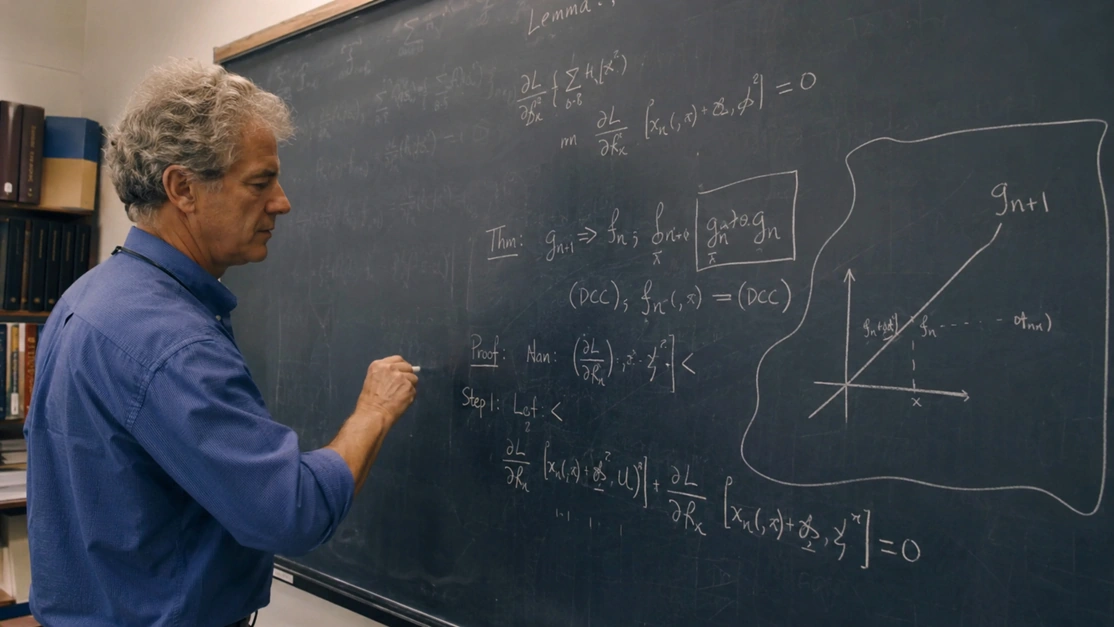
The central problem is not that GPTs cannot calculate, manipulate symbols, or occasionally produce sophisticated proofs. They clearly can.
The problem is that a transformer, by itself, has no reliable mechanism for knowing whether its mathematics is correct.
A language model can generate mathematical reasoning. A mathematician must govern mathematical reasoning.
That distinction is fundamental.
A transformer can perform mathematics without being a mathematician
Transformer models are trained primarily to estimate something resembling:
P(next token∣previous tokens)
Their native objective is therefore linguistic continuation—not proof, truth, consistency, or mathematical necessity.
When a model writes:
Therefore, (x=7).
it has generated a statistically plausible continuation. Nothing inside the basic transformer architecture automatically requires that:
every previous inference was valid;
every assumption was preserved;
all cases were considered;
no definition silently changed;
no contradiction was introduced;
the conclusion follows necessarily;
a counterexample does not exist.
Recent research has connected hallucination partly to next-word prediction and evaluation systems that reward guessing rather than appropriately admitting uncertainty.
That is why mathematical fluency must not be confused with mathematical authority.
What makes a mathematician different?
A mathematician does not simply continue a sequence of mathematical sentences. A mathematician manages an epistemic process:
Formalizes the problem.
Identifies definitions and assumptions.
Separates known results from conjectures.
Selects an appropriate proof strategy.
Tracks intermediate obligations.
Searches for counterexamples.
Detects contradictions and abandoned paths.
Validates each critical inference.
Recognizes when the available evidence is insufficient.
Distinguishes proof, numerical evidence, intuition, and speculation.
This is metacognition: reasoning about the status, reliability, direction, limitations, and correctness of one's own reasoning.
A base transformer performs little of this explicitly.
Why ordinary GPT self-reflection is insufficient
A common proposal is:
Ask the model to check its own answer.
But this often means that the same statistical system that produced the error is asked to evaluate the error using substantially the same internal patterns.
Its generator and judge therefore have correlated weaknesses.
Research has found that intrinsic self-correction without reliable external feedback can fail or even degrade reasoning performance. Other work has shown that more structured verification can improve results, which reinforces the point: verification must be architecturally distinct from merely asking the model to "think again."
A transformer may revise an answer because the new wording appears more convincing—not because it has established that the revised proof is valid.
Why benchmark success does not make a model a mathematician
This distinction remains important even after extraordinary benchmark results.
In 2025, an advanced Gemini system achieved gold-medal-level performance on the International Mathematical Olympiad using enhanced reasoning and parallel-thinking techniques. That is a major achievement. But success on six bounded competition problems is not equivalent to being an autonomous research mathematician.
A research mathematician must also:
select important problems;
build definitions;
connect distant theories;
maintain months or years of research state;
identify hidden assumptions in the literature;
determine whether an apparent result is novel;
produce independently verifiable proofs;
revise an entire research program after discovering a contradiction.
The strongest mathematical AI results also increasingly show that language generation alone is insufficient. AlphaProof combined a language model with formalization, reinforcement learning, search, and Lean verification. AlphaGeometry combined a neural generator with a symbolic deduction engine.
Likewise, verifier-based research has demonstrated that generating multiple candidate solutions and evaluating them separately improves mathematical reliability. Process supervision—checking intermediate reasoning rather than only the final answer—has also substantially improved performance.
The lesson is clear:
The closer AI comes to dependable mathematics, the less it resembles an unconstrained chatbot.
The specific limitations of transformer-only mathematics
1. It optimizes plausibility, not necessity
Mathematical proof requires that the conclusion follow necessarily from the premises.
Language generation requires only that the next sequence be plausible under the learned distribution.
These objectives sometimes overlap, but they are not identical.
2. It has no first-class proof state
Inside an ordinary conversational model, assumptions, subgoals, lemmas, contradictions, and unresolved obligations are represented implicitly across activations and tokens.
They are not necessarily maintained as governed objects such as:
Assumption A1: accepted
Lemma L3: unverified
Subgoal G4: unresolved
Claim C7: contradicted by counterexample E2
Without explicit state, a model can silently forget or alter a premise while still producing fluent reasoning.
3. It confuses explanation with verification
A well-written explanation can be false.
Transformer models are unusually good at producing text that resembles a polished proof. This makes mathematical hallucinations more dangerous, because linguistic quality can conceal a defective inference.
4. It lacks independent falsification
A mathematician does not merely seek support for a conjecture. The mathematician attempts to destroy it through:
boundary cases;
counterexamples;
alternative derivations;
dimensional checks;
numerical experiments;
proof-assistant validation;
adversarial peer review.
A basic GPT response normally has no mandatory falsification phase.
5. Its confidence is not epistemic confidence
Token probabilities do not directly represent:
"There is a 92% probability that this theorem is true."
They represent probabilities over generated tokens. Researchers have developed uncertainty methods such as semantic entropy to identify some classes of confabulation, but those mechanisms are additional assurance layers rather than proof engines.
6. Longer reasoning can amplify errors
More tokens do not necessarily mean more reasoning.
An early false assumption can contaminate every later step. The model may then produce an increasingly elaborate argument defending the original mistake.
7. It cannot reliably distinguish unknown from false
Mathematics contains several distinct statuses:
proven;
disproven;
conditionally proven;
numerically supported;
plausible;
unresolved;
undecidable under a given formal system;
inaccessible with current tools or evidence.
A language model frequently collapses these distinctions into a confident answer.
8. It does not own a durable research program
A mathematician accumulates definitions, failed approaches, lemmas, dependencies, literature findings, proof obligations, and conceptual changes over long periods.
A transformer context window is not a governed mathematical memory. Even a large context can contain information without reliably managing its epistemic status.
How AlpineGate's Metacognition AI addresses the problem
AlpineGate's approach should not be understood as making a larger transformer or adding a longer prompt.
It changes the architecture.
The transformer is moved out of the position of final mathematical authority and placed inside a governed, memory-rich hybrid cognitive runtime.
The transformer becomes an intuition and hypothesis engine. Metacognition AI becomes the epistemic controller.
Conceptually:
Transformer-only system=Prompt→Generated answer
AlpineGate's model is closer to:
Problem→Answerability Gate→Formal Task Model→Candidate Generation→Solver and Verification→Claim Validation→Governed Verdict
This changes the unit of intelligence from one model response to an explicit cognitive process.
1. Answerability Gate
Before attempting an answer, Metacognition AI determines what kind of answer is possible.
For example:
answerable by deductive reasoning;
answerable by deterministic computation;
requires formal theorem proving;
requires numerical experimentation;
requires external evidence;
requires runtime instrumentation;
under-specified;
currently unanswerable.
This prevents the system from treating every prompt as an invitation to generate an answer.
For mathematics, the gate can distinguish:
"Can this be derived from the supplied axioms?"
from:
"Would solving this require an unresolved theorem, external computation, or missing assumptions?"
That is already a major departure from ordinary GPT behavior.
2. Explicit mathematical task model
The system converts the problem into governed objects:
definitions;
variables;
domains;
assumptions;
constraints;
target theorem;
permitted inference rules;
dependent lemmas;
proof obligations;
candidate counterexamples.
Instead of allowing these elements to remain hidden in prose, Metacognition AI preserves them as inspectable state.
A change in an assumption can therefore invalidate dependent claims automatically rather than being silently absorbed into later text.
3. Evidence Ledger
Every material mathematical claim receives a status and provenance.
For example:

This prevents the system from laundering conjectures into facts merely because they appeared earlier in the conversation.
4. Transformers produce typed candidates, not verdicts
Within AlpineGate's architecture, a transformer should return controlled objects such as:
CandidateHypothesis
CandidateLemma
CandidateProofStrategy
CounterexampleSearchSuggestion
UnverifiedClaimSet
RenderingDraft
It should not directly commit:
the theorem is proven;
the conjecture is false;
the argument is complete;
the evidence is sufficient.
This is a critical architectural boundary.
The transformer proposes. The cognitive runtime adjudicates.
5. Solver routing
Different mathematical problems require different cognitive machinery.
Metacognition AI can route work to:
symbolic algebra systems;
numerical solvers;
constraint solvers;
automated theorem provers;
proof assistants such as Lean;
program synthesis or program search;
simulation;
counterexample generators;
mathematical knowledge retrieval;
one or more transformer-based hypothesis generators.
Formal theorem-proving research increasingly follows this hybrid direction. LeanDojo, for example, combines language-model-based proving with retrieval and a formal Lean environment, while later systems use decomposition, reinforcement learning, and direct verifier feedback.
The metacognitive layer decides which mechanism is authoritative for which claim.
6. Metacognitive State
AlpineGate's architecture can explicitly maintain:
task understanding;
goal progress;
knowledge sufficiency;
epistemic uncertainty;
observation uncertainty;
solver uncertainty;
conflicts;
unresolved obligations;
capability estimates;
cognitive budget;
expected value of additional computation;
selected next action;
reason for that action.
Possible next actions include:
retrieve a theorem;
inspect evidence;
formalize the problem;
invoke a deterministic solver;
generate a hypothesis;
search for counterexamples;
verify a lemma;
re-plan;
switch solver;
request missing assumptions;
defer;
abstain;
answer.
This is much closer to mathematical work than uncontrolled token continuation.
7. Metacognition Council
The Council provides independent, explicit roles rather than one model pretending to debate itself.
Possible mathematical roles include:
Proposer
Develops candidate proof strategies and lemmas.
Formalizer
Converts informal statements into explicit definitions, logical forms, or theorem-prover representations.
Skeptic
Attempts to find hidden assumptions, invalid implications, circularity, and counterexamples.
Solver
Executes the selected mathematical or computational method.
Verifier
Checks each proof obligation using an independent mechanism.
Runtime Auditor
Determines whether claimed computations, searches, or validations actually occurred.
Adjudicator
Issues the final governed verdict from the validated evidence—not from rhetorical persuasiveness.
The authority order must remain explicit. There should be no invisible coordinator that can silently override evidence or validation.
8. Claim Validator
Every important conclusion is tested against mechanical rules:
Does the claim follow from accepted premises?
Does it depend on a quarantined lemma?
Is the inference valid in the declared domain?
Was a required case omitted?
Is the evidence deductive or merely empirical?
Does another accepted claim contradict it?
Has the solver result been independently confirmed?
Does a counterexample invalidate the universal statement?
Unsupported claims are rejected or quarantined before rendering.
This stops an eloquent but invalid proof from becoming the system's public answer.
9. Witness Consistency Gate
Multiple agents do not automatically create reliability.
Five agents repeating the same mistake are still wrong.
Each witness must therefore pass a consistency gate before its output can count as evidence. A witness that contradicts its own premises, reverses an explicit rule, or makes an unsupported completion claim is quarantined.
The final verdict may continue without accepting the defective witness.
10. Formal verdict contract
Metacognition AI should never return the single ambiguous status "answered."
It should return mathematically meaningful outcomes such as:
Formally proven
Proven under stated assumptions
Disproven by counterexample
Numerically verified within declared bounds
Empirically supported, not proven
Internally consistent but externally unverified
Requires additional computation
Requires instrumentation
Insufficient information
Unresolved
Abstained
This is essential because mathematics is not merely concerned with conclusions. It is concerned with the exact epistemic status of conclusions.
11. Recovery and re-planning
When a proof attempt fails, the system should not merely regenerate another long answer.
It can classify the failure:
invalid formalization;
missing lemma;
solver timeout;
contradiction;
unsupported premise;
failed numerical check;
counterexample discovered;
insufficient evidence;
capability limitation.
It can then select an appropriate recovery strategy:
revise the formalization;
decompose the theorem;
search for a missing premise;
change proof technique;
invoke another solver;
reduce the claim;
return a conditional result;
abstain.
This transforms failure from hidden model behavior into governed cognitive state.
12. Governed learning from mathematical work
Validated traces can feed AlpineGate's adaptation layer:
Remember→Recall→Reason→Evaluate→Learn→Adapt→Re-test→Govern→Publish
Successful proof strategies, rejected patterns, verifier feedback, counterexamples, and recovery paths can become supervised or reinforcement-learning material.
However, new adapters should not be published merely because they improve one benchmark. They require:
regression testing;
scope controls;
evaluation metadata;
conflict analysis;
versioning;
governed approval.
The decisive architectural difference
A transformer asks:
What mathematical text should come next?
AlpineGate's Metacognition AI asks:
What is currently known? What is merely proposed? What remains unverified? Which method can establish or falsify this claim? Did that method actually run? What evidence did it produce? What may the system responsibly conclude?
That is the movement from generated reasoning to governed cognition.
The transformer should serve as mathematical intuition
Transformers remain extremely valuable. They can:
suggest promising substitutions;
recall related theorem families;
propose decompositions;
translate between informal and formal representations;
identify analogies;
generate candidate lemmas;
explain verified proofs;
guide expensive search.
These functions resemble mathematical intuition.
But intuition is not proof.
In AlpineGate's architecture:
Transformer=intuition and candidate generation
Metacognition AI=epistemic control and strategy
Formal tools=verification authority
Evidence Ledger=mathematical memory and accountability
Verdict Contract=responsible conclusion
Final conclusion
It is too strong to claim that transformer-based systems can never perform mathematics. They already solve difficult problems, generate useful conjectures, assist with proofs, and sometimes reach elite competition performance.
But a standalone transformer is not a dependable mathematician because it lacks first-class mechanisms for:
truth;
proof state;
epistemic status;
independent verification;
falsification;
durable research memory;
uncertainty governance;
strategic recovery;
accountable judgment.
AlpineGate's Metacognition AI addresses this not by pretending that the transformer has suddenly become self-aware, but by placing transformers inside a governed cognitive architecture.
It does not ask the model to sound more mathematical. It requires the system to know what has been established, identify what has not, choose how to test it, preserve the evidence, and refuse to call conjecture proof. That is the architectural foundation required for AI to progress from a mathematical language generator toward a credible machine mathematician.
Join the conversation! Your thoughts help the community grow.